
Trivex vs Polycarbonate: The Tougher Lens for Kids and Sport
Polycarbonate and Trivex are both impact-resistant, lightweight lens materials ideal for children, sport and safety eyewear. Polycarbonate is thinner and cheaper; Trivex offers slightly sharper optics and is a touch lighter. Both block UV. For most active users either works; choose Trivex if optical clarity is a priority.
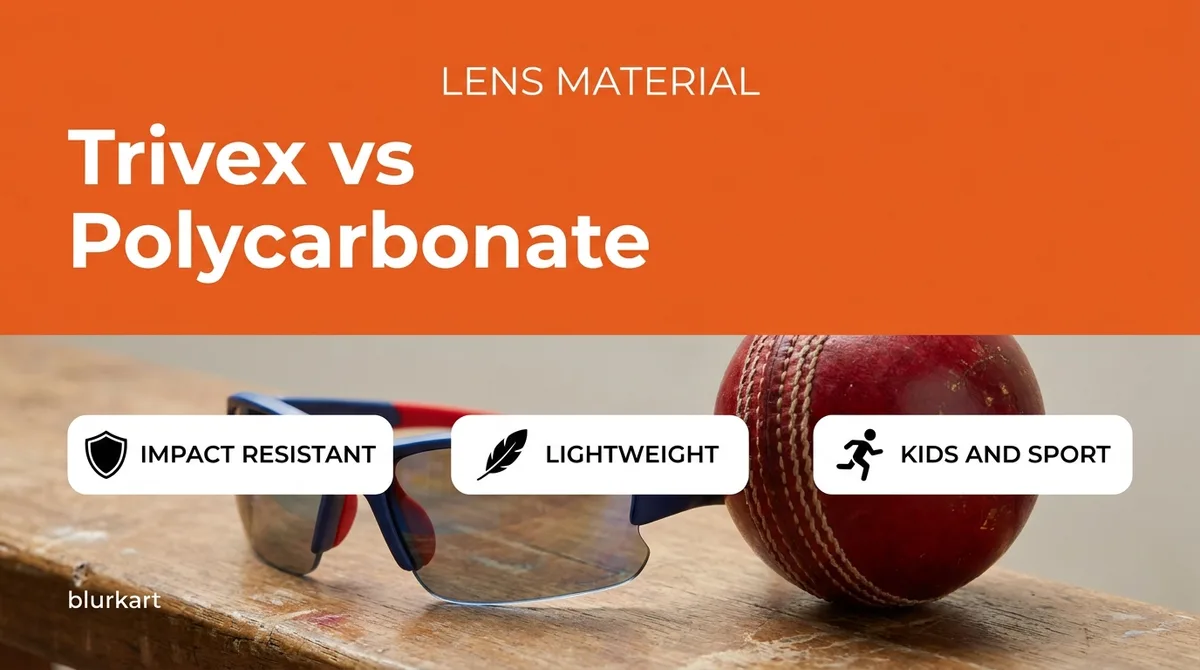
When toughness comes first
For most adults, lens choice is about thinness and clarity. For children, sport and safety, one quality matters more than any other: impact resistance. A lens that shatters is a hazard, not just an inconvenience. Two materials dominate here, polycarbonate and Trivex, and knowing the difference helps you protect active eyes without overpaying.
What they have in common
- Impact resistance: both are far tougher than ordinary plastic or glass.
- Light weight: both are comfortable for all-day and active wear.
- Built-in UV protection: both block essentially all UV, valuable in Nepal's strong sun.
- Safety use: both are standard for children, sports and protective eyewear.
Where they differ
| Polycarbonate | Trivex | |
|---|---|---|
| Impact resistance | Excellent | Excellent |
| Optical clarity (Abbe) | Good | Slightly crisper |
| Thickness | Thinner | Slightly thicker |
| Weight | Light | A touch lighter |
| Cost | Usually cheaper | Usually a bit more |
| UV protection | Yes | Yes |
The clarity gap comes down to Abbe value, which we explain in a separate guide.
How to choose
Choose polycarbonate if: you want proven impact protection at the best price, your child is hard on glasses, or you need a thin, economical safety lens.
Choose Trivex if: you want the sharpest optics and the lightest feel, and you are happy to pay a little more for that clarity edge.
For pure safety, both win. The deciding factor is usually clarity and budget, not protection.
Great uses in Nepal
- Children's everyday glasses: survive drops, throws and playground life.
- Cricket, football and cycling: impact resistance plus UV in one lens.
- Work safety eyewear: where a shattering lens is a real risk.
- Trekking and outdoor sport: tough and UV-blocking at altitude.
Buying for active eyes
If you are buying for a child or for sport in Nepal, ask for polycarbonate or Trivex specifically, rather than a standard plastic lens that can crack. Both bring the safety and UV benefits that matter most for active, outdoor lives. Pick polycarbonate to stretch the budget, or Trivex if you want the crispest vision and the lightest lens, and either way your active eyes are well protected.
Which material for which activity
| Use | Good pick |
|---|---|
| Young child, everyday | Polycarbonate (tough, economical) |
| Sport with impact risk | Either; both impact-resistant |
| Clarity-sensitive wearer | Trivex (higher Abbe) |
| Safety eyewear at work | Polycarbonate or Trivex |
Coatings and tints on tough lenses
Both materials take anti-reflective and scratch-resistant coatings, and both can be tinted or made into prescription sunglasses, which is handy for sport in Nepal's sun. A scratch-resistant coating is especially worth it on children's lenses, which take a beating. Remember that impact resistance is about the lens cracking, while scratch resistance is a coating on top; they are different things, and for active eyes you usually want both.
Related at Blurkart
- Kids eyewear: durable frames and glasses for children
- Sports eyewear: frames and glasses built for active use
- Prescription glasses: browse lens-ready frames for your power
Keep reading
- Polycarbonate, plastic or glass lenses?
- Unbreakable kids frames: what that word covers
- Your child's first pair of glasses: what to expect
- Abbe Value: The Clarity Trade-Off of Very Thin Lenses
Not sure which lens suits you? Book a free eye test at our Pulchowk or Boudha branch.
Frequently asked
- Which is more impact-resistant, polycarbonate or Trivex?
- Both are highly impact-resistant and far safer than ordinary plastic or glass, which is why both are used for children, sport and safety eyewear. For everyday impact needs, the difference is small; both protect well.
- Is Trivex clearer than polycarbonate?
- Slightly. Trivex has a higher Abbe value, meaning marginally crisper optics with less colour fringing at the edges. Polycarbonate is still perfectly good for most people, but Trivex has the edge on pure clarity.
- Which is better for children?
- Both are excellent for children because of their impact resistance and built-in UV protection. Polycarbonate is common and economical; Trivex is a step up if you want the best clarity and a touch less weight.
- Do both block UV?
- Yes. Both polycarbonate and Trivex block essentially all UV by nature of the material, which is a real bonus for Nepal's strong, high-altitude sunlight.
- Is Trivex worth the extra cost?
- If you value the sharpest optics and lightest feel, yes. For a child who is hard on glasses, or on a budget, polycarbonate delivers the key safety benefit for less.