
Your child's first pair of glasses: what to expect
A child's test uses pictures instead of letters, may use drops to relax the focusing muscle for an accurate power, and takes about 30 minutes. Choose a light flexible frame with polycarbonate lenses and a strap for under-eights. Get them to wear it by letting them pick the colour, starting with short sessions, and praising what they can suddenly see.
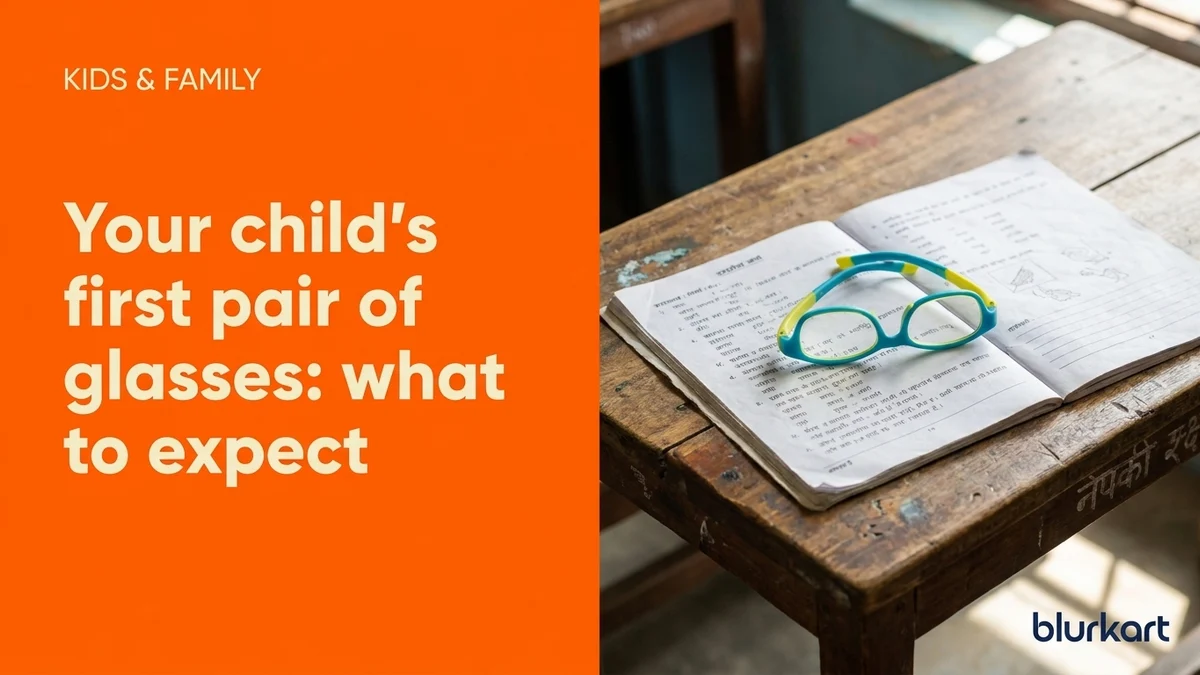
A child's first pair of glasses starts with a test that uses pictures instead of letters, often includes drops that relax the eye for an accurate reading, and takes about half an hour. The frame should be light and flexible with impact-resistant lenses, and the habit of wearing it is built in short sessions with a lot of praise. That is the short version. Here is what a parent should expect at each step.
When to bring them in
Any of these is a reason: sitting close to the TV, squinting at the board, tilting the head to one side, rubbing eyes a lot, losing their place when reading, headaches after school, or one eye that drifts. Some children show nothing and are found by a school screening. A first check around age three or four is a good habit even without symptoms.
What the test looks like
For children who cannot read yet, we use charts of shapes and pictures, and the child names them or matches them to a card. It feels like a game and most children enjoy it.
Children over-focus. Their focusing muscle is so strong it can hide a real long-sighted prescription. To measure the true power we sometimes use drops that relax that muscle for a few hours. Vision is blurry and light-sensitive until they wear off, so plan the test for after school with no homework that evening. A parent stays in the room the whole time.
The whole visit is around 30 minutes. The test is free at both Lalitpur showrooms.
Choosing a child's first pair of glasses that survives school
Rules we have learned from repairs:
- Flexible plastic (TR90) or silicone frames bend and come back. Metal frames bend and stay bent.
- Spring hinges, so pulling them off sideways does not snap the temple.
- Polycarbonate lenses. They are lighter than standard plastic and resist impact, which matters for cricket balls and playground falls.
- A strap or curved temple tips for children under eight, so the glasses stay put when they run.
- A frame that fits now, not one to grow into. Too big slides down and gets pushed up with dirty fingers all day.
Let the child choose the colour. It is the cheapest thing you can do to make them want to wear the glasses.
Getting them to keep them on
Three things work for us more often than anything else:
- Start with short sessions at home doing something they like, like a cartoon or a picture book. Twenty minutes, then a break, then longer.
- Ask them what looks different. Leaves on trees, faces across the room, the writing on a bus. When a child notices for themselves that the world got sharper, the argument is over.
- Get the teacher on side. A quiet word so the glasses are normal in the classroom, and so the child sits where they can see the board while they adjust.
Expect a week of taking them off. Do not make it a battle. Put them back on calmly, every time.
After the first pair
Children's prescriptions change fast. Retest every year, and bring the glasses in any time they look bent; refitting is free. If a lazy eye is found, the earlier the correction starts the better it works, and we will refer you to an eye hospital if patching or further treatment is needed.
Kids glasses in Nepal: what parents ask us
"Bachcha ko chasma kati ko aauchha?" A complete children's pair with polycarbonate lenses is NPR 2,500 to NPR 3,500 at Blurkart. The eye test is free, and refitting a bent frame is free for as long as they wear it.
"School le chasma lagauna bhanyo, tara bachcha le mandaina." Let them choose the colour, start with cartoons at home, and ask them what looks sharper. A week of taking them off is normal. Battles are not needed.
"Chasma lagaayo bhane power badhchha?" No. Correcting the vision is what a growing visual system needs. Leaving a lazy eye uncorrected is what causes lasting weakness.
"Kati barsha ma test garne?" From age three, with picture charts. Yearly after that, because children's eyes change fast and a good frame at six is too small at seven.
A first pair is usually NPR 2,500 to NPR 3,500 with the free test. Light frames like the Blurkart Cyber-Shield at NPR 999 with polycarbonate lenses are where most parents land. If the slip from the test confuses you, our guide to reading an eyeglass prescription explains each number. If you are a parent who has been putting this off, the test is the easy part. Book a Saturday slot and bring a snack for afterwards.
Frequently asked
- At what age can a child have an eye test?
- From about three, using picture and shape charts. Earlier if a parent or teacher notices a turned eye or a strong squint.
- Will glasses make my child's eyes weaker?
- No. Glasses let the eye see clearly, which is what a developing visual system needs. Not correcting a lazy eye early is what causes lasting weakness.
- How often should children be retested?
- Yearly. Children's prescriptions change fast, and a growing face needs the frame refitted.
- What does a child's pair cost at Blurkart?
- A flexible kids frame with polycarbonate single vision lenses is usually NPR 2,500 to NPR 3,500. The test is free.
- Bachcha ko chasma Nepal ma kati parchha?
- A child's first pair with impact-resistant polycarbonate lenses costs NPR 2,500 to NPR 3,500 at Blurkart. The eye test is free, and we refit the frame free as the child grows.