
Myopia Control for Children: Can You Slow Down Rising Eye Power?
Childhood myopia (near-sightedness) tends to worsen year on year until the late teens. You cannot reverse it, but myopia control lenses, low-dose atropine, ortho-k and more daylight outdoors can slow the rate of progression, often by 30 to 60 percent. The earlier you start, the lower your child's final power as an adult.
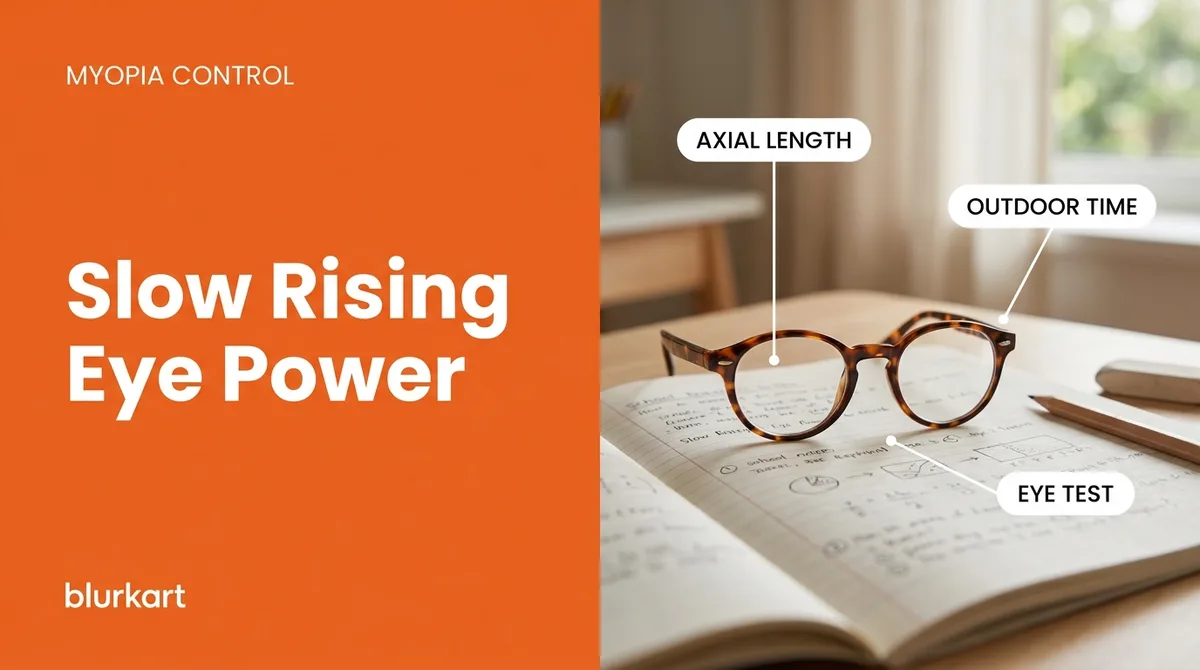
Why your child's power keeps going up
Most parents notice the pattern within a year or two: new glasses, a stronger prescription, then an even stronger one the next time. This is myopia progression, and it is one of the most common worries we hear from Nepali families.
Myopia (near-sightedness, or minus power) happens when the eyeball grows slightly too long, so distant objects focus just in front of the retina instead of on it. During childhood the eye is still growing, which is exactly why power tends to climb fastest between the ages of about 7 and 12. A rising number does not mean the previous glasses were wrong, or that your optician made a mistake. It means the eye is still changing, and ordinary glasses only correct today's blur without influencing tomorrow's growth.
It also helps to know that childhood myopia is becoming more common, not less. More screen time, more indoor study and less daylight have pushed rates up across cities in Asia, and Kathmandu is no exception. So if it feels like more children wear glasses than when you were young, you are right.
Why it matters more than just thicker lenses
High myopia is not only an inconvenience at the shop counter. A higher final prescription in adulthood is linked to a greater lifetime risk of retinal detachment, glaucoma, myopic maculopathy and earlier cataract. The thicker, heavier lenses are the visible cost; the hidden cost is to long-term eye health, decades later.
So the goal of modern care has shifted. It is no longer simply to keep updating the glasses each year. It is to slow the rate of progression while the eye is still growing, so your child reaches adulthood with a lower, safer power.
You cannot reverse myopia. But slowing it by even 40 percent over several growing years can be the difference between a mild and a high prescription for life.
The four tools that actually slow progression
1. Myopia control lenses
These look identical to ordinary clear glasses, but the lens surface is engineered to gently signal the eye to slow its growth, while still giving sharp central vision for school and screens. Your child wears them all day like normal spectacles, with nothing to insert, remove or clean beyond ordinary glasses care. For families who want a non-medical, low-effort first step, this is usually where we start.
2. Low-dose atropine drops
A very dilute atropine eye drop, used once at night, has strong clinical evidence for slowing progression. It is a medical treatment, so it must be prescribed and monitored by an eye doctor, and it is often combined with glasses for the best effect. Many children have no noticeable side effects at the low concentrations used for this purpose.
3. Ortho-k (overnight lenses)
Rigid lenses worn only while sleeping gently reshape the cornea, so the child sees clearly during the day without glasses, and they also slow progression. They demand careful fitting and strict hygiene, so they suit motivated, slightly older children and attentive parents who can supervise the nightly routine.
4. Daylight and distance
The cheapest tool is free. Children who spend two or more hours outdoors in daylight each day progress more slowly. Natural light and frequently looking into the far distance both help. In Nepal, where tuition classes, board-exam pressure and smartphones steadily eat into outdoor time, this is the easiest protection to lose, and the easiest to rebuild.
How the options compare
| Option | Effort | Who it suits | Notes |
|---|---|---|---|
| Myopia control lenses | Low (wear all day) | Most children | Looks like normal glasses |
| Low-dose atropine | Low (nightly drop) | Fast progressors | Needs doctor's prescription |
| Ortho-k | High (nightly lens care) | Older, motivated kids | No daytime glasses needed |
| Outdoor daylight | Low (habit change) | Every child | Free, combine with any option |
These are not either-or choices. The most effective plans often combine one active treatment, such as control lenses or atropine, with the daily daylight habit, and then review progress every six to twelve months.
A realistic 12-month plan
- Baseline eye test: confirm the prescription and ask specifically about myopia management.
- Choose an approach: control lenses and daylight for most, atropine or ortho-k added if progression is fast.
- Build the daylight habit: aim for outdoor time every day, not only weekends.
- Review at 6 months: measure how much the power has moved and adjust the plan.
- Review at 12 months: compare against the usual expected progression for the age.
Simple habits that help at home
- Follow the 20-20-20 rule during study: every 20 minutes, look 20 feet away for 20 seconds.
- Keep books and screens at least an arm's length from the eyes.
- No phone or tablet in a dark room.
- Push for outdoor play and sport, not only indoor tuition.
- Get an eye test at least once a year, and sooner if the child squints or complains of blur.
When to see someone in Nepal
If your child's power has jumped between two check-ups, or they squint, sit too close to the board, tilt their head, or rub their eyes often, book an eye examination. Ask your optometrist specifically about myopia management, not just a new pair of glasses, because the two are different conversations.
Once you have the prescription and a recommendation, you can order myopia control lenses in the frame your child will actually enjoy wearing. That last point matters more than it sounds: the best myopia lens in the world does nothing in a drawer. A frame your child likes is a frame that stays on their face all day, which is exactly where the lens needs to be.
Frequently asked
- Can myopia be cured or reversed in children?
- No. Myopia cannot be reversed with lenses, drops or exercises. The realistic goal is to slow how fast the power rises so your child ends up with a lower final prescription as an adult.
- At what age should myopia control start in Nepal?
- As soon as myopia is diagnosed, and especially if the power is rising quickly, usually between ages 6 and 14. Book an eye test if your child squints, sits close to the TV, or cannot read the school board clearly.
- Are myopia control lenses available in Nepal?
- Yes. Specialised myopia management single-vision lenses can be ordered on prescription. Talk to your optometrist about whether your child is a good candidate, then order the lenses through Blurkart with your frame of choice.
- Do myopia control glasses look different?
- No. To everyone else they look like normal clear glasses. The design that slows progression is built into the lens surface and is not visible.
- How much can progression actually be slowed?
- Depending on the method and the child, studies report slowing of roughly 30 to 60 percent compared to ordinary single-vision glasses. Results vary, which is why regular monitoring matters.