
Polycarbonate, plastic or glass lenses?
Standard plastic suits most adults: light, decent optics, affordable. Polycarbonate is far harder to break and is the right choice for children, sports and anyone on a bike. Glass gives the sharpest image and the best scratch resistance but is heavy and can shatter, which is why almost nobody fits it now.
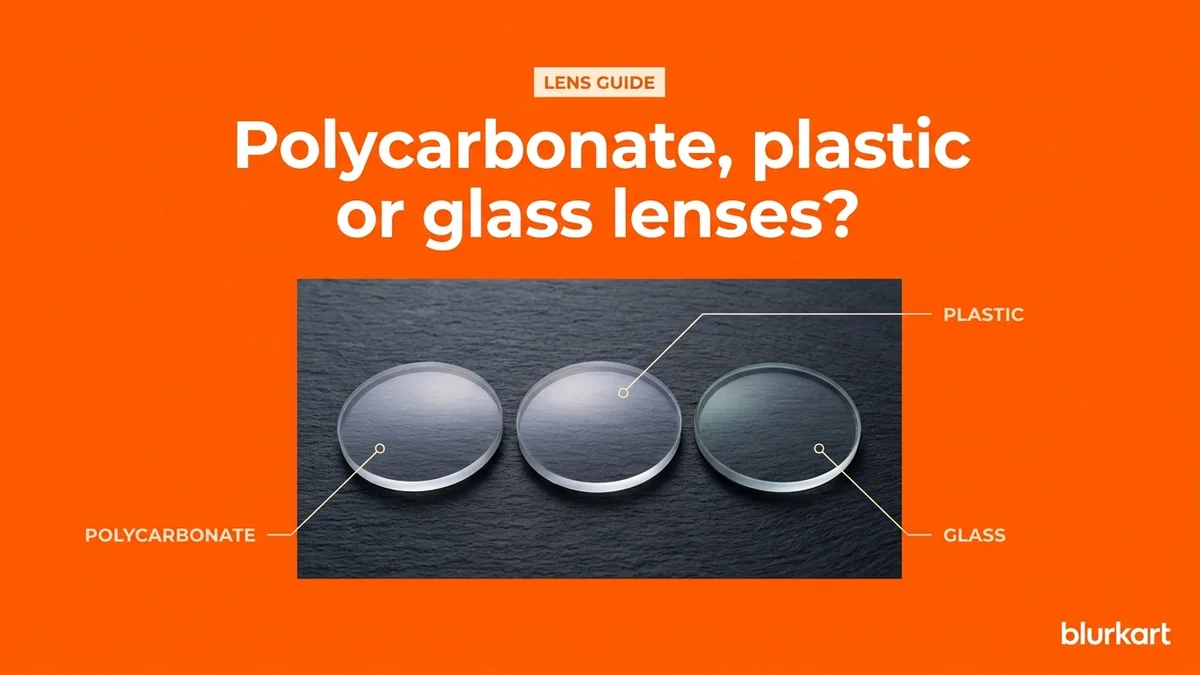
Choosing between polycarbonate, plastic or glass lenses is one of the few eyewear decisions where the right answer really does change depending on who you are and what you do all day.
Standard plastic, the sensible default
Most lenses sold today are CR-39 plastic. It weighs about half what glass does, takes coatings well, and its optical clarity is good enough that almost nobody notices the difference in normal use.
Its weakness is hardness. Uncoated plastic scratches more readily than glass, which is why a hard coat is standard rather than an upsell. For an adult with a mild to moderate prescription who works at a desk and travels by car or foot, plastic is the correct choice and spending more would be spending for nothing.
Polycarbonate, when something might hit your face
Polycarbonate was developed for safety applications, and that is still what it is for. It absorbs impact and deforms rather than shattering. In practice it is roughly ten times harder to break than plastic.
That matters for three groups. Children, whose glasses live a violent life. Anyone playing football, cricket or any sport with a ball. And anyone on a motorbike, where grit comes at you at speed. If you fall into any of those, the material question is already settled.
It is also thinner and lighter than plastic at the same power, which is a quiet bonus for stronger prescriptions and for small faces. The catch is that polycarbonate is softer at the surface and scratches more easily, so a good hard coat is genuinely necessary rather than optional. Cleaning habits matter more with this material than any other.
Glass, the one almost nobody fits now
Glass still wins on two counts. Its optical clarity is the best available, and it resists scratching far better than any plastic, coated or not. Older customers who wore glass for decades often say nothing since has looked quite as crisp, and they are not imagining it.
The problem is what happens when it breaks. Glass can fracture into sharp pieces close to the eye, which is the exact failure mode you least want. It also weighs about twice what plastic does, so a strong prescription in glass is genuinely uncomfortable on the nose after a few hours.
We do not recommend glass for everyday wear, and we would refuse it outright for a child. If your priority is scratch resistance, a good hard coat on plastic gets most of the way there without the risk.
Material is not the same as thickness
This confuses people constantly. Choosing polycarbonate or plastic is about safety and weight. Choosing a high index lens is about how thick the edge looks in a strong prescription. They are separate decisions, and past about minus 4 you may want both. The high index guide covers where that threshold sits.
What we would put in your frame
A desk worker with a mild power: plastic, multi-coated. A student or a child: polycarbonate, always. A rider or a footballer: polycarbonate, ideally in a frame that holds on. Someone with a strong prescription who hates thick edges: high index, in plastic or polycarbonate depending on their life.
Come to either showroom and we will hold the options against your prescription rather than guess. The eye test is free, and prescription frames start at NPR 999 with single vision lenses from NPR 750.
Polycarbonate, plastic or glass lenses: deciding in one minute
Answer three questions and the choice makes itself. Does anything ever hit your face, through sport, a bike, or being under ten years old? If yes, polycarbonate, and stop there. Is your prescription strong enough that thickness bothers you? Then you are choosing a high index lens, and the material question becomes secondary. Neither of those? Standard plastic with a hard coat, and spend the difference on a better anti-reflective coating instead.
The mistake we see most often is someone paying for a premium material and skipping the coating. A basic plastic lens with a good multi-coat is a more comfortable pair of glasses than a premium lens with nothing on it, because the coating is what you notice every day and the material is what you notice once, if something goes wrong.
Frequently asked
- Are glass lenses better than plastic?
- Optically a little sharper, and much harder to scratch. But they weigh roughly twice as much and can break into sharp pieces, which is why most opticians stopped recommending them for everyday wear.
- Do children need polycarbonate lenses?
- Yes, we would insist on it. A child's glasses take impacts that an adult's never do, and polycarbonate bends and marks where plastic cracks. The weight saving helps a small nose too.
- Kun lens ramro hunchha, plastic ki glass?
- Dherai jaso manche ko lagi plastic thik chha, halka ra sasto. Bachcha, khelkud ra bike chalaunelai polycarbonate ramro, kinabhane sajilai bhachchhaina. Glass safa dekhinchha tara gahrau hunchha ra futna sakchha.