
Lenticular and Blended Lenses for Extreme Prescriptions
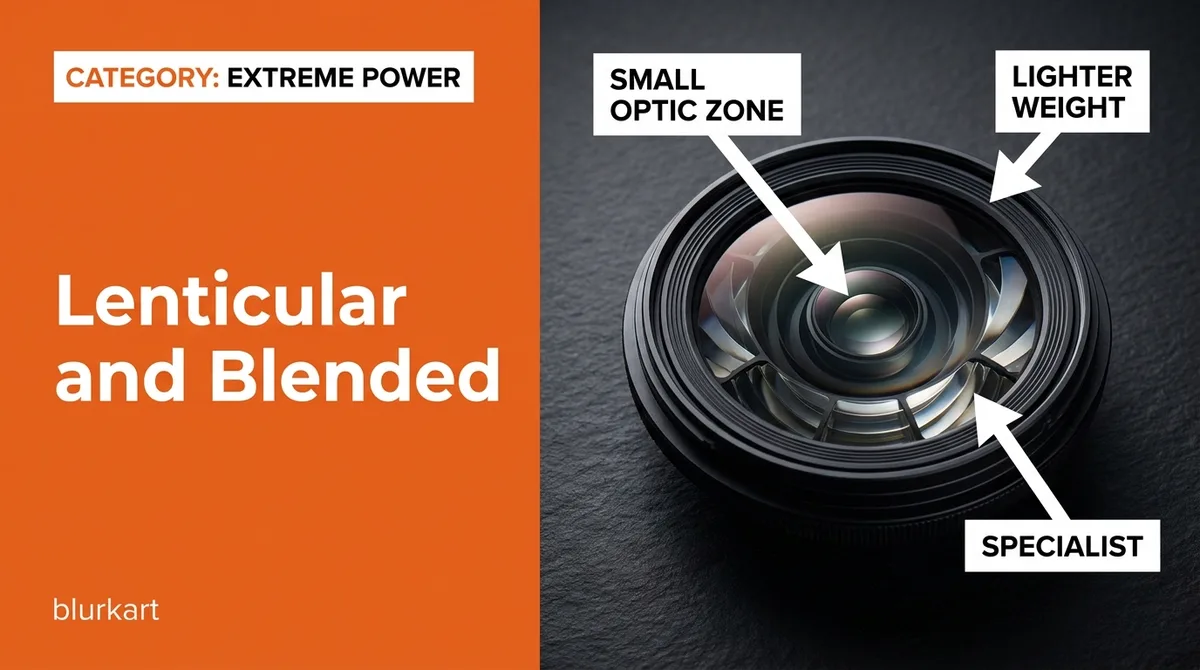
Lenticular lenses carry your full power only in a central zone, surrounded by a flatter carrier, so extreme prescriptions stay lighter and thinner than a full-surface lens. Blended versions soften the visible join. They are specialist, custom lenses for very strong powers beyond what standard high-index can keep comfortable.
When high index is not enough
For most strong prescriptions, a high index plus an aspheric design in a small frame solves thickness and weight. But some prescriptions are so strong that even these would produce a lens too thick and heavy to wear comfortably. This is where lenticular and blended designs come in: specialist lenses built for the extremes.
How a lenticular lens works
Instead of carrying your full power across the whole lens, a lenticular lens puts the full prescription only in a central zone, the part you look through most. Around that zone sits a flatter carrier with little or no power, whose only job is to fill the frame. By not grinding the heavy full power across the entire lens, the design saves a great deal of weight and thickness.
Think of it as putting the powerful optics only where your eyes actually point, and keeping the rest light.
The trade-offs, honestly
- Limited power zone: sharp vision is through the central area, so you turn your head more than your eyes.
- Visible carrier edge: the join between the power zone and the carrier can be seen by others.
- Specialist fitting: the zone must be centred precisely to your eyes.
How blended designs improve the look
A blended lenticular lens softens the transition between the central power zone and the flatter carrier, so the join is less abrupt and less obvious to onlookers. It is a cosmetic and comfort refinement on the same core idea, and for many wearers it makes the design far more acceptable.
Who they are for
| Situation | Likely best option |
|---|---|
| Strong but not extreme power | High index + aspheric |
| Very extreme power | Lenticular or blended lenticular |
| Wants least visible edge | Blended lenticular |
| Post-surgical very high plus | Discuss lenticular with a specialist |
A specialist decision
Lenticular lenses are not an everyday product and are not needed by most strong prescriptions. They exist for the genuine extremes, where keeping the lens wearable at all is the priority. Deciding between a high-index aspheric lens and a lenticular design is a judgement call best made with an optician experienced in very strong prescriptions.
Getting them in Nepal
Because these are custom, made-to-order lenses, expect a longer wait and a specialist conversation. Bring your full prescription, describe how you use your eyes day to day, and ask whether a blended lenticular would suit you if the edge visibility concerns you. For the strongest prescriptions, these designs can be the difference between glasses you can wear all day and ones you cannot.
Living with a lenticular lens
Day to day, a lenticular lens asks you to point your eyes through the central power zone, so you turn your head a little more to keep things sharp. Most wearers adapt, because the alternative, a very heavy full-power lens, is harder to live with. The visible carrier edge is the main cosmetic compromise, which a blended design softens. Setting expectations up front makes the adjustment far easier.
Alternatives to consider first
Before committing to lenticular, make sure a high-index aspheric lens in a small frame genuinely cannot do the job, because for many strong prescriptions it can. Contact lenses are also worth discussing for very high powers, sometimes alongside glasses. Lenticular lenses are a specialist answer for genuine extremes, so a frank conversation with an optician experienced in strong prescriptions helps you reach the right, not just the most dramatic, solution.
Related at Blurkart
- ZEISS ClearView 1.74 UVProtect – Single Vision FSV, DuraVision Platinum UV (Pair): the thinnest standard option to try before going lenticular
- ZEISS ClearView 1.67 UVProtect – Single Vision FSV, DuraVision Platinum UV (Pair): a high-index lens for strong, but not extreme, prescriptions
- Contact lenses: an alternative worth discussing for very high powers
Keep reading
- Lens Options for Very High Power (-8.00 and Beyond)
- Lens Index Explained: 1.56 vs 1.61 vs 1.67 vs 1.74
- Thinner Lenses for a Strong Plus (Hyperopia) Prescription
- How Thick Will My Lenses Be? A Power-to-Thickness Guide
Not sure which lens suits you? Book a free eye test at our Pulchowk or Boudha branch.
Frequently asked
- What is a lenticular lens?
- A lens that carries your full prescription only in a central zone, with a flatter, lower-power carrier around it. This keeps weight and thickness down for extreme prescriptions that would otherwise be very heavy across the whole lens.
- Who needs lenticular lenses?
- People with very strong prescriptions, beyond what standard high-index lenses can keep thin and light. This includes some high myopia, strong hyperopia, and certain post-surgical prescriptions.
- What is the downside of lenticular lenses?
- The central power zone is limited in size, so vision is full only when looking through that zone, and the carrier edge can be visible. Blended designs reduce the visibility of that join.
- What is a blended lenticular lens?
- A version where the transition between the central power zone and the flatter carrier is smoothed, so the join is less noticeable to others and less abrupt to the wearer.
- Can I get lenticular lenses in Nepal?
- They are specialist custom lenses, so they are made to order and take longer. Work with an optician experienced in very strong prescriptions, who can advise whether a lenticular or a high-index aspheric lens is the better choice for you.