
Unbreakable kids frames: what that word covers
Unbreakable kids frames usually means flexible TR90 or memory metal, which bend and spring back instead of snapping. That solves the commonest failure, a twisted or crushed frame. It does not make hinges, screws or lenses invulnerable, and no frame survives being stood on. Polycarbonate lenses matter as much as the frame.
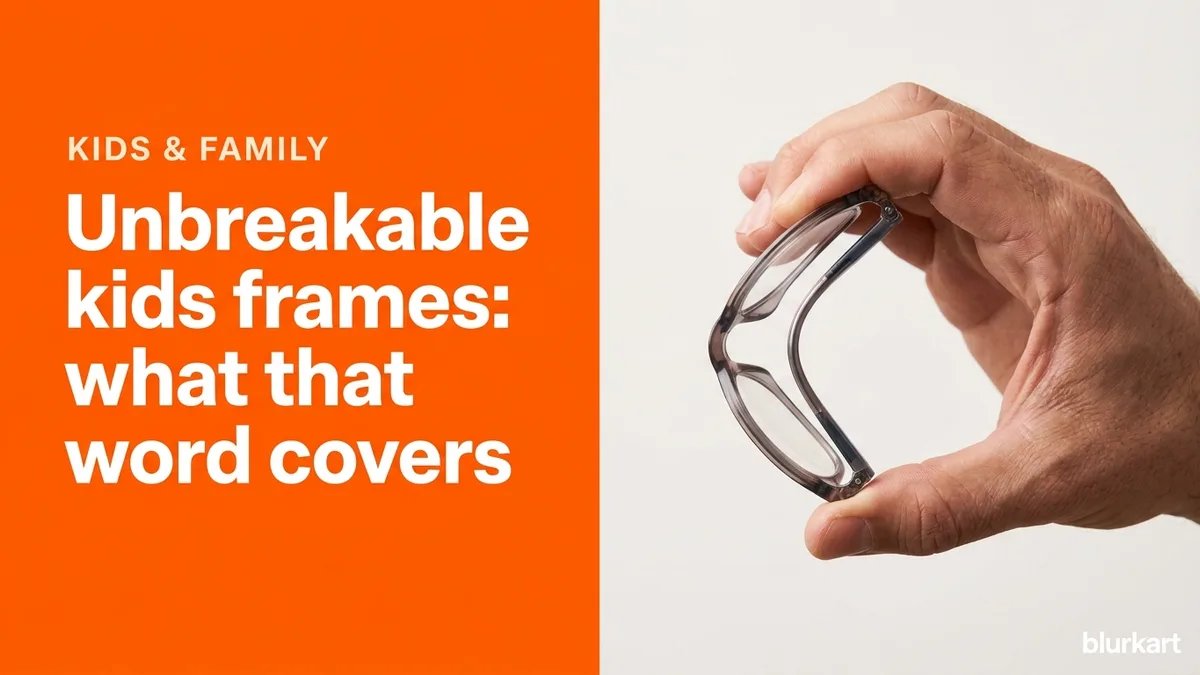
Every optical shop sells unbreakable kids frames, and the word is doing a lot of work. Nothing worn by a seven-year-old is unbreakable. What these frames actually are is flexible, and understanding the difference sets the right expectations before you spend the money.
What unbreakable kids frames really means
Two materials get the label. TR90 is a flexible thermoplastic that can be twisted a long way and springs back to its original shape. It is very light, it does not become brittle in cold, and it takes a beating. Memory metal, usually a titanium alloy, does the same thing in a metal frame: bend an arm right over and it returns.
Both solve the commonest way children's glasses die, which is being twisted, sat on, or crushed in a bag. A conventional acetate frame in that situation snaps at the hinge or the rim. A flexible one deforms and recovers.
What the word does not cover
Hinges and screws. The flexible material is the front and the arms. The hinge is still a small mechanical joint with a tiny screw, and that is where most repairs happen. Look for spring hinges, which flex outward rather than forcing the joint when the frame is pulled over the head one-handed, which is how every child removes glasses.
Lenses. The frame surviving does not help if the lens is scratched to milk. Polycarbonate is the only sensible lens material for a child, and a hard coat on it is essential rather than optional. The material guide explains why.
Being stood on. No frame at any price survives a shoe on a hard floor. That is not a defect and no warranty covers it.
Being lost. Statistically the leading cause of a child needing new glasses.
What actually keeps a pair alive
A strap or sports band does more than any material claim, especially for children under about eight and for anyone playing football. It costs very little and it prevents the drop that starts everything else.
A hard case that the child will actually use matters more than one that is nicer. If it does not fit in their school bag, it stays at home.
And a fit that is right. A frame too big slides down, gets pushed up with one hand all day, and works loose at the hinge. We size children properly rather than fitting something to grow into, because a year of a badly fitting frame damages both the glasses and the habit of wearing them.
Plan for the repair, not just the purchase
Ask whether spare parts exist for the frame before you buy. A frame we can get arms and hinges for is worth more over three years than a slightly nicer one we cannot.
Adjustments, nose pads and temple tips are free at both showrooms, on any frame, whether it came from us or not. Bring the pair in as soon as it starts sitting crooked rather than after a month, because a loose hinge worked loose further is what eventually snaps. Warranty and repairs sets out what a defect is and what is accidental damage.
The spare pair question
When your child's prescription changes, keep the outgoing pair if the power is still close. A slightly out-of-date spare is far better than a week of school without glasses while a repair is done. A complete pair starts at NPR 1,749, so a deliberate second pair is not the expensive decision people assume. Two pairs or one good pair covers the maths.
Bring them to Pulchowk or Boudha and we will measure properly. The eye test is free, and children's frames start at NPR 999 in the eyeglasses range.
The questions worth asking in the shop
Ask what the frame is made of, specifically, rather than accepting the word flexible. Ask whether it has spring hinges. Ask whether replacement arms and hinges are available and roughly what they cost. And ask what the warranty covers, because a manufacturing defect and a stood-on frame are treated very differently everywhere.
Then ask the question most parents skip: how will this be adjusted as my child grows? Heads change shape over a couple of years, and a frame that cannot be adjusted becomes a frame that fits badly long before it wears out.
Our adjustments are free at both showrooms on any frame, which matters more for a child than for anyone else, because theirs will need doing several times a year.
Frequently asked
- What is TR90 and is it worth it for children?
- A flexible thermoplastic that bends a long way and returns to shape. It is light, does not crack in cold, and suits children well. It cannot be heat-adjusted as precisely as acetate, which is a fair trade.
- How often will my child break their glasses?
- Expect at least one incident a year. Plan for it: choose a frame we can get parts for, keep the old pair as a spare when the prescription is still close, and bring them in early rather than after a week of a loose hinge.
- Bachcha ko chasma bhachchha, ke garne?
- TR90 jasto lachilo frame lina sakinchha, jun morieko pani pheri sidha hunchha. Tara hinge ra screw ta bhachhna sakchha. Lens chai polycarbonate nai chahinchha ra strap laga yo bhane dherai bachchha.