
Abbe Value: The Clarity Trade-Off of Very Thin Lenses
Abbe value measures how much a lens scatters colours. A higher Abbe value means crisper vision with less colour fringing at the edges. Higher-index, thinner lenses tend to have a lower Abbe value, so for strong prescriptions there is a small trade-off between thinness and edge clarity. Most people adapt and do not notice it.
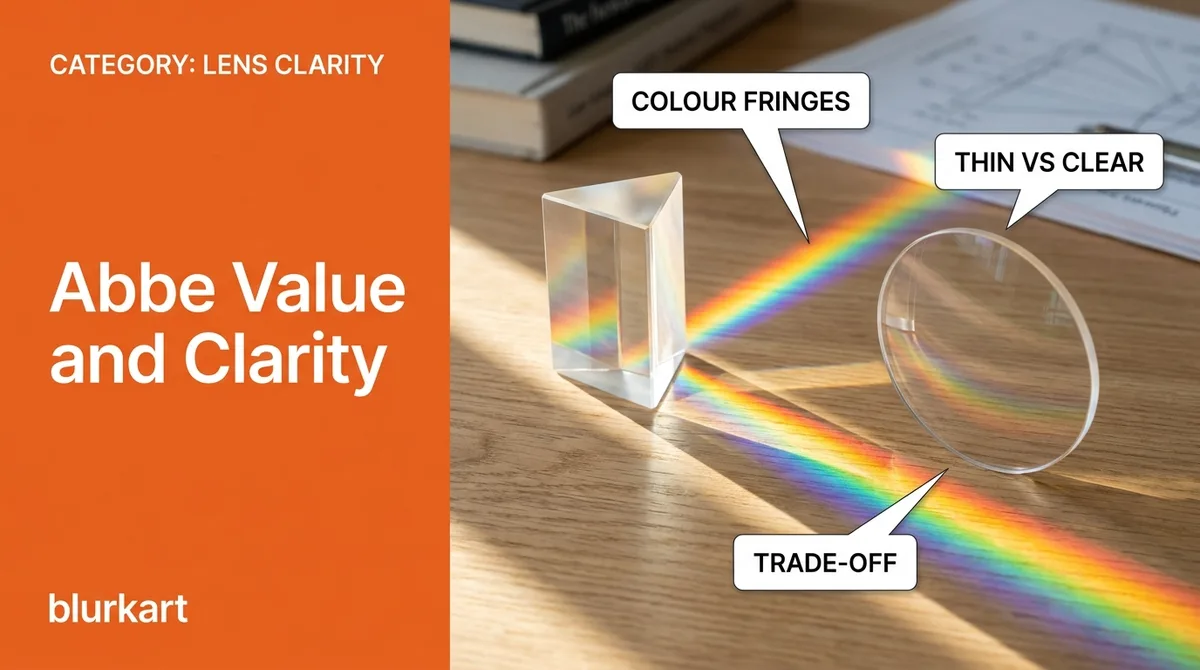
The trade-off nobody puts on the price list
High-index lenses are sold on one promise: thinness. What rarely gets mentioned is a quiet trade-off that comes with it, measured by something called Abbe value. It will not ruin your vision, but understanding it stops you from over-buying index and helps you balance slim looks against edge clarity.
What Abbe value measures
Light is made of colours, and any lens splits those colours a little as it bends them, the same effect that creates a rainbow through a prism. Abbe value measures how much a lens material does this. A higher Abbe value means the colours stay together, giving crisp vision with little fringing. A lower Abbe value means slightly more colour separation, seen as faint coloured edges around objects when you look through the periphery of the lens.
High Abbe equals crisp edges. Low Abbe equals a touch of colour fringing, mostly at the sides of the lens.
Why thinner lenses can mean lower Abbe
Here is the catch: the higher-index materials that make lenses thin tend to have a lower Abbe value. So as you climb from 1.56 toward 1.74, lenses get slimmer but the Abbe value generally drops. For strong prescriptions this is a genuine, if small, trade-off between thinness and edge clarity.
How much will you notice?
| Situation | Likely to notice fringing? |
|---|---|
| Mild power, lower index | No |
| Moderate power, 1.61 or 1.67 | Rarely |
| Strong power, 1.74, large frame | Possibly, at the edges |
| Looking through the lens centre | No, centre stays crisp |
Crucially, any fringing is an edge effect. Through the centre of the lens, where you look most, vision stays sharp. Most people never notice it, and those who do usually adapt within days.
How to get the balance right
- Choose the lowest index that gives comfortably thin lenses for your power.
- Do not chase 1.74 for a mild or moderate prescription; you lose clarity for thinness you do not need.
- Consider a smaller frame so a lower, higher-Abbe index still looks slim.
- Add a good anti-reflective coating, which improves overall clarity and contrast.
The practical takeaway
Abbe value is a useful reason to resist the instinct that higher index is always better. For a strong prescription, the right index keeps your lenses slim while holding clarity high; for a mild one, it barely matters. In Nepal, when an optician offers you the thinnest possible lens, ask whether your power really needs it, because sometimes a slightly lower index gives you both a slim look and crisper vision for less money.
Abbe values of common materials
As a rough ranking, lower-index materials like standard plastic and Trivex have higher Abbe values (crisper edges), while the highest-index materials have lower Abbe values. Polycarbonate, despite being tough and useful, has a relatively low Abbe value, which is one reason clarity-sensitive adults sometimes prefer Trivex or a mid-index lens. None of this ruins vision; it simply explains why the thinnest or toughest option is not automatically the clearest.
Coatings do not change Abbe
A common mix-up: an anti-reflective coating improves light transmission and contrast, but it does not change the material's Abbe value or remove colour fringing at the edges. Coating and Abbe are separate properties. So if edge fringing bothers you with a very high-index lens, the fix is a slightly lower index or a smaller frame, not a different coating. Keep the two ideas apart when you compare options.
Shop the lenses mentioned in this guide
- ZEISS ClearView 1.56 UVProtect – Single Vision FSV, DuraVision Platinum UV (Pair): a standard-index lens with higher Abbe clarity for mild powers
- ZEISS ClearView 1.6 UVProtect – Single Vision FSV, DuraVision Platinum UV (Pair): a balanced middle ground between thinness and clarity
- ZEISS ClearView 1.67 UVProtect – Single Vision FSV, DuraVision Platinum UV (Pair): a high-index lens for strong prescriptions
- ZEISS ClearView 1.74 UVProtect – Single Vision FSV, DuraVision Platinum UV (Pair): the thinnest option, best kept for very strong powers
Keep reading
- Lens Index Explained: 1.56 vs 1.61 vs 1.67 vs 1.74
- Trivex vs Polycarbonate: The Tougher Lens for Kids and Sport
- Aspheric Lenses: Flatter, Thinner and Better Looking
- How Thick Will My Lenses Be? A Power-to-Thickness Guide
Not sure which lens suits you? Book a free eye test at our Pulchowk or Boudha branch.
Frequently asked
- What is Abbe value in lenses?
- It is a measure of how much a lens material splits light into its colours. A higher Abbe value means less colour fringing and crisper vision, especially at the edges of the lens. A lower value means slightly more fringing.
- Do high-index lenses have worse clarity?
- Higher-index materials tend to have a lower Abbe value, so there can be slightly more colour fringing at the edges. For most prescriptions and most people it is unnoticeable, but it is why the highest index is not always the best choice.
- Will I actually notice low Abbe value?
- Often not. Any fringing appears mainly at the lens edges, not the centre, and most people either do not notice it or adapt within days. It is more likely to be seen with very high-index lenses in large frames.
- How do I balance thinness and clarity?
- Choose the lowest index that gives you comfortably thin lenses for your power. That keeps the Abbe value as high as possible while still looking slim. Over-buying index trades clarity for thinness you do not need.
- Does Abbe value matter for mild prescriptions?
- Barely. Mild prescriptions use lower indexes with higher Abbe values anyway, and the lenses are thin regardless, so there is little trade-off to worry about.