
Signs your child cannot see the board
Children almost never report blurry vision, because they assume everyone sees what they see. Watch instead for squinting, tilting the head, sitting closer to the television, copying from a neighbour's book, headaches after school, and marks that drop without an obvious reason. A free ten-minute test settles it.
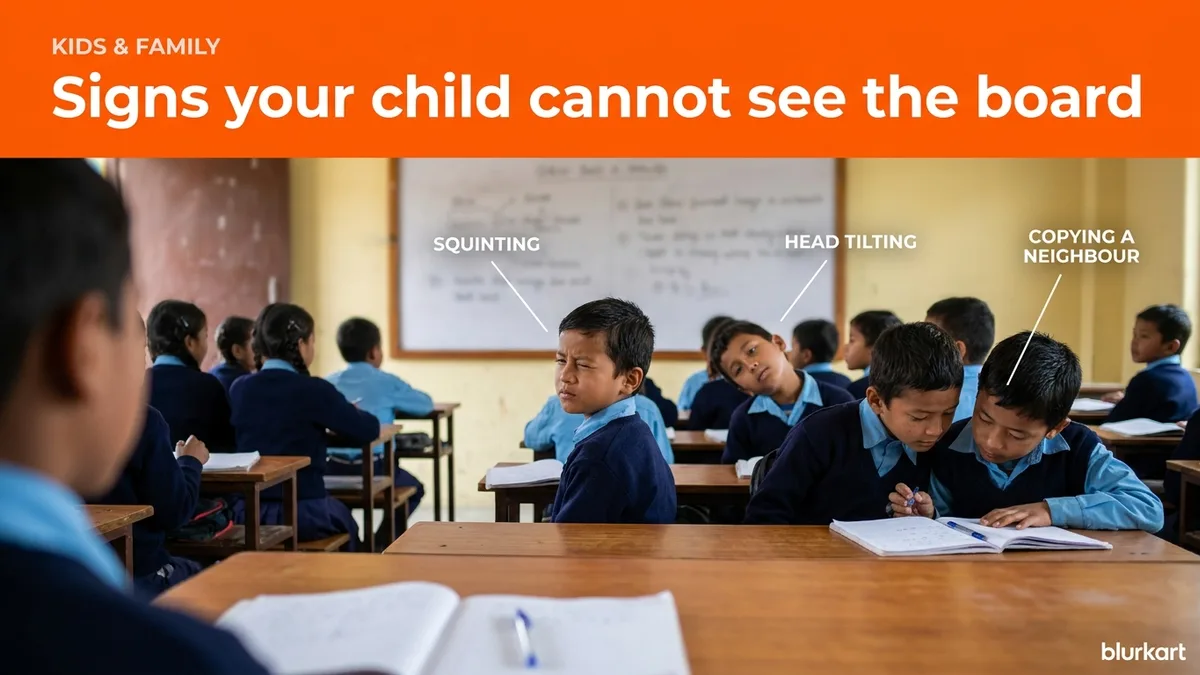
When a child cannot see the board, the one thing they almost never do is say so. They have nothing to compare their vision against, so a blurry world is simply the world. The problem announces itself in behaviour instead, and usually in a form that gets read as something else.
Signs a child cannot see the board
Squinting. Narrowing the eyes sharpens a short-sighted image slightly, and children work this out without being taught. Persistent squinting at anything distant is the single most reliable sign.
Head tilting or turning. Consistently favouring one angle often means one eye is doing more work than the other, or that astigmatism makes some directions clearer than others.
Sitting very close. To the television, to a tablet, to a book. Moving closer makes the image bigger, which compensates for blur.
Copying from a neighbour. This one is important because it gets punished. A child who cannot read the board will read their friend's exercise book instead, and that looks exactly like cheating.
Headaches and eye rubbing after school. Not in the morning. Late-day headaches point to effort accumulated over hours of straining.
Marks dropping without explanation. Especially in subjects taught from the board rather than from a textbook. Maths often falls before reading does.
Losing their place while reading, or avoiding reading. Frequently read as laziness or a concentration problem.
Why teachers often spot it first
A teacher sees thirty children in the same room doing the same task, so a child who behaves differently stands out. At home there is no comparison. If a teacher raises it, take it seriously even if nothing looks wrong to you.
The reverse is also true: a child who reads happily up close and struggles only with the board is a textbook short-sighted pattern, and it can go years without anyone connecting the two. Minus or plus explains why near vision stays sharp while distance goes.
What a school screening does and does not catch
School screenings usually check distance vision with a letter chart, which finds short-sightedness reasonably well. They tend to miss long-sightedness, because a young eye compensates for it and reads the chart fine while quietly working hard. They also miss astigmatism at lower levels and any difference between the two eyes if both are tested together.
So passing a school screening is reassuring but not conclusive, particularly if the behaviour above continues.
What happens at a proper test
Ten minutes, free, at either showroom. A short history, an auto-refractor reading, then the letter chart with trial lenses where we ask which is clearer. Children are tested one eye at a time, which is how a weaker eye gets found. We measure PD and check the fit. What a free eye test includes covers each step.
If we see anything beyond a refractive error, a squint, an eye that does not follow properly, or a difference between the eyes that looks like amblyopia, we send you to an eye hospital rather than fitting glasses. Early treatment matters a great deal for that, and it is not an optician's job.
If they do need glasses
Polycarbonate lenses, because children's glasses take impacts adults' never do. A full-rim frame that fits properly rather than one they will grow into. And a yearly test, because powers move fast at this age. A child's first pair covers the practical side, and children's frames start at NPR 999 in the eyeglasses range.
How to raise it without worrying them
Children pick up anxiety quickly, and a child who thinks something is wrong with their eyes can become reluctant to be tested at all. Keep it ordinary. Frame it as a check everyone has, mention that plenty of their classmates wear glasses, and avoid asking leading questions like whether things look blurry, because a child with lifelong blur will answer no in good faith.
A better question is comparative: ask whether the board looks the same as their book, or whether they can read a sign that you can read across the street. Comparison gives them something to measure against, which describing blur does not.
Bring them in mid-morning rather than after a full school day, when they are less tired and the answers are more reliable.
Frequently asked
- At what age should a child have their first eye test?
- Before starting school, and then yearly. Children change faster than adults and a power that shifts mid-year is easy to miss, because nothing about the child's behaviour announces it.
- My child says they can see fine. Should I still test?
- Yes. A child with a lifelong mild blur has no comparison and will honestly answer that they see fine. That is not them hiding it, it is them describing the only vision they have known.
- Bachcha le board dekhena bhanne kasari thaha paune?
- Bachcha aafai bhandainan. Aankha chimlanu, tauko dolaunu, TV najik basnu, sathi ko copy herera lekhnu ra school pachhi tauko dukhnu yi sanket hun. Aankha jaanch nihsulka chha ra das minute lagchha.