
Lazy eye: why early glasses matter
Lazy eye, or amblyopia, happens when the brain favours one eye during the years vision is developing, usually because of a squint or a big difference in prescription. It is highly treatable in young children with glasses and patching, and much harder to treat after about eight. There are often no symptoms the child can report.
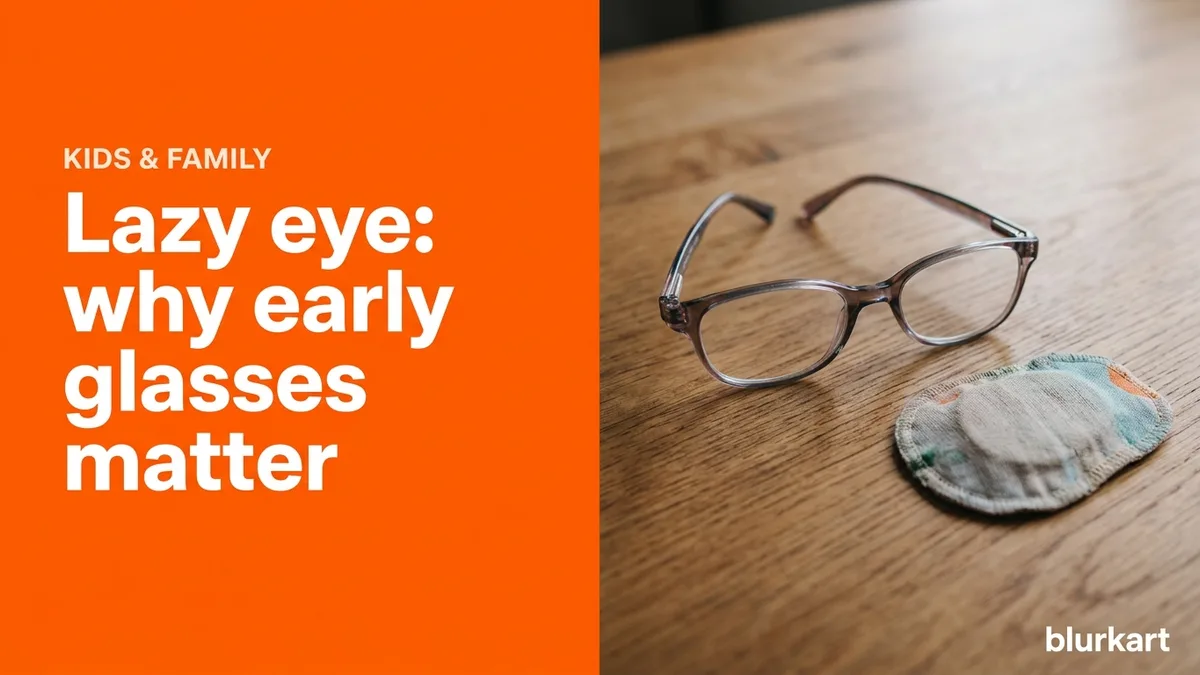
Lazy eye is one of the few eye problems where the timing of detection changes the outcome more than the treatment does. It is also one of the hardest to notice, because the child has no symptom to report.
What a lazy eye actually is
The name is misleading. Amblyopia is not a weak muscle and it is not an eye that wanders, although a wandering eye can cause it. It is the brain learning to ignore the input from one eye during the years when the visual system is still wiring itself.
That happens when the two eyes send images the brain cannot reconcile. If one eye points slightly differently, the brain suppresses one image to avoid double vision. If one eye has a much stronger prescription than the other, the brain favours the clearer picture and gradually stops processing the blurrier one.
Either way, the ignored eye stops developing. The eye itself is healthy. The pathway between it and the brain never matures.
Why children never mention it
Because nothing looks wrong to them. The good eye covers the whole field, depth perception is imperfect but it is the only depth perception they have ever had, and there is no pain, no blur they can name and no obvious difference.
A child with amblyopia in one eye will honestly tell you they see fine, and they are not being difficult. This is why it is so often found by accident, during a test done for another reason.
What can be visible to a parent: one eye drifting inward or outward, especially when the child is tired. A persistent head tilt or turn. Sitting with the head at an angle to read. Closing or covering one eye in bright light. Clumsiness with catching, which needs depth perception. And a child who strongly objects when you cover one particular eye, because that is the eye they see with.
The window, and why it matters so much
The visual system is plastic in early childhood and becomes much less so by around seven or eight. Treat amblyopia at four and the results are usually very good. Treat it at ten and improvement is more limited. Treat it in adulthood and you are largely managing rather than correcting.
This is the whole argument for testing children before school and then every year. Not because glasses are urgent, but because this specific condition has a deadline, and nothing about it announces itself. Signs a child cannot see the board covers the broader behaviours worth watching.
What treatment looks like
Usually glasses first, to make sure both eyes are receiving a clear image. Where the cause is a large difference in prescription between the eyes, correcting it can be most of the treatment on its own.
Often that is combined with patching the stronger eye for a few hours a day, which forces the brain to use the weaker one. Sometimes drops are used instead of a patch. A squint may need surgery.
All of those are decisions for an ophthalmologist. We say that plainly: this is not an optician's job, and a shop that offers to treat a lazy eye is overstepping.
What we do
At both showrooms we test children one eye at a time, which is how a difference between the eyes gets found in the first place. If we see a large gap in prescription, an eye that does not follow properly, or a squint, we refer you to an eye hospital the same day rather than fitting glasses and sending you off.
If an eye doctor prescribes glasses as part of treatment, we make them up and fit them properly, which matters more than usual here: a child's glasses only work if they are worn all day and sit right. The test is free, takes about ten minutes, and children's frames start at NPR 999 in the eyeglasses range. Unbreakable kids frames covers what survives a school year.
Getting the glasses worn, which is the hard part
Once an eye doctor has prescribed glasses as part of treatment, the whole benefit depends on them being on the child's face all day. That is a fitting problem as much as a medical one.
A frame that slides down means the child looks over the top of the lenses, which is the same as not wearing them. A frame that pinches comes off at school. A frame the child dislikes gets left in a bag. So we fit to the head the child has now rather than one they will grow into, we use spring hinges, and we tell parents to bring the pair back the moment it sits crooked.
Adjustments are free and take a few minutes. With amblyopia they are not cosmetic; they are the treatment working or not.
Frequently asked
- Can a lazy eye be fixed in adults?
- Improvement is possible but much more limited than in a young child. The visual pathway is far less plastic once developed, which is precisely why early detection matters so much.
- Will glasses alone fix a lazy eye?
- Sometimes, when the cause is purely a large prescription difference. Often glasses are combined with patching the stronger eye for part of the day. That decision belongs to an eye doctor, not a shop.
- Lazy eye bhaneko ke ho?
- Euta aankha lai dimag le kam prayog garda drishti nabadhne samasya ho. Dherai jaso bachcha aafai thaha paudainan kinabhane arko aankha le kaam garirakheko hunchha. Sano umer mai upachar garyo bhane ramro hunchha, tyasaile aankha aspatal ma dekhaunu parchha.