
Minus or plus: what your numbers say about your eyes
A minus sign on your prescription means short-sighted: distance is blurry, close is clear. A plus sign means long-sighted: your eye has to work to focus close. The number is the strength in dioptres, and anything past about 4 counts as strong enough to want a thinner lens.
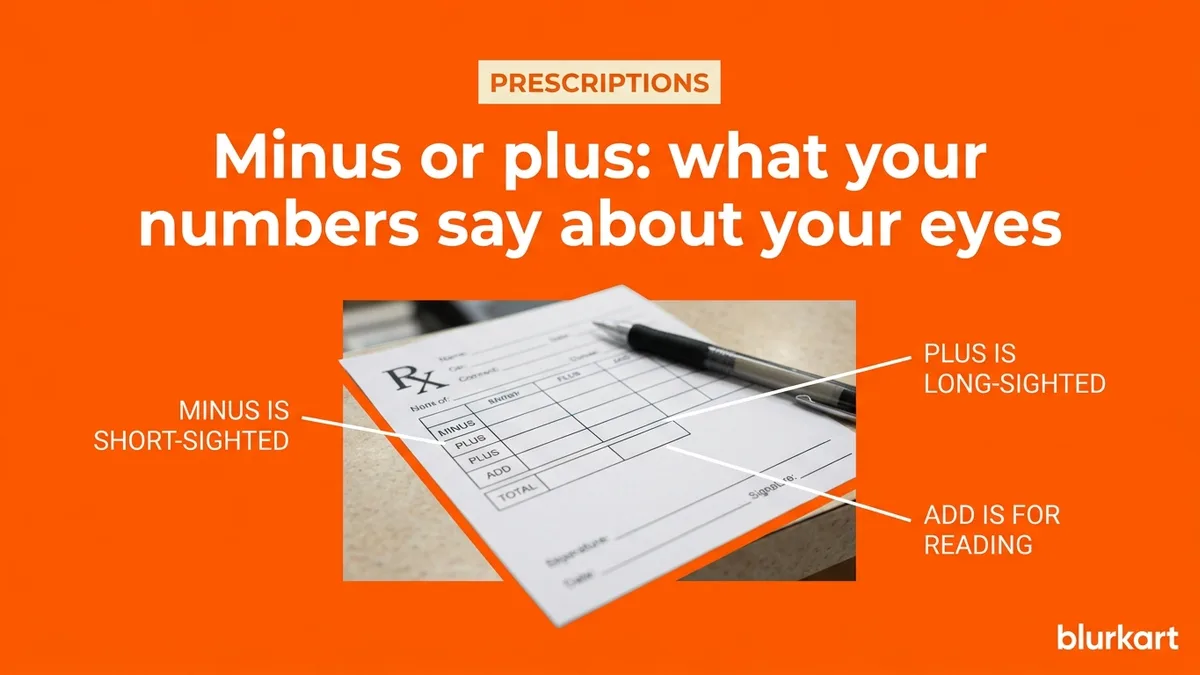
Two people compare prescriptions and immediately try to work out who has worse eyes. It is the wrong question, because minus or plus is not a scale from bad to worse. They are two different directions.
What the minus sign means
Minus is short-sightedness, or myopia. Your eye is slightly too long from front to back, so light from far away focuses just in front of the retina rather than on it. Distance goes soft. Close-up stays sharp, which is why short-sighted people often read very comfortably without glasses and cannot read a number plate.
This is the pattern we see most in students and anyone who spent their teens on close work. It usually appears between about 8 and 16, moves for a few years, and settles in the twenties.
What the plus sign means
Plus is long-sightedness, or hyperopia. The eye is slightly too short, so light wants to focus behind the retina. A young eye can compensate by squeezing its own lens, which is why mild plus often causes no blur at all in your twenties.
What it causes instead is effort. Headaches around the temples by late afternoon, tired eyes after reading, a reluctance to do close work that gets mistaken for a concentration problem in children. The blur shows up later, when the eye loses the ability to compensate. If your eyes ache rather than blur, the headaches guide is worth reading.
Minus or plus, and how big the number is
The number after the sign is in dioptres, and it is the strength of the lens needed to correct it.
Under 2.00 is mild. You can probably get through a normal day without glasses and just find some things harder. 2.00 to 4.00 is moderate, and most people at that level wear glasses most of the time. Past 4.00 is strong, and that is where two practical things start to matter.
First, thickness. A strong minus lens is thin in the middle and thick at the edge, which is what produces the ring effect at the rim. A strong plus lens is the opposite, thick in the middle. Past about 4 it is worth asking about a high index lens, which bends light more sharply and so does the same job with less material. Our guide to making a strong prescription look thin covers what that costs and when it is worth it.
Second, frame choice. A smaller lens area means less edge thickness on a strong minus. A thick acetate rim hides what edge there is. A big rimless frame in a strong power does the reverse.
Two numbers people confuse
A prescription can have both a minus SPH and a plus ADD, and this confuses almost everyone who sees it for the first time.
SPH is your distance power. ADD is extra reading power, added to the bottom of the lens from around 40 onwards as the eye's own focusing stiffens. Having minus 2.00 distance and plus 2.00 add is completely normal at 50. It does not mean the numbers cancel out and it does not mean your eyes are fighting each other. They are two different jobs. What changes after 40 explains how one lens handles both.
What to do with your number
If it is mild and stable, a check every two years is enough. If it moved more than about 0.50 since the last test, or if you are under 18, come yearly. And if you have never had the number explained to you, ask at the counter. We would rather spend two minutes on it than sell you a lens you do not understand.
The eye test is free at both showrooms and carries no obligation to buy. Frames start at NPR 999 in the eyeglasses range, with single vision lenses from NPR 750.
Why your two eyes rarely match
Almost nobody has the same number in both eyes, and a gap of half a dioptre or so is completely ordinary. It only becomes a practical issue when the difference is large, because then the two lenses magnify by noticeably different amounts and your brain has to reconcile two differently sized images. If one of your eyes is much stronger than the other and glasses have never felt right, mention it at your next test, because there are lens choices that reduce the mismatch.
Frequently asked
- Is minus power worse than plus power?
- Neither is worse. They are opposite directions, not a scale. What matters is the size of the number and whether it is corrected, not the sign in front of it.
- Can my power get lower over time?
- Short-sightedness usually stabilises in the twenties and rarely reduces much. Long-sighted numbers can appear to rise after 40 as the eye's own focusing power fades. A test every two years tracks it properly.
- Minus ra plus power ma ke farak chha?
- Minus bhaneko tadha ko dhamilo, najik ko safa. Plus bhaneko najik herna aankha le badhi mehanat garnu parchha. Ankha ko number thulo bhayo bhane lens motto hunchha, tyasaile high index lens sodhnus.