
What a free eye test actually includes
A free eye test at Blurkart takes about ten minutes and covers your history, an auto-refractor reading, a subjective check on the letter chart, your pupillary distance and a frame fit check. It is not a medical eye examination, so anything that looks medical gets referred to an eye hospital.
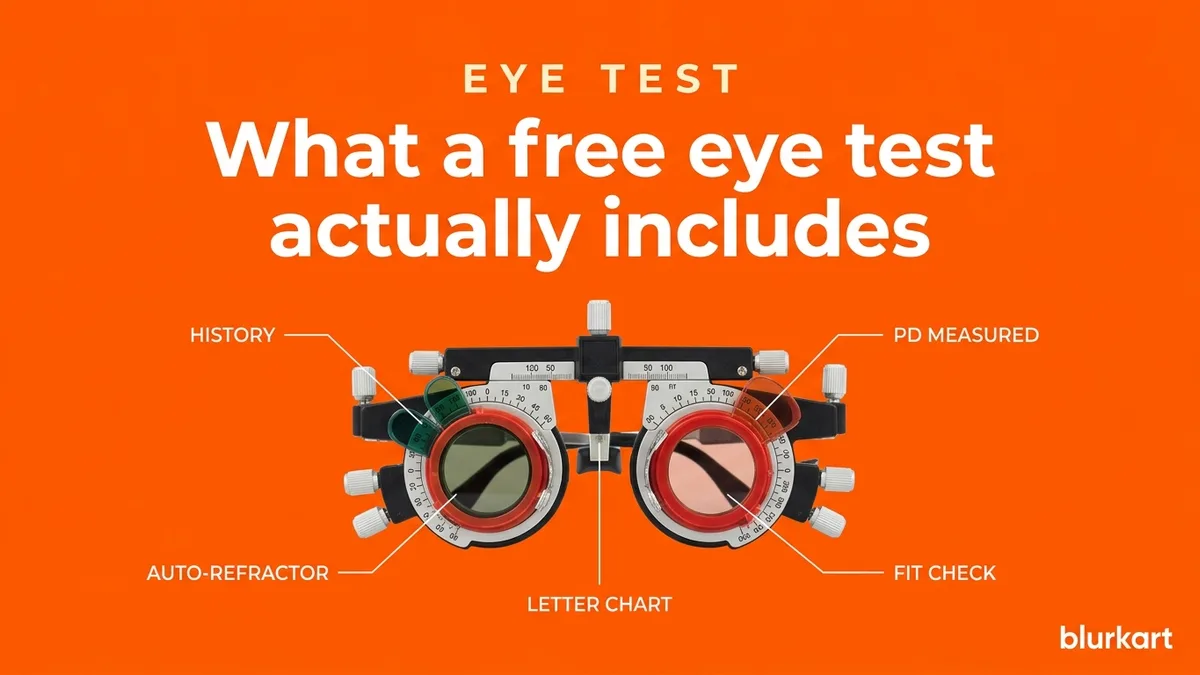
A free eye test makes people suspicious, and it should. So here is exactly what a free eye test at Blurkart involves, step by step, including the parts it does not cover.
What a free eye test in Nepal covers
The whole thing takes about ten minutes. There are five steps and none of them are a sales pitch.
One, a short history. We ask what brought you in, whether you already wear glasses, how old the current pair is, what you do all day and whether anything specific hurts. A person who codes for nine hours needs a different conversation than a driver.
Two, the auto-refractor. You look into a machine at a picture and it estimates your prescription in a few seconds. This is a starting point, not the answer. Auto-refractors tend to over-read minus power, especially in younger eyes, which is why nobody should hand you glasses based on this number alone.
Three, the letter chart. This is the part that matters. We put trial lenses in front of each eye and ask which is clearer, one or two. Your answers refine the machine's guess into a prescription you will actually be comfortable wearing. If you find yourself guessing, say so, because a guessed answer produces a wrong lens.
Four, your PD. The distance between the centres of your pupils, in millimetres. It decides where the optical centre of each lens sits. Get it wrong and a correct prescription still gives you eye strain.
Five, the fit. We check how a frame sits on your bridge and whether the temple length suits your head, because the best lens in a badly fitting frame is a wasted lens.
What you walk out with
A written prescription with SPH, CYL, AXIS, ADD if you need it, and your PD. It is yours. Take it to any shop in Nepal, or keep it on your phone. We would rather you came back because the fitting was good than because we held your numbers hostage.
What it does not include
This is a sight test, not a medical eye examination, and the difference matters. We are not dilating your pupils, photographing your retina, measuring the pressure inside your eye or screening for glaucoma. Those need an ophthalmologist and equipment we do not have.
So if you come in with eye pain, sudden blurring in one eye, flashes of light, a curtain across your vision, double vision or a red eye that will not settle, we stop and send you to an eye hospital. We will tell you plainly rather than sell you glasses. Those symptoms need a doctor the same day, not a new prescription.
How often should you come?
Every two years for most adults with stable vision. Every year if you are over 40, if your power has been moving, if you have diabetes, or if there is glaucoma in your family. Children and teenagers change fastest and should be checked yearly, because a power that shifts during a school year is easy to miss.
Come sooner than that if anything changed. Headaches by late afternoon, squinting at the board or the number plate ahead, holding your phone further away than you used to, or one eye clearly doing more work than the other are all worth ten minutes.
Before you come in
Bring your current glasses, even if they are old and scratched. Bring any prescription slip you have, including one from a hospital or an eye camp. If you wear contact lenses, take them out at least an hour before, or come in glasses, because a lens that has been sitting on your cornea all day changes the reading.
Both showrooms have an optician on site: Situngah Galli in Pulchowk, Lalitpur, and the main road opposite KFC in Boudha, Kathmandu. If you want to read your slip yourself afterwards, our guide to reading an eyeglass prescription walks through every number, and why it is worth examining your vision covers what regular checks catch early. Frames start at NPR 999 in the eyeglasses range, but there is genuinely no obligation to buy one.
Why a shop offers this for nothing
Worth being straight about the business logic, because free things invite suspicion. Most people who get tested buy glasses somewhere, and we would rather it was here. That is the whole model. It only works if the test is honest, because a prescription you cannot wear comfortably comes straight back to us. Nobody is paid a commission on the strength of your lens, and we have no reason to find a power you do not have.
Frequently asked
- Is the eye test really free?
- Yes. No fee, no appointment, and no obligation to buy. Walk into either showroom, Pulchowk in Lalitpur or Boudha in Kathmandu, Sunday to Friday between 9:00 and 19:00.
- Can I take the prescription elsewhere?
- Yes. A prescription is a measurement of your eyes, not a product of the shop that took it. You are welcome to take the slip and buy anywhere.
- Aankha jaanch garna kati bela janu parchha?
- Aitabar dekhi sukrabar, 9 baje dekhi 7 baje samma, kunai pani bela. Appointment chahiddaina. Late afternoon is busiest, so mid-morning is usually quicker.