
School eye tests: what they catch and what they miss
School eye tests are a distance letter chart, which finds short-sightedness reasonably well. They routinely miss long-sightedness, because a young eye compensates and reads the chart fine, along with mild astigmatism, focusing problems and how the two eyes work together. If the behaviour continues after a pass, get a full test.
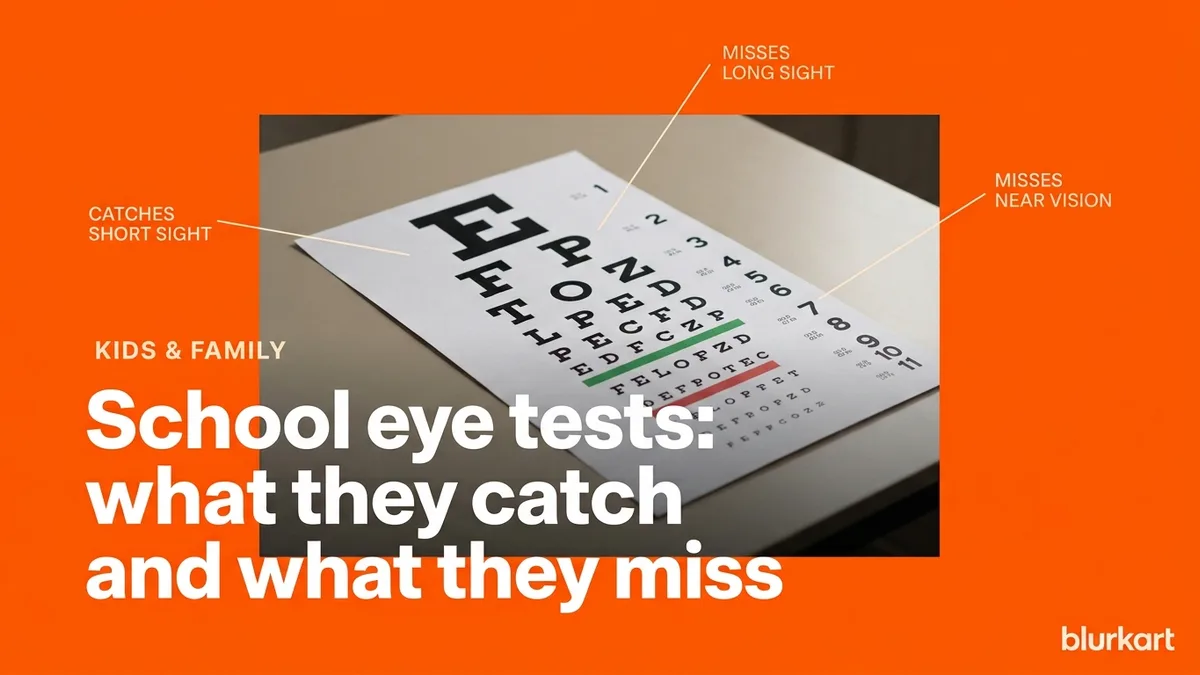
School eye tests do real good. They find children who genuinely cannot see the board and who would otherwise go years unnoticed. They are also a screening rather than an examination, and the gap between those two words is where a lot of children fall.
What school eye tests actually do
In most Nepali schools the screening is a distance letter chart. A child stands at a set distance, covers one eye, and reads down until the letters stop being clear. The result is recorded as something like 6/6 or 6/9.
It is quick, it needs almost no equipment, and for its one job it works. Short-sightedness makes distant letters blurry, so a short-sighted child fails the chart and gets referred. That is the case the screening is built for.
What it misses
Long-sightedness. The big one. A young eye can squeeze its own lens to compensate for mild to moderate long-sightedness, so the child reads the chart perfectly and passes. What the chart cannot see is the effort. That effort shows up as headaches after school, avoiding reading, losing their place on the page and fidgeting through homework. Minus or plus explains the mechanism.
Mild astigmatism. Enough to blur edges and cause strain, often not enough to fail a chart read at a good contrast in decent light.
Eye teaming and focusing. How the two eyes work together, whether they converge properly for close work, and how quickly focus shifts from board to book. None of that is tested by reading letters at six metres.
Near vision. Most screenings never test it, and near work is what a school day is made of.
Anything medical. A screening is not looking at the back of the eye, at pressure, or at the optic nerve.
Why a pass can be misleading
A pass tells you the child could read a high-contrast chart across a room on one particular morning. It does not tell you they can comfortably read a textbook for forty minutes. Parents understandably treat the pass as a clean bill and then look elsewhere for an explanation when the child keeps struggling, usually landing on concentration or effort.
So the rule is simple. If the behaviours in signs your child cannot see the board continue after a pass, the screening did not answer the question.
What a full test adds
Ten minutes at either showroom, free. We take a history, get an objective starting point from the auto-refractor, then refine it subjectively with trial lenses one eye at a time. We check near vision as well as distance, measure PD, and look at how the eyes move together.
Crucially, we are looking for the child who reads the chart fine but is working to do it. That is the case a screening is structurally unable to find.
If we see a squint, a large difference between the two eyes, or anything that looks like amblyopia, we refer you to an eye hospital the same day rather than fitting glasses. Those need treatment while the visual system is still developing.
The practical advice
Treat the school screening as one input. Test properly before school starts, then yearly, and sooner if behaviour changes. Bring any school slip with you, even a scrappy one, because it gives us a comparison point.
Walk into Pulchowk or Boudha Sunday to Friday, no appointment. If glasses turn out to be needed, children's frames start at NPR 999 in the eyeglasses range, and what unbreakable really covers is worth reading first.
What to do with the screening result
Keep the slip, even a scrappy one, and photograph it. A screening result on its own says little, but two or three across successive years show whether anything is drifting, and that pattern is genuinely useful to whoever tests your child next.
If the school refers your child, act on it rather than waiting for the next term. If the school does not refer them but you are still seeing the behaviours, book a test anyway and say what you have noticed, because that description often points us at what to check more usefully than the chart does.
And remember that a screening tests what a child could do that morning. A tired, distracted or shy child can read poorly with perfectly good eyes, and the reverse happens too.
Frequently asked
- My child passed the school eye test but still struggles. What now?
- Get a full test. A screening checks distance vision only. A child who reads 6/6 on the chart can still be straining to focus up close, which shows as headaches, avoidance of reading and losing their place.
- How often should a school-age child be tested?
- Yearly. Powers move fastest between about eight and sixteen, and a shift mid-year shows up in schoolwork long before anyone suspects vision.
- School ma jaanch bhayo, ani pani jaanch garaunu parchha?
- School ko jaanch le tadha ko drishti matra herchha. Najik herda dukhne, tauko dukhne ya padhna man nalagne chha bhane purai jaanch garaunu. Hamro showroom ma nihsulka chha ra das minute lagchha.