
Choosing glasses for an older parent
For an older parent, weight and grip matter more than style. Choose a light frame with wide nose pads, spring hinges and arms they can find and open easily. A high index lens is worth the cost because it is lighter. Anti-reflective coating helps night glare, which is often the real complaint.
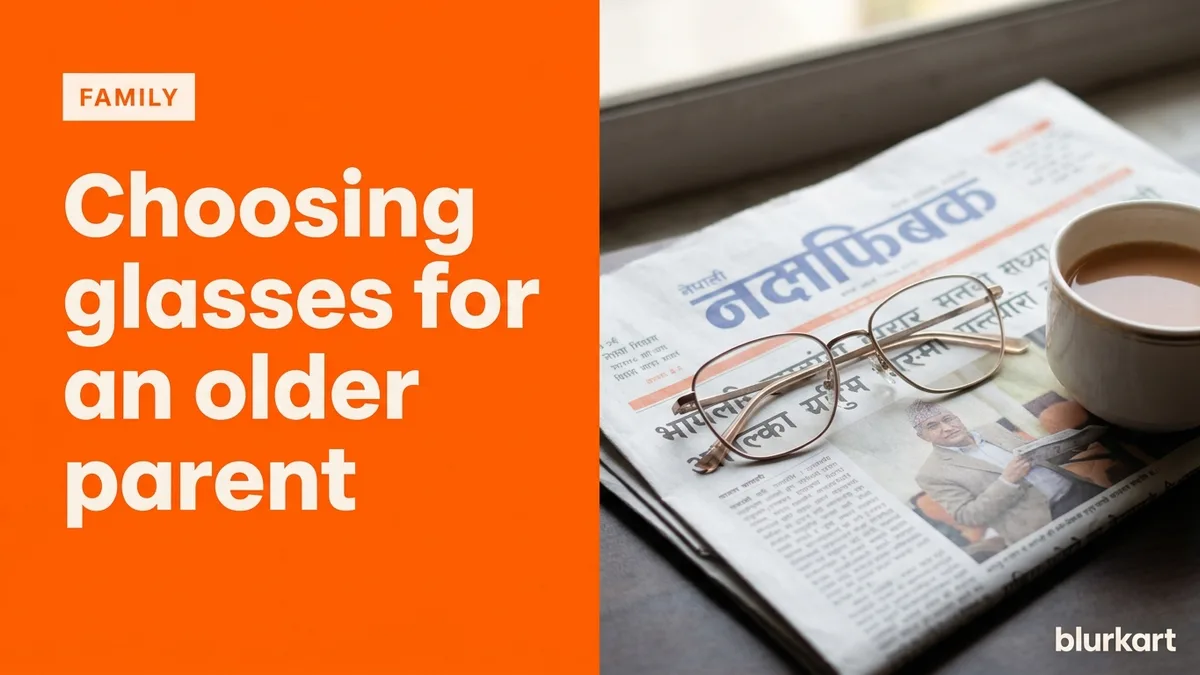
Buying glasses for an older parent is a different problem from buying your own. The things that decide whether a pair gets worn every day are weight, grip and glare, and none of them are what a shop display is arranged around.
Weight comes first when choosing glasses for an older parent
Skin thins with age and cartilage gets less forgiving, so a frame that would merely mark a younger nose can leave a genuinely sore spot. At the same time, prescriptions at this age are often stronger, which means heavier lenses.
Two things fix it. A light frame material, titanium or TR90 rather than thick acetate. And a thinner lens: a high index lens in a strong power weighs meaningfully less than standard plastic, which is the clearest case for paying more for a lens at any age. The high index guide covers the thresholds.
Wide, soft nose pads spread whatever weight remains across more skin. Why glasses leave marks explains why that matters more than loosening the frame.
Grip and handling
Everyone eventually takes glasses off one-handed, and that is what destroys frames. Spring hinges flex outward instead of forcing the joint, which makes a real difference to how long a pair survives.
Arms that are easy to find and open matter too. Very thin wire temples are hard to grip with less dexterity, and a frame that is fiddly gets left on the table. So does a frame that is hard to spot: a mid-tone tortoiseshell on a wooden table disappears, while a darker or bolder frame is findable.
A cord or chain is worth suggesting, without making a thing of it. It keeps the pair on the person rather than on a surface somewhere in the house.
Glare is usually the real complaint
When an older person says they cannot see at night, they often do not mean blur. They mean headlights spread into halos and the road disappears around them. Glare sensitivity rises with age, and early cataract scatters light before it ever blurs anything.
An anti-reflective coating is the single most useful upgrade here. It stops light bouncing off the lens surfaces and is exactly the layer that reduces the smear. Lens coatings explained covers what you are buying.
If the glare started recently or is getting worse, that is worth an eye hospital appointment rather than a new lens. Cataract signs people mistake for dirty glasses lists what to watch for, and cataract is treatable.
Do not assume progressives are an upgrade
If your parent has worn separate reading and distance pairs for thirty years, switching them to progressives in their seventies is a bigger ask than it sounds. Adaptation is slower at this age and the corridor requires head movement habits that take time to build.
Sometimes the kinder answer is two good pairs that each do one job well. Bifocal or progressive covers the trade-offs honestly.
Bring them in rather than buying for them
Fit cannot be judged remotely, and a pair chosen without the wearer is a pair that ends up in a drawer. Both showrooms have an optician on site, the eye test is free and takes about ten minutes, and there is no obligation.
If mobility is the obstacle, order online and we will adjust the fit free whenever they can get in. Frames start at NPR 999 in the eyeglasses range.
The practical things that decide daily wear
Two pairs beats one, if the budget allows. Someone who has to hunt for their glasses to find their glasses gives up on them. A pair by the reading chair and a pair by the door solves more than any feature on a frame.
Check the fit every few months rather than yearly. Frames loosen gradually, and an older parent is less likely to mention it or to make a trip about it, so the pair slides for months and gets quietly abandoned.
And keep the old pair when the prescription changes, as long as the power is still close. It covers the week a repair takes, which at this age is the difference between managing independently and waiting on somebody else for everything that needs reading. Keep the old case with it, so the spare does not become the pair that gets scratched.
Frequently asked
- Are progressive lenses a good idea for an older person?
- They can be, but a first pair of progressives in your seventies is a harder adaptation than in your forties. If someone has worn separate pairs for decades, switching is not automatically an upgrade.
- Why does my parent complain about night driving?
- Glare sensitivity rises with age, and early cataract scatters light into halos around headlights. An anti-reflective coating helps a lot. If it started recently or is getting worse, an eye hospital check is worth arranging.
- Buba aama ko lagi kasto chasma kinne?
- Halka frame, chaudo nose pad ra spring hinge bhayeko ramro. Power dherai chha bhane high index lens le jhan halka banauchha. Rati batti ko chamak ko lagi anti-reflective coating le sahayog garchha.