
Bifocal or progressive: what changes after 40
A bifocal has two zones with a visible line and a sudden jump between them, and no middle distance for a screen. A progressive blends distance, intermediate and near with no line. For most people today a progressive is the better lens; bifocals still suit long-time wearers who do not want to relearn and people who need a very wide reading zone.
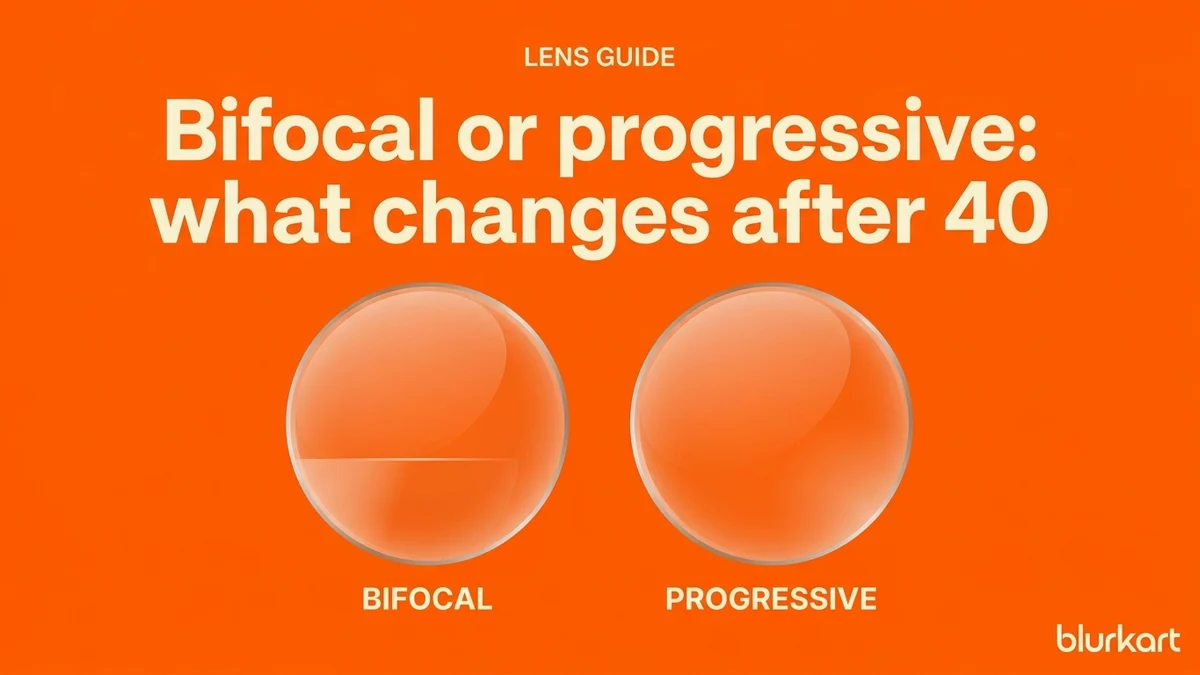
After 40, the lens inside your eye stiffens and stops focusing close. That is presbyopia, it happens to everyone, and the choice it forces is bifocal or progressive. The short answer is that a progressive is the better lens for most people now, and a bifocal still has two legitimate uses.
What a bifocal is
Two prescriptions in one lens with a hard boundary between them. Distance above, reading below, and a visible line where they meet, usually a half-moon or a straight segment.
Two consequences follow from that hard boundary. The line is visible to other people, which some wearers dislike and others do not care about. And your vision jumps as your eye crosses it: an object at the boundary appears to shift position. Long-time bifocal wearers stop noticing. New wearers find it disconcerting, especially on stairs.
The bigger practical problem is what is missing. A bifocal has far and near and nothing in between. The computer sits in between. So does the dashboard, the person across a meeting table, and the shelf you are reaching for.
What a progressive is
One lens with a gradual change in power from top to bottom: distance at the top, intermediate through the middle, reading at the bottom, with no line and no jump.
The trade-off is the corridor. The clear path down the lens is a channel rather than the full width, with some soft distortion to either side. How wide that channel is depends on the lens design, which is exactly what you pay for.
Our three tiers:
| Tier | Corridor | Price | Who it suits |
|---|---|---|---|
| Generic | Small | NPR 1,900 | Light use, tight budget, first try |
| Budget | Wide | NPR 3,400 | Daily wear, office plus driving |
| Premium | Large | NPR 5,500 | All-day screens, or a previous failed attempt |
The adaptation week, honestly
Three to seven days for most people. The first two days you will over-turn your head, misjudge the bottom step and feel slight swim at the edges when you move quickly.
The rule that decides success: wear them full time from day one. People who switch back to their old glasses when it feels awkward take weeks instead of days, because the brain never gets a clear run at learning the lens.
Look through the bottom of the lens to read by dropping your eyes, not your head. Turn your head toward what you want to see rather than looking out of the corner. Both become automatic within a week.
Bifocal vs progressive: who should still choose a bifocal
Two groups. People who have worn bifocals for twenty years, are happy, and have no interest in relearning anything. And people who need a very wide, unrestricted reading area for detailed close work, such as tailoring or fine repair, where a progressive corridor feels confining.
For everyone else, especially anyone who uses a computer, the progressive wins because it has the middle distance.
The frame matters more than people expect
A progressive needs vertical room. The reading zone sits at the bottom, and if the lens is too shallow there is nowhere to put it. About 30 mm of lens height is the working minimum.
That rules out very shallow fashionable shapes. We will tell you before you buy rather than after, and steer you to something like the Premium Rectangle Frame at NPR 1,500 which carries the lens comfortably. Our guide to frame measurements explains why height is the number not printed on the temple.
Bifocal ki progressive: what customers ask
"Line dekhinchha bhanne dar chha." Only bifocals have a line. Progressives have none at all, and that is the most common reason people switch.
"Adjust huna gah ro hunchha re?" Three to seven days if you wear them full time. The wider the corridor, the faster.
"Sasto progressive kinda pugchha?" The NPR 1,900 lens works, with more head movement. If you can stretch to NPR 3,400, adaptation is easier and daily use is more comfortable. We would rather you knew that than felt sold to.
"Computer ma progressive thik chha?" Workable but narrow in the middle. If you sit at a screen all day, ask about an office lens as well, which we covered in glasses for developers.
What to do
Book the free test at either Lalitpur showroom and say what your days look like: driving, screens, reading, workshop. The lens follows from that rather than from the price list. If your near work is almost entirely a phone, reading glasses for phones after 40 covers the simpler option. And if you try a progressive and truly cannot adapt after a fair attempt, come back within the month and we will work it out with you.
Not sure which your eyes actually need? Book a free eye test at either showroom and we will measure the reading addition before you commit to a lens.
If you are working this out on behalf of a parent rather than for yourself, choosing glasses for an older parent covers the things that decide daily wear at that age: weight, grip and glare, none of which are what a shop display is arranged around.
Frequently asked
- Are bifocals cheaper than progressives?
- Slightly, but our budget progressive at NPR 3,400 is close to the price of a good bifocal and does more. Price alone is rarely a good reason to pick a bifocal now.
- Why do some people never adapt to progressives?
- Usually a narrow corridor lens in a frame that is too small, or a pupillary distance measured wrongly. Both are correctable. Come back within the first month and we recheck.
- Can I use progressives at a computer all day?
- You can, but the intermediate zone is narrow. For desk-dominant work an office lens with a much wider mid zone is usually better, with a progressive for everything else.
- Bifocal ra progressive ma ke farak?
- A bifocal has a visible line and jumps suddenly between far and near, with no middle distance. A progressive blends all three with no line. Most people today are better served by a progressive.
- Chalis barsa pachhi kasto lens chahinchha?
- Najik herna garho bhayo bhane reading power thapinchha. Bifocal ma euta rekha dekhinchha, progressive ma dekhindaina. Duitai ko price ra farak hamile counter ma dekhai dinchhau.