
Rimless, half-rim or full-rim glasses?
Full-rim is the toughest, the easiest to repair and the best at hiding a thick lens edge, which makes it the default for strong prescriptions. Half-rim is lighter and shows more of your face. Rimless is the lightest and most discreet but the most fragile, and it suits mild prescriptions and careful owners.
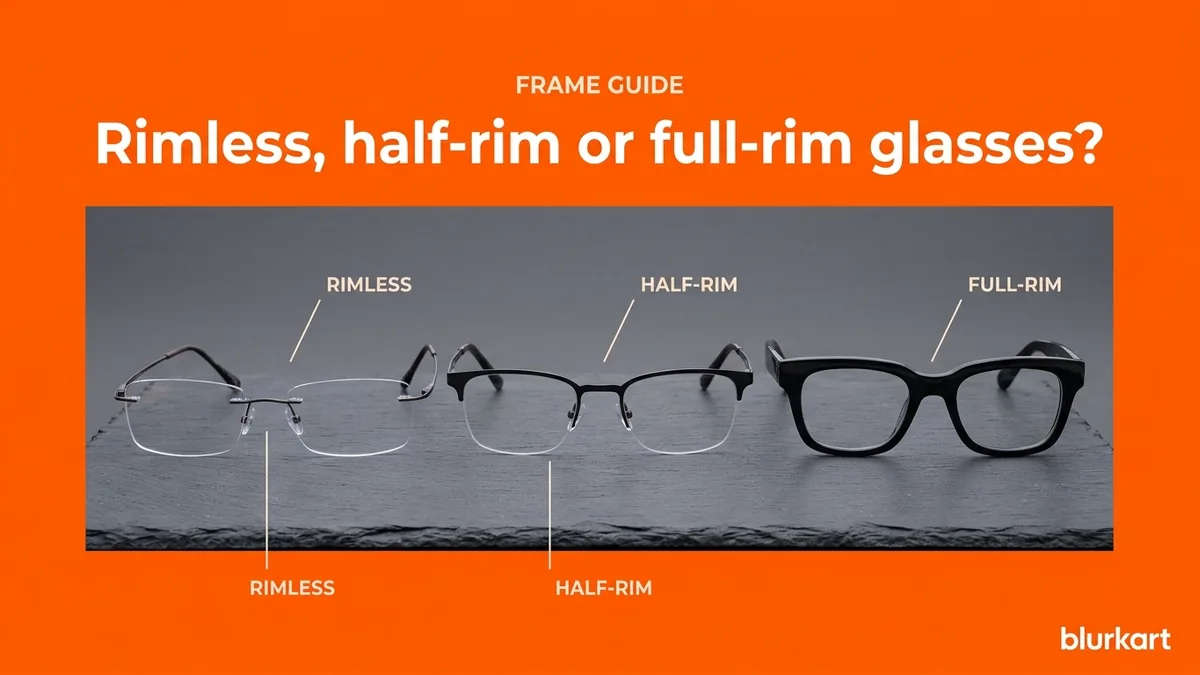
Choosing between rimless, half-rim or full-rim is usually treated as a style question. It is partly that, but it also decides how tough the frame is, how thick your lens looks and whether a repair is even possible.
Full-rim: the default for good reasons
The lens sits in a groove that runs all the way round, so the frame carries the stress rather than the lens. That makes full-rim the strongest of the three by a clear margin and the easiest to repair, since a hinge or an arm can be replaced without touching the lens.
It also has an optical advantage people rarely mention. A strong minus prescription produces a lens that is thick at the edge, and a thick rim hides exactly that edge. If your power is past about minus 4, this is the single easiest thing you can do to make the pair look better. High index lenses handle the other half of that problem.
The trade is visual weight. A thick acetate rim is a statement on your face, which some people want and some do not.
Half-rim: lighter without the fragility
Half-rim frames, sometimes called supra, hold the top of the lens in a metal or acetate brow and run a fine nylon cord along a groove cut into the bottom edge. Your face shows through the lower half, so they read lighter than full-rim while keeping a solid top bar.
They sit in the middle for durability. The nylon cord can perish or snap after a few years, which is a cheap fix, but the lens groove means re-lensing is fussier than full-rim.
They suit people who want something less heavy than acetate but are not careful enough for rimless, and they carry a moderate prescription without drawing attention to the lens.
Rimless: the lightest and the most breakable
Rimless frames have no rim at all. Two small screws pass through holes drilled in each lens and attach it to the bridge and the temple arm. The result is very light, very discreet, and genuinely elegant on the right face.
It is also the design where all the stress lands on two small holes in a piece of plastic. Drop them, sit on them or push them into a bag without a case and they crack at exactly those points. A cracked lens on a rimless frame is a new lens, not a repair.
Rimless works well with a mild prescription, because the lens is thin and even all the way round, and works badly with a strong one, because there is nothing to hide the edge. If you are hard on glasses, this is the wrong choice regardless of how it looks.
What we would put you in
A child: full-rim, in polycarbonate, no exceptions. A motorbike rider: full-rim with thin temple arms so it sits under a helmet, which the helmet guide covers. A desk worker with a mild power who wants something quiet: rimless or half-rim, both fine. A strong prescription: full-rim in a smaller shape, every time.
One practical point about repairs
Adjustments are free at both our showrooms on any frame, including ones bought elsewhere. But there is more that can be adjusted on a full-rim frame than on a rimless one, where bending anything risks the lens. If you like a frame you can keep fettling for years, that points to full-rim too.
Come and hold all three against your face, which tells you more in two minutes than any article. The eye test is free, and prescription frames start at NPR 999.
Rimless, half-rim or full-rim: how to decide in the shop
Pick up all three and do the same two things with each. Hold the frame by one arm and feel the weight, then put it on and turn your head quickly from side to side. A frame that shifts on your face when you turn will shift all day, whatever the rim style.
Then think honestly about where the glasses live when they are not on your face. If the answer is a case, every option is open. If the answer is a jacket pocket, a bag, or the top of your head, that rules rimless out and probably points to full-rim.
Nobody regrets a full-rim frame on durability. Some people regret rimless, and it is always for the same reason.
Frequently asked
- Are rimless glasses fragile?
- More fragile than the alternatives, yes. Each lens is held by screws through drilled holes, and that is where stress concentrates. They are fine for careful daily wear and a poor choice for sport, children or a bag without a case.
- Which rim style is best for a strong prescription?
- Full-rim, in a smaller lens shape. A thick rim conceals the thick lens edge that a strong minus power produces, while rimless puts that edge on full display.
- Rimless chasma tikchha ki tikdaina?
- Bistarai chalayo bhane tikchha, tara full-rim jati majbut hundaina. Screw halne thaun ma chirinchha. Bachcha, bike chalaune ra khelkud garnelai full-rim nai thik.