
Why glasses leave marks on your nose
Marks on your nose mean the frame's weight is landing on too small an area, usually because the nose pads are set wrong, the frame is too wide, or the lenses are heavy. Adjusting the pads is free and fixes most cases. Thinner lenses and a lighter frame fix the rest.
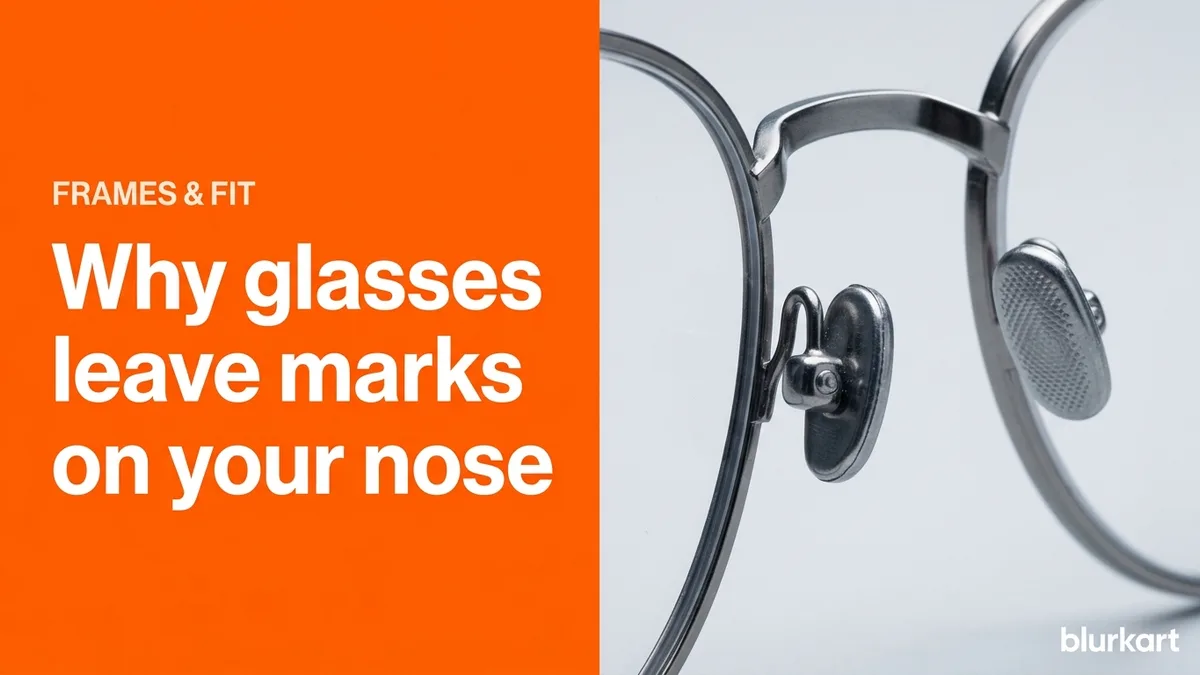
Two red dents either side of the bridge, and sometimes a patch of darker skin after a few years. Glasses leave marks on your nose because of how the weight is distributed, and almost every case is fixable at the counter for nothing.
Why glasses leave marks on your nose in the first place
A pair of glasses weighs between about 20 and 45 grams. That is not much, but it rests on two small patches of skin over cartilage, for twelve hours a day, every day. Pressure is weight divided by area, so the smaller the contact patch, the deeper the mark.
That gives you the actual diagnosis. Marks mean the contact area is too small or in the wrong place, not that the frame is too tight. Which is why loosening a frame usually fails: it slides lower, lands on a narrower part of the bridge, and concentrates the same weight on less skin.
The four causes, in the order we see them
Nose pads set wrong. On a metal frame with adjustable pads, the pads should sit flat against the skin along their whole length. When they are angled, only one edge touches and all the weight goes through that edge. This is the commonest cause and it takes two minutes with a pair of pliers.
A frame too wide for your face. If the frame is wider than your temples, nothing holds it up at the sides, so it walks down your nose until it wedges. Then it presses. The numbers printed inside the temple arm tell you whether the frame fits, and the 52-18-140 guide explains them.
The wrong bridge shape. A saddle bridge spreads weight along the whole top of the nose. A keyhole bridge perches on the sides. Pads concentrate it on two points. A low or flat bridge, which is common across South Asia, often does badly with a standard saddle designed for a higher one. The bridge guide covers which suits which.
Heavy lenses. A strong prescription in standard plastic is thick and heavy, and all of that weight ends up on your nose. A high index lens in the same power weighs meaningfully less.
What to do about it
Start with the free option. Bring the pair to either showroom and we will adjust the pads, level the frame and check the temple length. We do this on any frame, including ones bought elsewhere, and we do not charge. A surprising share of nose-mark complaints end here.
If the pads are worn hard and yellowed, we replace them, also free. Silicone pads with a larger surface area spread the load better than the small hard ones some frames ship with.
If the frame genuinely does not fit your face, no adjustment will save it, and we will tell you that rather than keep bending it. And if the lenses are the problem, thinning them is the fix. High index lenses are lighter as well as thinner.
Habits that help
Take glasses off with both hands rather than pulling from one arm, which slowly twists the frame so it sits unevenly and presses harder on one side. Clean the pads when you clean the lenses, because skin oil and dust build into a crust that is abrasive. And give your nose an hour off in the evening if you can.
If the marks have been there for years and the skin has darkened, that fades slowly once the pressure is corrected. Worth getting the fit sorted sooner rather than later. Walk into Pulchowk or Boudha any day Sunday to Friday, or browse frames from NPR 999 if it turns out the frame is simply the wrong size.
When the marks are telling you something else
Two situations are worth flagging rather than adjusting. If the marks appear on only one side, the frame is sitting unevenly, usually because one arm has been bent further than the other over time. That also means you are looking through your lenses at different heights, which causes eye strain nobody connects to the frame.
If the skin is genuinely broken rather than indented, stop wearing that pair until it is refitted. Broken skin over the bridge can become infected, and in a hot Kathmandu summer that happens faster than people expect.
Neither takes long to sort. Both showrooms adjust free, on any frame, and it is the sort of thing we would rather see early than after three months of putting up with it.
Frequently asked
- Are dents on the nose from glasses permanent?
- The indentation fades within an hour or two of taking them off. Long-term darkening of the skin can take much longer to settle, which is a reason to fix the fit rather than tolerate it.
- Will looser glasses stop the marks?
- Usually not, and often it makes things worse. A looser frame slides down, then rests on a narrower part of your nose, concentrating the same weight on less skin. The answer is better distribution, not less grip.
- Chasma le nakh ma dabbar banauchha, ke garne?
- Nose pad milaunu parne ho, chasma kasieko bhanera hoina. Duitai showroom ma nihsulka milai dinchhau, jahaan kineko bhaye pani. Lens gahrau chha bhane patlo high index lens le pani farak pardachha.