
High index lenses: how to make a strong prescription look thin
High index lenses bend light more strongly, so the same prescription needs less material and the edges come out thinner. Below about minus 3 the difference is barely visible. Between minus 4 and minus 6, 1.61 or 1.67 makes an obvious difference.
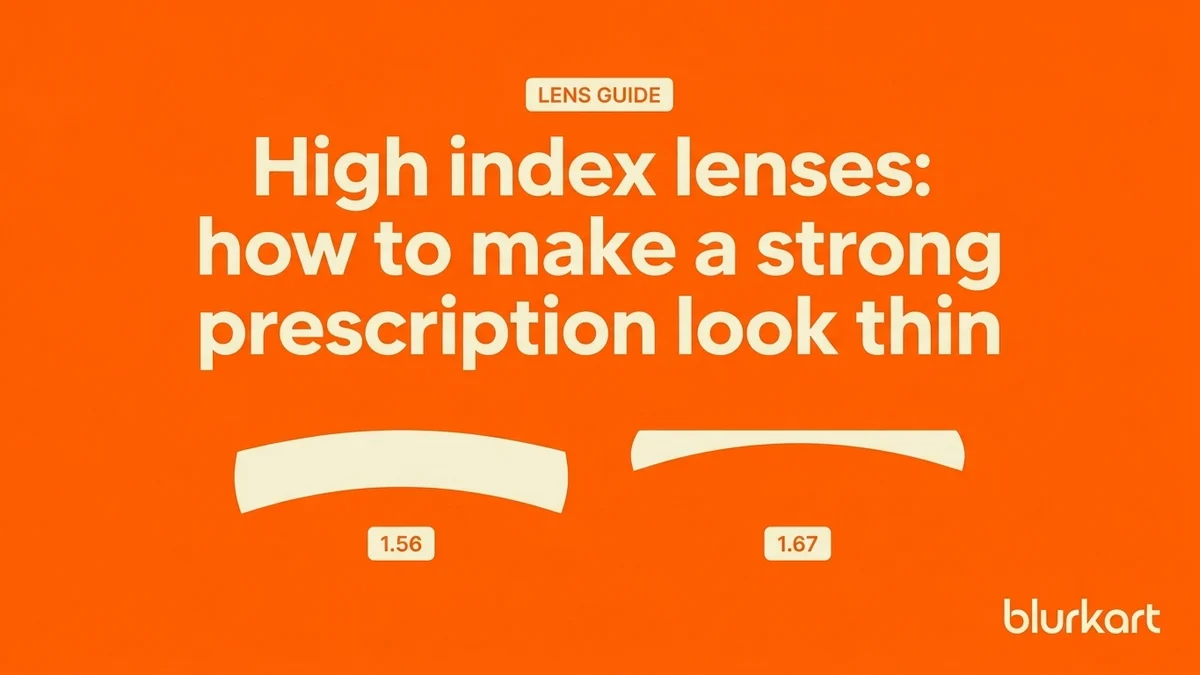
High index lenses make a strong prescription look thinner by bending light more per millimetre of material, so less material is needed. The number, 1.56 through 1.74, is the refractive index: how strongly the material bends light. Higher number, thinner lens, higher price.
Whether you need one depends almost entirely on your power, and partly on the frame you want.
High index lenses: what the numbers mean in practice
Standard plastic is 1.50, and most basic lenses today are 1.56. Polycarbonate sits around 1.59 and is impact resistant, which is why we use it for children. Then 1.61, 1.67 and 1.74 are the steps people mean by high index.
Rough guidance from the counter:
- Up to minus 3: 1.56 is fine. The edges are already slim and you will not see the difference.
- Minus 3 to minus 5: 1.61 starts to show, especially in a larger frame.
- Minus 5 to minus 7: 1.67 is where most people are happy. Moving from 1.56 to 1.67 at minus 5 cuts edge thickness by roughly a third.
- Above minus 7: 1.74 if you want the edges to look normal, and a small frame regardless.
The frame does more than the lens
This surprises people. A lens gets thicker the further it extends from its optical centre, so the width and height of the lens opening drive edge thickness as much as the material does.
Two practical consequences. A smaller lens area in a full-rim frame can beat an entire index upgrade for appearance, and it costs nothing extra. And a large, wide frame at minus 6 will look thick no matter what you spend.
Full-rim frames also hide the edge inside the rim. Rimless exposes the whole edge to view, which is why rimless at a strong power almost always needs a higher index. Our guide to frame materials covers which rim types hold a thick lens securely.
For strong prescriptions we usually pull something like the Premium Rectangle Frame at NPR 1,200, which has a modest lens area and a full rim.
The trade-offs nobody mentions
Higher index materials reflect more light at the surface. A 1.74 lens without an anti-reflective coating shows noticeably more surface glare than a 1.56 lens without one. In practice this means an anti-reflective coating stops being optional above 1.61, which is a real added cost to factor in. We made the case for it in is an anti-reflective coating worth the extra NPR.
Very high index materials also disperse colour slightly more, and a small number of wearers notice faint colour fringing toward the lens edges. Most never see it.
And higher index is not more scratch resistant. It usually needs a hard coat, which good lenses include.
Plus powers behave differently
If your prescription is a plus number, the lens is thick in the centre and thin at the edge, the opposite of short sight. High index still helps, but so does a smaller frame, and the visual effect people dislike is magnification of the eyes rather than a thick rim. A slightly smaller lens area and a proper anti-reflective coating both reduce that.
Motto power ko chasma: what customers ask
"Mero power dherai chha, chasma motto dekhinchha ni?" Not necessarily. A higher index lens with a smaller full-rim frame makes a minus 6 look close to ordinary. We will show you sample lenses in your power so you can see the difference rather than take our word.
"Kun index kinne?" Tell us the power and the frame you like, and we will name the index that suits both. Buying the highest index by default is a common way to overspend.
"Patlo lens kamjor hunchha?" No. Thin does not mean fragile. For children and sports we still prefer polycarbonate for impact resistance rather than the thinnest option.
"Kati mahango parchha?" It depends on the power and index, so we quote after seeing the prescription. The frame price is unchanged; only the lens moves.
What to bring
Your prescription, and the frame you are hoping to wear if you already own it. Those two things together decide the index. If a heavier lens has been dragging your frame down your nose, the bridge fix is the other half of the answer. Send the prescription photo ahead and we will tell you what it needs before you travel, or come in for the free test and we will measure and advise in one visit.
Whether a high index lens is worth it depends on your exact power. Bring your slip in, or book a free eye test, and we will tell you at the counter rather than after you have paid.
Frequently asked
- Do high index lenses affect vision quality?
- They are optically excellent, but very high index materials disperse colour slightly more, which a few sensitive wearers notice as faint colour fringing at the edges. It is rarely a problem in practice.
- Is high index worth it for a weak prescription?
- Usually not. Under about minus 3 the lens is already thin, and the money is better spent on a good anti-reflective coating.
- Does the frame really matter more than the lens?
- Often yes. Edge thickness grows with how far the lens extends from its centre, so a smaller full-rim frame can do more for appearance than paying for the next index up.
- Motto power ko chasma patlo banauna sakinchha?
- Yes. A higher index lens plus a smaller full-rim frame is how we make a strong prescription look normal. Bring your prescription and we will show you the thickness difference on sample lenses before you choose.