
Early cataract signs people mistake for dirty glasses
Early cataract looks like a lens problem: a haze that cleaning never fixes, halos and starbursts around headlights at night, colours looking washed out or yellowed, and a prescription that keeps changing. If new glasses stop helping for long, the lens inside your eye is the cause, not the lens in your frame.
The early signs of cataract look exactly like a lens problem, which is why so many people spend a year cleaning their glasses instead of getting tested. A cataract is the clouding of the lens inside your eye. Light passes through it before it ever reaches the lens in your frame, so the symptoms feel like dirty or wrong glasses.
Four things to watch for.
Early cataract signs, part one: haze that cleaning never fixes
The classic. You clean both sides of both lenses properly, with water and soap rather than a shirt hem, and the world still has a faint film over it. Then you clean them again an hour later.
If our routine in how to clean glasses without scratching them gives you a perfectly clear lens and the view is still hazy, the haze is not on your glasses.
Two: halos and starbursts at night
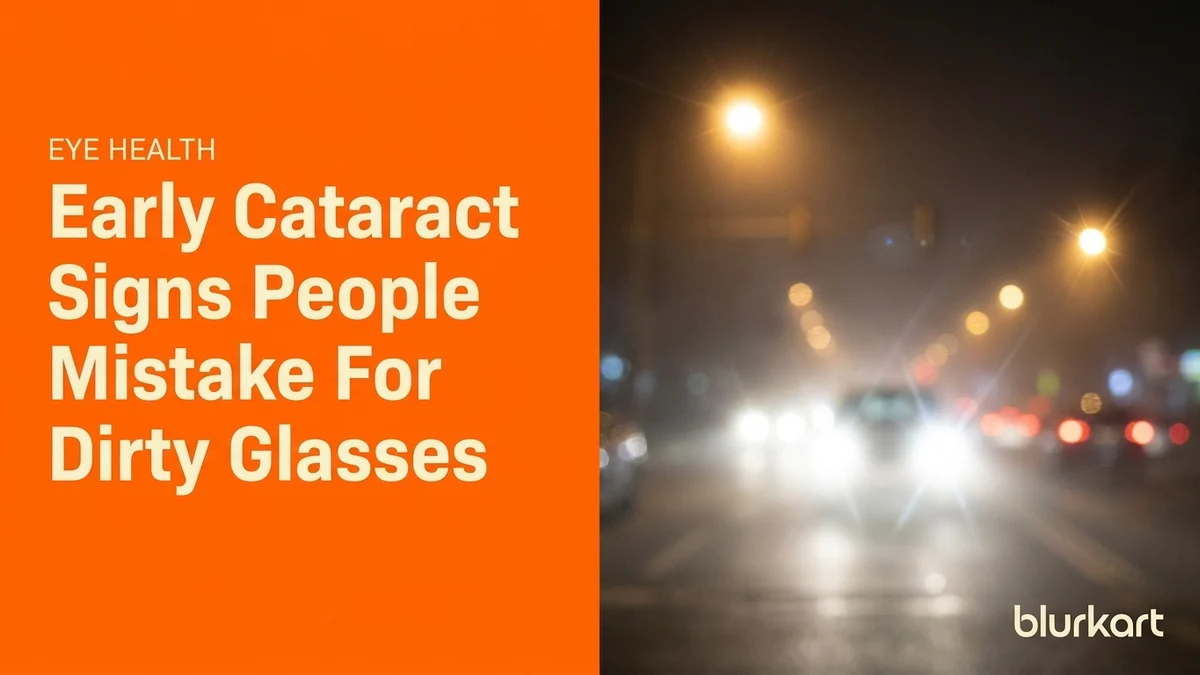
Oncoming headlights on the Ring Road grow rings, or sprout spikes. Street lamps smear. Night driving becomes tiring in a way it never used to be.
A clouding lens scatters light rather than focusing it cleanly, and scattered light around a bright point is what a halo is. An uncoated spectacle lens does something similar, which is the confusing part, so this symptom is only meaningful once you know your glasses have a good anti-reflective coating. If they do not, read the case for an anti-reflective coating first and rule that out.
Three: colours quietly fade
A cataract usually yellows as it clouds, so blues dull first and everything warms slightly. It happens over years, so almost nobody notices on their own.
People discover it after surgery on the first eye, when they cover one eye and then the other and find that the treated side is noticeably bluer and brighter. Until then, the brain simply accepts the slow change as normal.
Four: the prescription keeps changing
A stable adult prescription drifts slowly. If you are in your sixties and needing a new power every few months, and each new pair works well for a while and then does not, that pattern points at the lens inside the eye changing rather than your eye growing.
There is a specific version of this worth knowing: some people become temporarily more short-sighted as a cataract develops, and suddenly find they can read without their reading glasses again. It gets called second sight, it feels like good news, and it is usually the opposite.
Why this matters more in Nepal
Cumulative ultraviolet exposure is one of the contributing factors, and Kathmandu sits at 1,400 metres under some of the clearest winter skies anywhere. People who work outdoors here accumulate a lot of it, as we covered in why Kathmandu winter sun is stronger than you think.
The protective part is simple and cheap: a genuine UV400 lens worn on bright days. Any real UV400 pair does it, including our Stella at NPR 999. Prevention is worth far more than any lens upgrade after the fact.
Motibindu: what people ask us
"Chasma phereko chhu tara ramro dekhindaina, kina?" If a new correct prescription stops helping within a few months, the cataract is doing the work, not the glasses.
"Operation garnu parchha?" Eventually, and it is a short routine operation done in a day at eye hospitals across Nepal. It is not something to be frightened of, and it is not urgent in the early stage.
"Kahile garne?" When it interferes with what you need to do, especially driving at night or reading. Your eye doctor decides the timing with you.
"Chasma le rokchha?" Glasses do not slow a cataract. UV400 sunglasses may reduce the contribution from sunlight over years, which is worth doing from now regardless of age.
What to do next
Get a free eye test at either Lalitpur showroom. We check the power, look at the lens and the front of the eye, and tell you plainly whether what you are seeing is the glasses or something we should refer onward. If it is the glasses, we fix it that day, often with new lenses in your existing frame or a light pair like the Premium Rectangle Frame at NPR 1,200.
If it is not the glasses, you will know that too, which is the whole point of testing rather than guessing. For the related night-time complaint, see prescription sunglasses in Nepal.
Frequently asked
- Can new glasses fix a cataract?
- Only briefly. A change in prescription can sharpen things for a few months as the lens inside the eye changes, but it does not treat the cataract. When new glasses stop helping for long, that is the signal.
- At what age do cataracts start?
- Most commonly after 60, though sun exposure, diabetes and some medicines bring it earlier. High-altitude sunlight makes it more common in Nepal than in many countries.
- Does an optician treat cataracts?
- No. We can spot the signs during a routine eye test and refer you to an eye hospital. Treatment is a short operation replacing the clouded lens.
- Motibindu ko suruwati lakshan ke ho?
- Haze that does not clear when you clean your glasses, halos around lights at night, colours looking faded, and a prescription that keeps changing. A free eye test can tell you whether it is the cataract or just the glasses.