
Two pairs of glasses or one good pair?
If your prescription is strong, spend it on one good pair with a thin lens and a proper coating, because a cheap thick spare will sit in a drawer. If your power is mild, two pairs is usually the better use of the same money, because a spare covers the week your main pair is being repaired.
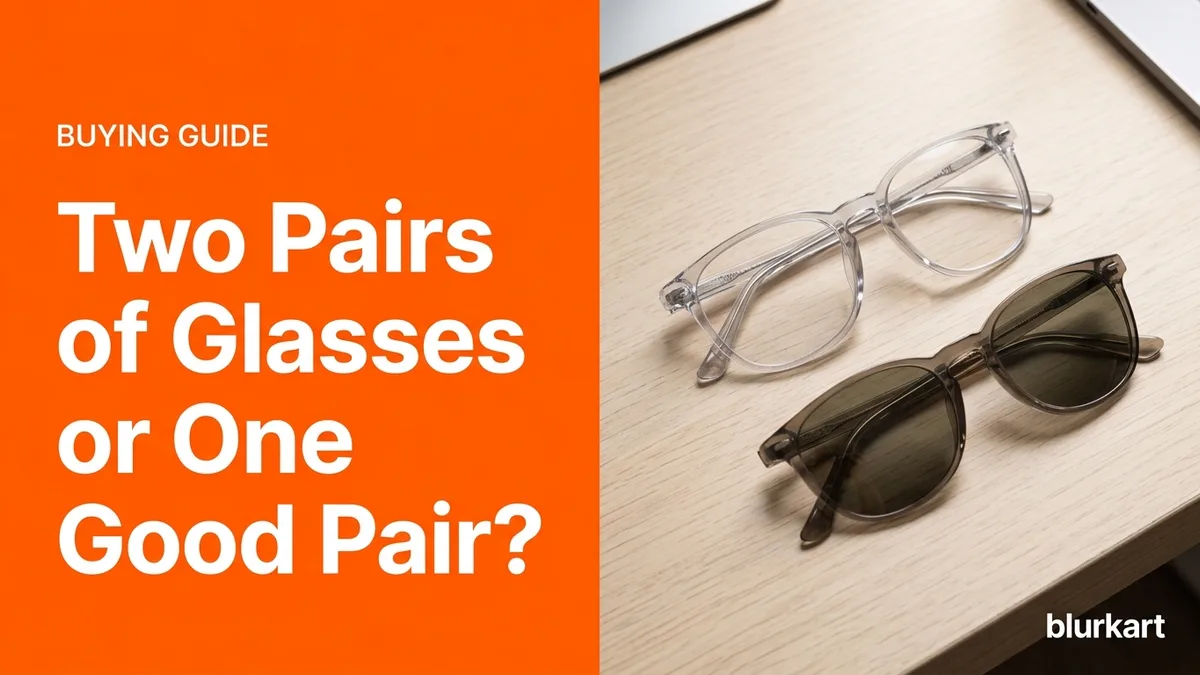
Someone walks in with a rough budget of NPR 5,000 and the same question: two pairs of glasses, or one better one? The answer genuinely depends on your prescription, and a shop that gives the same answer to everyone is selling rather than advising.
If your prescription is strong, buy one good pair
Past about minus 4, lens thickness becomes the thing you notice. A standard lens in a strong power is thick at the edge, heavy on your nose, and makes your eyes look smaller from the side. A high index lens fixes that, and it costs more.
Split the same budget across two pairs in a strong power and you get two thick, heavy pairs. In practice you wear one and the other lives in a drawer, which means you paid for a spare you will not use. Put the whole budget into one pair with a thinner lens and a proper multi-coated anti-reflective at NPR 1,800, and you get something you actually keep on your face all day. The high index guide covers where the thresholds fall.
If your prescription is mild, two pairs usually wins
Under about minus 2, the difference between a standard lens and a premium one is small enough that most people cannot tell it apart on the street. That changes the maths completely.
A complete pair here starts at NPR 1,749, a NPR 999 frame plus a NPR 750 single vision lens. Two of those is NPR 3,498, and you have covered the scenario that actually ruins people's weeks: your only pair breaks, and you cannot drive, work or read until it is fixed.
When two pairs of glasses earn their place
A second pair is only insurance if it is somewhere else. In the same bag as your main pair, both get sat on together. Keep the spare at your desk, in the car, or at home in a drawer that is not the bedside one.
The most useful second pair for most people in Nepal is not a duplicate at all. It is prescription sunglasses. If you drive, ride, or spend the middle of the day outside, you are choosing between seeing clearly and not squinting, and a tinted prescription lens ends that. Our guide to prescription sunglasses walks through the options.
The second most useful is a dedicated screen pair for anyone at a desk all day, especially if you are over 40 and your reading add is starting to fight with your distance power. What actually helps after ten hours of code goes into that.
Where not to save money
Two places, and they are the same two every time.
The first is the coating on the pair you wear most. Anti-reflective is the layer that decides whether headlights smear at night and whether your eyes ache under office tubes. It is the cheapest upgrade with the most noticeable effect.
The second is UV on anything tinted. A dark lens with no UV filter opens your pupil and lets more ultraviolet in than bare eyes would. That is not a cheap pair of sunglasses, it is a harmful one, and we will test any pair free on a UV meter at either showroom.
A simple rule
Under minus 2, buy two. Over minus 4, buy one good one and save for the second. In between, buy the good pair now and add prescription sunglasses when you can, because that is the pair you will notice most in Kathmandu daylight.
Whatever you decide, the eye test is free at both showrooms and carries no obligation. Start with eyeglasses from NPR 999 or the sunglasses range and we will price both options honestly so you can see the difference.
The pair most people forget to count
If you already wear contact lenses, you are not choosing between one and two. You need glasses regardless. Every lens wearer has days with a dusty commute, a cold, or an eye that is simply unhappy, and those are the days you cannot put a lens in. A pair of glasses sitting at home is not a luxury purchase for a contact lens wearer, it is the fallback that stops a minor irritation becoming a day off work.
Frequently asked
- Is it worth having a spare pair of glasses?
- For anyone who cannot drive, work or read without glasses, yes. The cost of a spare is small next to a week of not being able to see properly while your main pair is repaired.
- Can I use an old prescription for the spare?
- Only if it is recent and your vision has not changed. An out-of-date spare gives you headaches at exactly the moment you are relying on it, which defeats the point.
- Duita sasto ki euta ramro chasma?
- Power dherai chha bhane euta ramro pair kinnu, kinabhane sasto motto lens lagaunu hunna. Power kam chha bhane duita pair nai baddhi kaam lagchha, euta spare rakhda dukha hunna.