
Prescription sunglasses in Nepal: your power in a tinted lens
There are four routes: tinted prescription lenses in a sunglass frame, photochromic lenses that darken outdoors, clip-on shades over your normal glasses, or contact lenses with any ordinary sunglasses. Tinted prescription lenses look and work best. Strong powers above about minus 6 do not sit well in heavily curved wraparound frames.
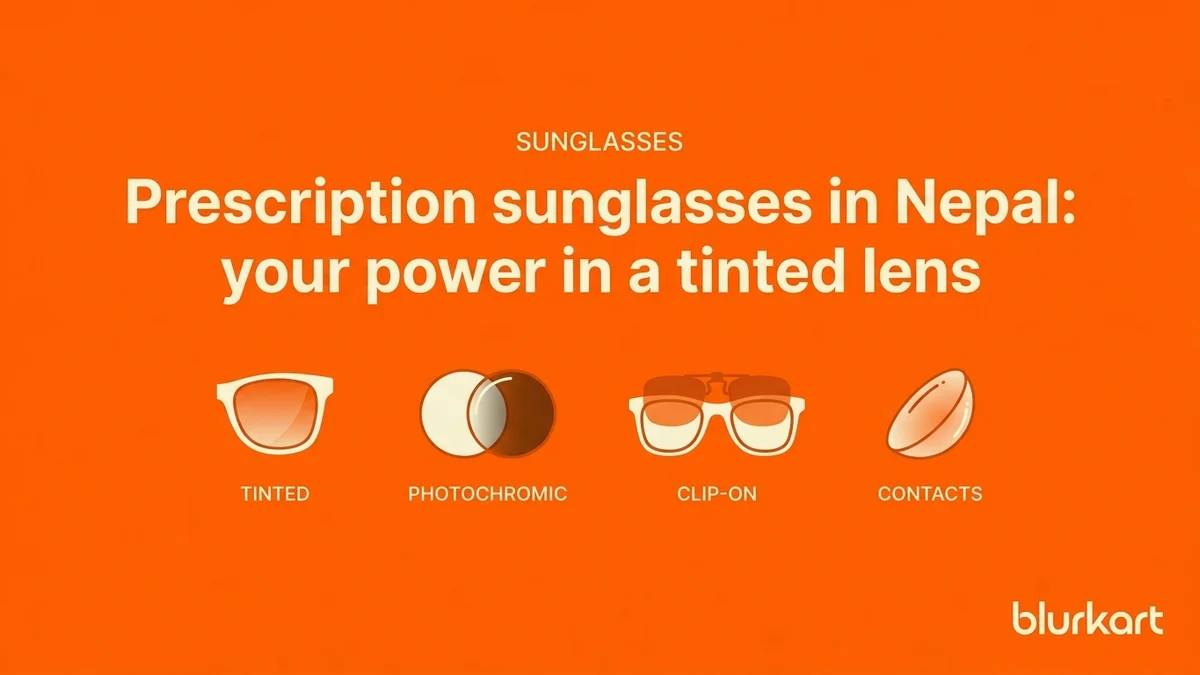
Prescription sunglasses can be made four different ways, and the right one depends on how much sun you are actually in. Tinted prescription lenses in a sunglass frame look and work best. Photochromic lenses are the one-pair compromise. Clip-ons are the budget route. Contacts plus any ordinary shades is the most flexible.
Here is what each costs you in money, convenience and quality.
Prescription sunglasses option one: tinted lenses
Your power, ground into a lens that is then tinted, fitted to a sunglass frame. This is the proper answer. The optics are correct edge to edge, the tint is even, and nobody can tell they are prescription.
You choose the tint depth and colour. Grey keeps colours true and suits general use. Brown lifts contrast and is good for driving and hills. Green sits between them.
Polarisation can be added and is worth it for wet roads and water glare, with the phone screen caveat we explained in what the UV400 and polarised stickers mean.
The limitation is frame curve. A heavily wrapped sport frame bends the lens so much that strong prescriptions distort toward the edges. Above roughly minus 6 we steer people to a flatter frame like the Unisex Wayfarer at NPR 1,800 rather than a wrap.
Option two: photochromic lenses
One clear pair that darkens outdoors. Convenient, no swapping, full UV protection indoors and out.
Two honest limits. They stay close to clear behind a car windscreen, because the trigger is ultraviolet and glass blocks it. And they rarely go as dark as a real sunglass lens. Both are covered in photochromic lenses in Kathmandu.
Good for people on foot all day. Poor for drivers who wanted dark lenses.
Option three: clip-ons
A tinted clip that attaches over your normal glasses, magnetic or hooked. Cheapest by a distance, and genuinely useful if you only need sun protection occasionally.
They look like what they are, they can rattle, and the optical quality of the clip layer is rarely as good as a proper lens. For a walk to the shop, fine. For a day in the hills, not really.
Option four: contact lenses plus any sunglasses
Put the correction on your eye and wear whatever shades you like, including wraparound sport frames that could never take your prescription. This is what most trekkers and footballers end up doing.
It also means a cheap pair being lost on a trail is not a disaster. A daily lens like the SEED 1dayPure pack at NPR 3,900 plus a UV400 pair is a common trekking combination, and our post on trekking sunglasses explains why coverage matters more than tint up there.
Which we would pick
If you drive a lot or are outdoors daily: tinted prescription sunglasses as a second pair. It is the only option that is genuinely dark when you need it.
If you walk between buildings all day and hate carrying two pairs: photochromic.
If sun is occasional: clip-ons, and spend the saved money on a better everyday lens coating.
If you trek, ride or play sport: contacts plus a wraparound UV400 pair such as the Maverick Aviator at NPR 6,500.
Power ko sunglass: what customers ask
"Sunglass ma power halna milchha?" Yes, in almost any flat or lightly curved frame. Bring the frame or choose one here.
"Kati din lagchha?" About a week for a standard tint. Order two weeks before a trek or a flight.
"Progressive ma pani milchha?" Yes. Progressive tinted sunglasses are common for people over 40 who drive. The frame needs enough lens height, which we check before ordering.
"Gradient tint ke ho?" Dark at the top, lighter at the bottom, so you can still read a dashboard. It suits driving well.
"Sasto banaune upaya?" Clip-ons, or contacts with an inexpensive UV400 pair like the Navigator Round Aviator at NPR 1,800.
Tint colours, and what each is for
The tint is a separate decision from the power, and most people pick it in ten seconds without knowing what the options do.
Grey keeps colours accurate. It dims everything evenly, which makes it the safe default and the right answer for driving, because traffic lights stay the colour they actually are.
Brown and amber lift contrast by cutting some blue. Edges look crisper and distance looks sharper, which suits hills, trekking and overcast days. The trade-off is a slight colour shift that some people dislike at first.
Green sits between the two, close to neutral with a small contrast gain.
Depth matters as much as colour. Around 75 to 85 percent absorption is the everyday sunglass range. Lighter than that and bright Valley afternoons still make you squint. Much darker and you are into snow and glacier territory.
Before you order
If you are replacing a stall-bought pair, do cheap roadside sunglasses damage your eyes explains what to check first. Bring the prescription, and tell us what you will actually be doing in them. Driving, trekking and walking to work each point at a different answer, and the cheapest correct answer is usually not the most expensive lens. The eye test is free at both Lalitpur showrooms if your prescription is over two years old.
Frequently asked
- Can any sunglasses frame take a prescription?
- Most flat and lightly curved frames can. Heavily curved wraparound sport frames are harder, and above about minus 6 the curve introduces distortion, so we steer strong prescriptions to a flatter frame.
- Are prescription sunglasses cheaper than photochromic?
- Usually similar. Photochromic is one pair doing both jobs; tinted sunglasses are a second pair that does the sun job better. Many people end up with clear glasses plus tinted sunglasses rather than one photochromic pair.
- How long do prescription sunglasses take to make?
- About a week for a standard tint, a little longer for polarised or for a wrap frame. Order two weeks ahead of a trek or a trip.
- Power ko sunglass banauna kati din lagchha?
- About a week for tinted prescription lenses. Bring or send your prescription and pick the frame, and we confirm the exact timing before you pay.