
Why glasses cost different prices in different shops
Two shops quoting different prices for the same frame are usually not selling the same thing. The frame is one line on the bill. The lens, the coating, whether a fitting and PD measurement are included, and what happens if the pair is wrong are the rest, and they are where the money goes.
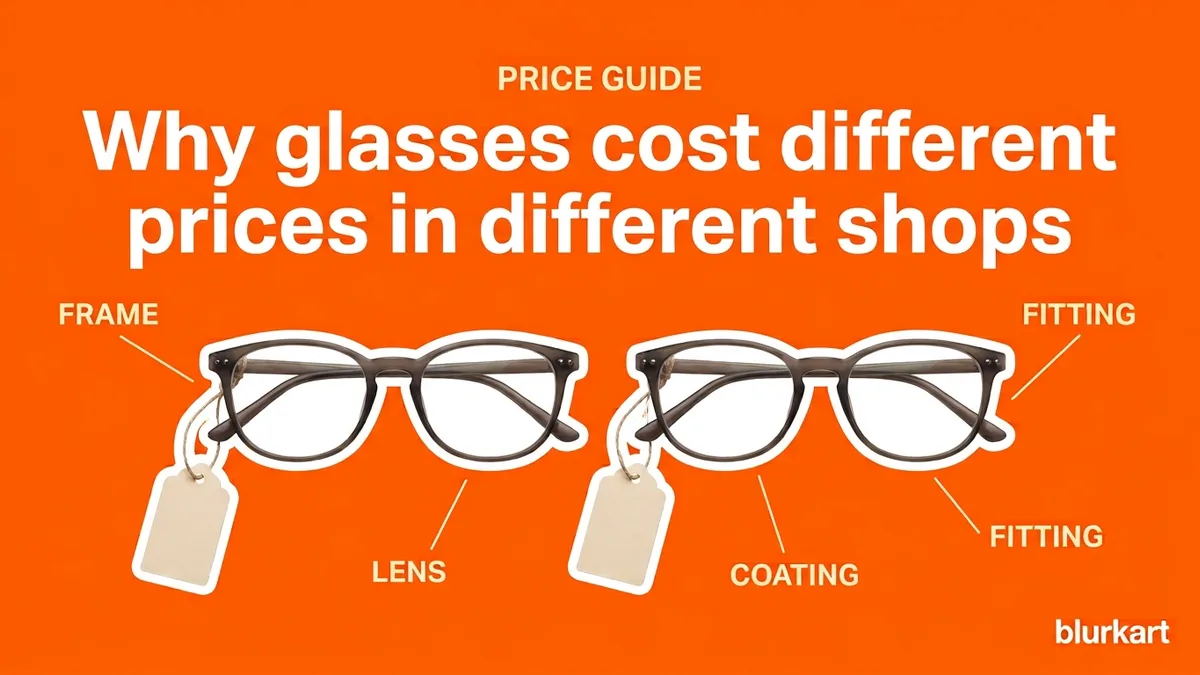
You see a frame in one shop for NPR 2,500 and something that looks identical down the road for NPR 4,000. Glasses cost different prices for reasons that are rarely about anyone ripping you off. You are usually comparing two different products that happen to share a shape.
Why glasses cost different prices: the frame is the smallest part
This is the thing almost nobody is told. When you buy prescription glasses, you are buying two products bolted together, and the one you looked at in the mirror is often the cheaper half.
At Blurkart a frame starts at NPR 999. A single vision lens with a blue coat is NPR 750, the multi-coated version is NPR 1,800, and the fully digital blue filter is NPR 2,990. Progressive lenses run from NPR 1,900 to NPR 5,500 depending on how wide the clear corridor is. So the same NPR 999 frame can leave the shop as a NPR 1,749 pair or a NPR 6,500 pair, and both are honest prices.
When a shop quotes you one number for the whole pair, you cannot see which half the money went to. Ask them to split it.
Five things that actually differ between quotes
The lens index. A standard lens and a high index lens in the same power look very different at the edge. If your prescription is past about minus 4, the thin one costs more and is usually worth it. Our guide on high index lenses explains when it matters.
The coating. "Anti-glare" is not one thing. A single blue coat and a proper multi-coated anti-reflective lens behave differently in night driving and under office lights, and the second costs more because it is more layers. If nobody named the coating in your quote, you do not know what you are getting.
Whether the fitting is included. Measuring your PD, setting the optical centre at the right height, and adjusting the frame to your face is work. Some shops do it and price it in. Some skip it, which is faster and cheaper and produces glasses that give you a headache by four in the afternoon.
What happens afterwards. Adjustments, nose pads and temple tips are free at both our showrooms, forever, including on frames bought elsewhere. Elsewhere that is a charge per visit. Over two years that adds up.
Rent and volume. A shop on a main road in a mall pays more for the floor you are standing on than one down a galli, and that lands in the price. It is not a scam, it is arithmetic.
How to compare properly in three questions
Ask each shop the same three things and the confusion clears up fast.
One: what is the frame price on its own? Two: what lens are you putting in it, what index, and what exactly is the coating called? Three: does the price include measuring my PD and adjusting the frame, and what do you charge for adjustments later?
A shop that answers all three clearly is easy to compare. A shop that will only give you one combined number is asking you to trust it, which is fine if you already do.
When cheap is genuinely fine
Plenty of the time. A mild prescription in a simple full-rim frame with a decent basic coating is a perfectly good pair of glasses, and paying more will not make you see better. Our cheapest complete pair is NPR 1,749 and it does the job.
Where cheap goes wrong is a strong power in a thick lens that you then refuse to wear, or a tinted lens sold as sun protection with no UV filter at all. That second one is not a bargain, it is worse than nothing, and we wrote about why. Most customers here land around NPR 3,300 for a complete pair, which is the point where the lens stops being the compromise. Start with prescription frames and ask us to itemise it.
When the frame genuinely is different
Sometimes two frames that look identical are not. Hinge quality is the usual tell: a spring hinge that flexes outward survives daily handling far better than a plain barrel hinge, and you cannot see the difference in a photo. Acetate that has been properly cured holds its shape in heat, and cheaper plastic does not, which matters in a bag on a motorbike in May. Open and close the arms a few times before you buy. A frame that feels gritty or loose in the shop will not improve.
Frequently asked
- Is a cheaper pair of glasses always worse?
- Not always, but it is usually a different pair. Cheaper normally means a basic uncoated lens, no anti-reflective layer, or a fitting you were not given. Ask what the lens is before deciding the shop is generous.
- What should I compare when getting quotes?
- Four things: the frame price on its own, the lens type and index, the exact coating, and whether fitting and future adjustments are included. If a shop will not split the bill, that is your answer.
- Euta shop ma sasto, arko ma mahango, kina?
- Frame ustai bhaye pani lens ra coating farak hunchha. Blurkart ma frame NPR 999 dekhi ra single vision lens NPR 750 dekhi suru hunchha, ani duitai alag alag bill ma dekhincha.