
Switching From Single Vision to Progressives: What to Expect
Moving from single-vision to progressives adds reading and intermediate vision into one lens, but it also introduces soft side zones you must learn to look around. Expect one to two weeks of adaptation. A wider freeform lens, a frame with enough height, and full-time wear make the switch much easier.
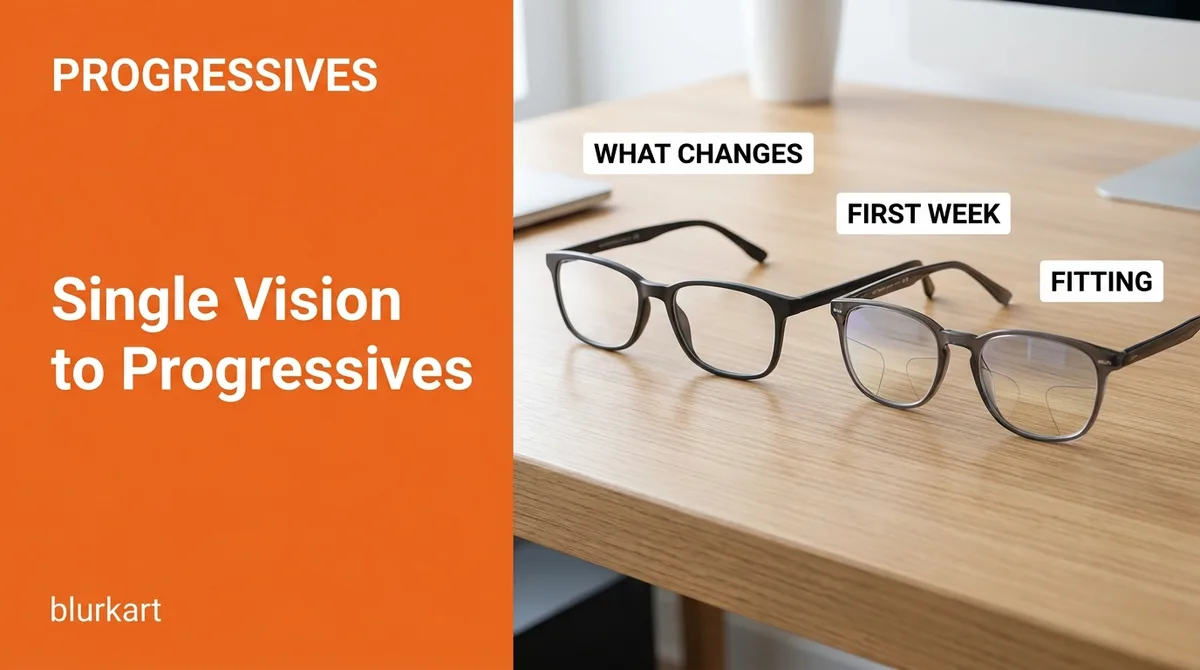
A different kind of new pair
For most of your life, a new pair of glasses meant the same single-vision lens with a tweaked number. Switching to progressives is a bigger step, because you are not just changing strength, you are changing how the whole lens works. Knowing that up front makes the transition far less frustrating.
What actually changes
A single-vision lens has one power across the whole lens. A progressive packs three zones into one surface: distance at the top, intermediate in the middle, near at the bottom. That is a huge gain in convenience, one pair for everything, but it comes with soft, slightly distorted zones at the sides that you must learn to look around.
You are not losing your distance vision. You are adding near and mid-range below it, in exchange for learning where to look.
Why the first pair is the hardest
Your brain has spent years assuming the whole lens is in focus. Progressives break that assumption, so for a week or two you will notice the side blur and the reading zone at the bottom. This settles as your brain learns the new map. People who have worn progressives before adapt to a new pair almost instantly; it is specifically the first switch that takes effort.
Single vision vs progressives
| Single vision | Progressive | |
|---|---|---|
| Powers | One | Distance, intermediate, near |
| Pairs needed | Often two (distance + reading) | One |
| Side vision | Clear across the lens | Soft zones at the edges |
| Adaptation | Minimal | One to two weeks first time |
How to make the switch smooth
- Choose a wider freeform lens for your first pair; it has gentler side zones.
- Pick a frame with enough height, so the reading zone is not cramped.
- Wear them full-time, not just when you remember.
- Point your nose at what you read, and use the bottom of the lens for close work.
- Be careful on stairs for the first few days.
If progressives really are not for you
Most people settle happily, but not everyone. If after a fair trial they still do not suit your work or eyes, there are alternatives: separate distance and reading pairs, or office lenses tuned for desk and screen distances. The point is that you have choices, so you do not have to simply endure glasses that frustrate you.
Buying your first progressives in Nepal
Say clearly that this is your first progressive pair. That one sentence lets the optician steer you toward a wider, more forgiving design, a suitable frame height and a careful fitting. Add a good anti-reflective coating, commit to full-time wear for a couple of weeks, and the convenience of one pair for everything usually wins people over.
A simple first-week plan
- Day 1 to 2: wear them at home for everyday tasks; practise looking through the right zones.
- Day 3 to 4: use them for reading and screens; point your nose at what you read.
- Day 5 to 7: wear them out and about, taking stairs and kerbs with your chin dropped.
- End of week one: most of the swim should be fading; keep going full-time.
Signs the switch is going well
You will know you are adapting when you stop hunting for the reading zone, the floor stops tilting, and you reach for the glasses without thinking. If instead you still feel lost after two to three weeks, or one eye never feels right, go back for a check rather than abandoning progressives; the fitting height or prescription may simply need adjusting. Give the change a fair chance, and the convenience of one pair for far, mid and near usually wins.
Shop the lenses mentioned in this guide
- Essilor Varilux Liberty 3.0 Crizal Easy Pro – Progressive Lens (Pair): a forgiving wide-corridor design for a first progressive pair
- ZEISS Progressive SmartLife Pure 1.5 – DuraVision Platinum UV (Pair): a ZEISS freeform progressive for easier adaptation
- Essilor Varilux Progress Crizal Easy Pro – Entry Progressive Lens (Pair): an entry option for mild prescriptions
Keep reading
- Why Progressive Lenses Feel Swimmy at First, and How to Adapt Faster
- Progressive Lenses and Frame Choice: Why Height and Shape Matter
- Bifocal or progressive: what changes after 40
- Single vision or progressive lenses: which one do you need?
Not sure which lens suits you? Book a free eye test at our Pulchowk or Boudha branch.
Frequently asked
- Is it hard to switch from single vision to progressives?
- There is a learning curve, usually one to two weeks, because progressives add side zones you must look around. Most people adapt well, especially with a wider freeform lens and full-time wear. Your first progressive pair is the hardest; later ones feel natural.
- Why can't I just use reading glasses instead?
- You can, but then you juggle two pairs and cannot see mid-range (like a computer) well with either. Progressives put distance, intermediate and near into one pair, which many people find far more convenient day to day.
- Will my distance vision get worse in progressives?
- No. The top of a progressive carries your distance prescription just like your single-vision lenses did. You are adding near and intermediate vision below it, not losing distance clarity.
- What makes the first switch easier?
- A wider freeform lens, a frame with enough vertical height, an accurate fitting, and committing to full-time wear. Tell the optician it is your first progressive so they can choose accordingly.
- Can I go back to single vision if I dislike progressives?
- Yes, but give progressives a fair two to three weeks first, because early discomfort usually fades. If they still do not suit you, options like separate distance and reading pairs or office lenses exist.