
Freeform vs Conventional Progressive Lenses: What You Are Paying For
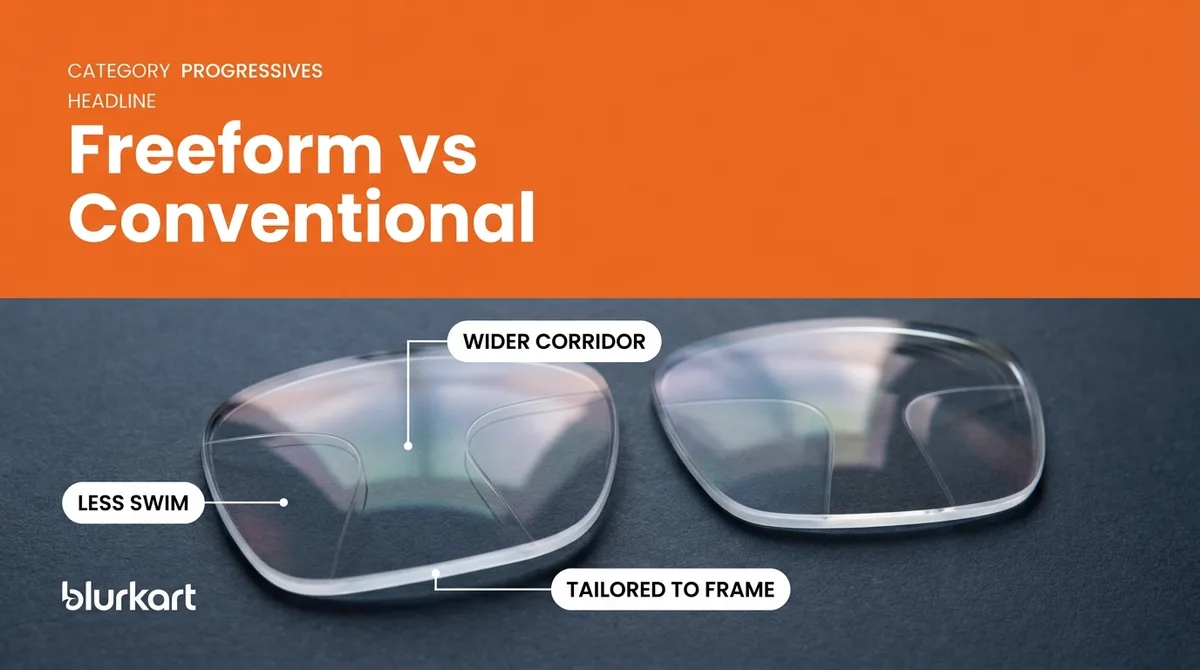
Conventional progressives are mass-moulded with a fixed design. Freeform (digital) progressives are surfaced to your exact prescription and frame, giving a wider clear corridor and less edge distortion. For strong prescriptions, demanding jobs, small frames or first-time wearers, the upgrade is usually worth it.
First, what a progressive lens actually does
A progressive lens packs three prescriptions into one surface: distance at the top, intermediate (your computer, the dashboard) in the middle, and near (your phone, a book) at the bottom. There is no visible line like an old bifocal. The power changes gradually as your eye travels down the lens, so one pair covers far, middle and close vision.
That gradual change is clever, but it comes with a trade-off built into the physics. On either side of the clear central corridor there is always some soft, slightly distorted vision. How wide that clear corridor is, and how gentle the side distortion feels, is exactly what you are paying for when two quotes differ by thousands of rupees.
Conventional (moulded) progressives
Entry-level progressives use a design that is pre-moulded into the lens blank. It is a fixed, one-size pattern that is not tailored to your frame or to how you wear it. They genuinely work, and for a light wearer with a mild prescription they can be perfectly acceptable. The downsides show up as:
- A narrower clear corridor, so you move your head more to find the sweet spot.
- More noticeable 'swim' or distortion when you glance to the sides.
- No optimisation for your specific frame shape, which hurts most in smaller frames.
Freeform (digital) progressives
Freeform lenses are a different manufacturing approach entirely. Instead of a fixed mould, the surface is computed and cut by machine to your exact prescription and frame, often accounting for how the frame sits on your face. This is the technology behind premium progressive tiers. What it buys you:
- A wider clear corridor, so reading and screen work feel more natural.
- Softer peripheral distortion, which means less 'swimmy' feeling when you turn your head.
- Better performance in your actual frame, including smaller stylish frames.
- Easier adaptation, which is a real relief for first-time wearers.
Think of it like a tailored suit versus an off-the-rack one. Both cover you. One simply fits the way you actually move.
The tiers, side by side
| Tier | How it is made | Clear corridor | Best for |
|---|---|---|---|
| Conventional | Fixed mould | Narrow | Mild Rx, experienced, budget |
| Mid freeform | Surfaced to your Rx | Wide | Most daily wearers |
| Premium freeform | Surfaced to Rx + frame + habits | Widest, softest edges | Strong Rx, small frames, heavy screen users, first-timers |
So what are the price tiers really selling?
As you climb the ladder you are mostly buying corridor width and comfort, plus better anti-reflective coatings. Higher tiers may also factor in your reading habits and head posture. The jump from conventional to a good freeform lens is the one most people genuinely feel. The jump from mid to top tier is subtler and matters most for heavy, demanding users or very small frames.
At Blurkart, progressive lenses are NPR 1,900 for a small-corridor design, NPR 3,400 for a wide corridor and NPR 5,500 for a large corridor, on top of the frame. Premium branded freeform lenses cost more again. Material and coating change the total, so the useful habit is to ask what tier, material and coating a quote includes before you compare it to another.
How to read a progressive lens quote
When you get a price, break it into its real parts rather than accepting one number. Ask:
- Design tier: conventional, mid freeform, or premium freeform?
- Material and index: standard or thinner high-index for a strong power?
- Coating: which anti-reflective coating, and is it scratch resistant?
- Warranty: is there an adaptation guarantee if you cannot get on with them?
Two quotes that look far apart are often selling different things. Once you line up the four points above, the fair comparison becomes obvious.
The first two weeks: what adaptation feels like
Even with a good freeform lens, your brain needs a short while to learn where to look. Expect to point your nose at what you want to read, drop your eyes rather than your head for your phone, and take the stairs a little carefully for the first few days. Most people are comfortable within one to two weeks. A wider freeform corridor shortens that learning curve, which is the practical reason we steer first-time wearers toward it.
Who should pay more, and who should not
Pay up for freeform if you: have a strong or complex prescription, spend hours on screens, drive a lot, wear a smaller stylish frame, or are buying progressives for the first time.
You can stay mid-range if you: have a mild prescription, are an experienced progressive wearer, and mostly need glasses for general daily life.
Buying progressives in Nepal
Bring a recent, accurate prescription, and be honest with yourself about how you spend your day. The right corridor width depends on your work and habits, not just your power. A tailor, a coder and a driver can share the same prescription and still need different progressive designs. Once you know the tier that fits your needs and budget, you can pair the lenses with any frame you like and have them surfaced to order. Choose a frame with enough height, too, because a very shallow fashion frame leaves little room for the corridor to do its job.
Frequently asked
- Is freeform really better than conventional progressive lenses?
- For most people, yes. Freeform lenses are surfaced to your exact prescription and frame, which gives a wider usable area and softer peripheral distortion. The difference is most noticeable with strong powers and for first-time progressive wearers.
- Why are some progressive lenses so much more expensive?
- The price mostly reflects the design tier. Entry progressives use a fixed moulded design. Premium freeform tiers are individually computed, often account for how you tilt your head and hold your phone, and come with better anti-reflective coatings.
- Do I need the most expensive progressive lens?
- Not always. A mid-tier freeform lens suits most daily wearers. The top tier mainly benefits people with demanding visual needs, small fashion frames, or those who struggled to adapt to progressives before.
- Can first-time wearers adapt to progressives?
- Most people adapt within one to two weeks. Freeform designs with a wider corridor make that first week noticeably easier, which is why we often recommend them for a first pair.
- How much do progressive lenses cost in Nepal?
- At Blurkart, progressive lenses are NPR 1,900 for a small corridor, NPR 3,400 for a wide corridor and NPR 5,500 for a large corridor, on top of the frame. Premium branded freeform lenses cost more. Always confirm the design tier, material and coating included in any quote.