
Progressive Sunglasses: Can You Get No-Line Bifocals in a Tint?
Progressive sunglasses put your full no-line progressive prescription into a tinted, UV-protective lens, so you can see far, mid and near outdoors without swapping glasses. You can choose a fixed tint or photochromic lenses that darken in sunlight. Ideal for drivers, travellers and anyone active outdoors over 40.
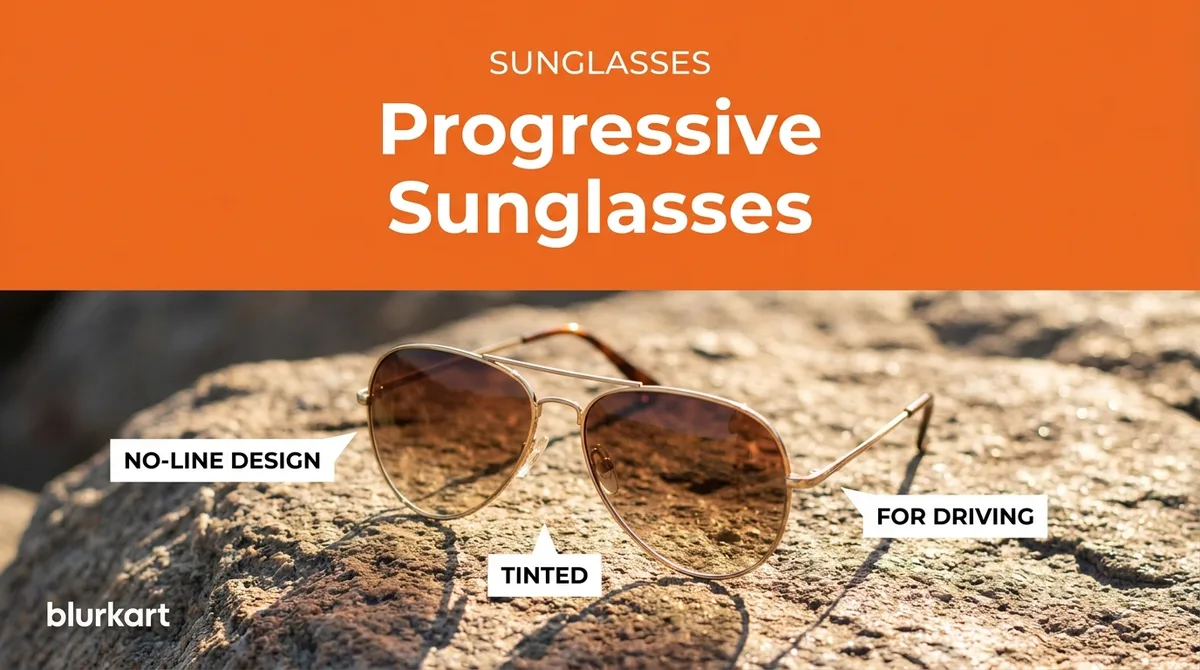
The outdoor problem progressives leave behind
Progressive lenses are brilliant indoors: far, middle and near vision in one pair, no line. Step outside into Nepal's bright sun, though, and many people swap to ordinary sunglasses, only to find they cannot read a phone, a menu or a map. Progressive sunglasses fix exactly that gap.
What they are
A progressive sunglass carries your full progressive prescription inside a tinted, UV-protective lens. You keep distance vision for the road and the view, intermediate for mid-range, and near for your phone, all outdoors, all in one pair, with no visible line. For anyone over 40 who is active outside, it is a genuine quality-of-life upgrade.
Fixed tint or photochromic?
| Fixed tint | Photochromic | |
|---|---|---|
| Behaviour | Always dark | Darkens outdoors, clears indoors |
| Best as | Dedicated sunglasses or driving pair | One pair for everywhere |
| In the car | Stays dark | Darkens less behind a windscreen |
| Convenience | Need a clear pair too | No swapping needed |
If you want a committed sunglass for driving and the outdoors, a fixed tint is ideal. If you want one pair that handles both inside and out, photochromic progressives are the convenient choice.
Do not confuse tint with UV protection
A dark lens is not automatically a safe lens. Tint darkness and UV protection are separate. Always insist on UV400.
This matters especially in Nepal, where altitude increases UV exposure. A dark lens without UV protection actually lets the pupil open wider and admit more harmful UV, so confirm UV400 regardless of how the tint looks.
Polarised for glare
Adding polarisation cuts the harsh horizontal glare off roads, water and vehicle bonnets, which is excellent for driving the highways and for time near rivers or snow. One caveat: polarised lenses can make some digital dashboards and phone screens look dark at certain angles, so bear that in mind if you rely on them.
Who should buy a pair
- Drivers who need to read the dashboard and satnav in bright light.
- Travellers and trekkers who use a phone and map outdoors.
- Anyone over 40 who is active outside and tired of swapping glasses.
Buying in Nepal
Bring your current progressive prescription and decide between a fixed tint and photochromic based on how you will use them. Confirm UV400, consider polarisation if you drive a lot, and pick a frame with enough coverage and height. If you already wear progressives happily, a progressive sunglass will feel familiar from day one, just darker and kinder to your eyes in the sun.
Choosing a lens tint
- Grey: keeps colours true, the safest all-round choice for bright sun and driving.
- Brown or amber: boosts contrast, pleasant for variable light and outdoor sport.
- Green: a balanced option that reduces glare while keeping colour reasonably natural.
Tint colour is about comfort and contrast; it is separate from UV protection and from how dark the lens is. Pick the colour you find easiest on the eyes for how you will use the glasses.
Caring for tinted progressive lenses
Treat them like any good lens: rinse before wiping to avoid dragging grit, use a microfibre cloth, and store them in a case so the coating and tint stay intact. Avoid leaving them on a hot dashboard, which can stress coatings over time. Looked after well, a progressive sunglass lasts as long as your clear pair and spares your eyes a lot of squinting under Nepal's strong sun.
Shop the lenses mentioned in this guide
- Essilor Varilux Liberty 3.0 Xperio Polarised – Progressive Sunglass Lens (Pair): polarised progressive sunglasses for drivers and everyday outdoor wear
- Essilor Varilux Comfort Max Xperio Polarised – Progressive Sunglass Lens (Pair): a comfort-focused polarised progressive sun lens
- Essilor Varilux XR Design Transitions Gen S Crizal Rock – Light-Reactive Progressive (Pair): one light-reactive pair that works indoors and out
- Essilor E-Mirror Varilux 1.50 – Progressive Mirror Sun Lens, Wrap & Large Frame (Pair): a mirror-coated progressive sun lens for wrap and large frames
Keep reading
- Prescription sunglasses in Nepal: your power in a tinted lens
- UV400 or polarised: what the sunglasses sticker really means
- Bifocal or progressive: what changes after 40
- ZEISS Prescription Sunglasses: Polarised, Mirror and Flash
Not sure which lens suits you? Book a free eye test at our Pulchowk or Boudha branch.
Frequently asked
- Can progressive lenses be made into sunglasses?
- Yes. Your full progressive prescription can be surfaced into a tinted, UV-protective lens, so you get distance, intermediate and near vision outdoors in one pair, with no visible line.
- Should I choose a fixed tint or photochromic for progressive sunglasses?
- A fixed tint stays dark and is ideal as dedicated outdoor or driving sunglasses. Photochromic lenses darken outdoors and clear indoors, so one pair works everywhere, though they darken less behind a car windscreen.
- Do progressive sunglasses still need UV protection?
- Yes, and it is essential. Tint darkness and UV protection are separate things. Make sure the lenses are UV400, which blocks virtually all UVA and UVB, especially important at Nepal's altitude.
- Are progressive sunglasses good for driving?
- Very. A polarised progressive sunglass cuts road and dashboard glare while letting you glance at the speedometer and satnav clearly. Note that polarised lenses can make some digital dashboards harder to read.
- Is adaptation different from normal progressives?
- No, the adaptation is the same as any progressive. If you already wear progressives comfortably, a progressive sunglass will feel familiar.