
Office lenses: the in-between option
Office lenses, also called room or degressive lenses, trade distance vision for a much wider intermediate and near zone. They suit people over 40 who spend the day between a screen and paper, and they fix the head tilting that progressive wearers develop at a desk. They are not for driving.
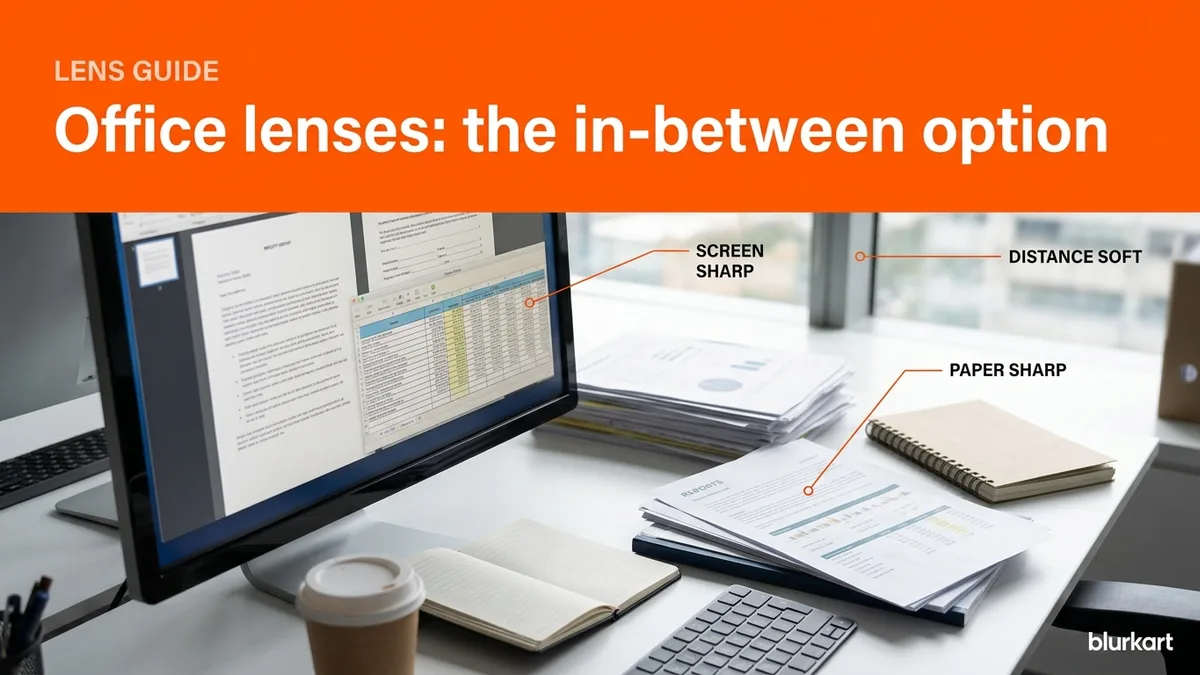
Office lenses are the least known useful thing in an optical shop. Almost nobody asks for them by name, and for a particular group of people they are the single biggest comfort improvement available.
What office lenses actually are
A progressive lens has to cover everything from reading distance to the horizon, and it fits all of that into one surface. The result is a narrow corridor: the zone that is sharp at any given distance is a band down the middle, and you move your head to find it.
An office lens throws away the far end. It gives up clear vision past about two to four metres, and spends the freed-up surface on a much wider intermediate and near zone. Same idea, different priorities.
In practice that means the whole width of your monitor is sharp without moving your head, your keyboard is sharp when you glance down, and a colleague at the next desk is still readable.
Who they are for
The clearest case is a progressive wearer over 40 who works at a desk. Watch someone in that situation and you will see the chin lift: they tilt their head back to catch the intermediate band of the lens on the monitor, and hold it there for hours.
That posture is why so many desk workers develop neck and shoulder pain and blame the chair. Office lenses put the screen in a wide zone that needs no tilt at all, and the posture problem disappears with it.
They also suit anyone over 40 who works between paper and a screen constantly, and anyone whose reading glasses are fine for a book but leave the monitor slightly soft. Whether you need computer glasses covers the wider question.
Who they are not for
Anyone under about 40 with a working focusing range. If your eyes still shift comfortably from screen to wall, you do not need a lens to do it for you, and you would be paying for a solution to a problem you do not have.
Anyone who needs one pair for everything. Office lenses are a second pair by design, and you keep your normal glasses for the rest of life.
And absolutely not for driving. Distance is soft, deliberately. Keep them at your desk and swap before you leave, which is the one discipline they require.
What they cost and how they are fitted
They are a specialist progressive design, so pricing sits in the progressive range, NPR 1,900 to NPR 5,500 depending on how wide the corridor is, plus the frame from NPR 999.
Fitting matters more than usual. We need your actual working distance, so measure how far your monitor sits from your eyes before you come in and tell us. A lens set for 70 centimetres in a workspace that is 50 will not perform. We also set the fitting height carefully, because the zones only land where they should if the lens sits right in the frame.
Before you buy them
Try the free fixes first. Monitor at arm's length, top of the screen at or just below eye level, brightness matched to the room, and the twenty twenty twenty break. Some of what feels like a lens problem is a desk problem, and setting up a desk properly covers it.
If the chin tilt is still there after that, come to either showroom and describe your desk. The eye test is free, and we will tell you honestly whether an office lens is worth it for the way you actually work. Frames start at NPR 999 in the screen range.
How to measure your desk before you come in
Sit at your desk the way you actually sit, not the way you think you should. Have someone measure from the bridge of your nose to the centre of the screen, in centimetres, and then to the page or keyboard you look at most. Note both numbers.
Take a photo of the setup too. A monitor on a stand, a laptop flat on the desk and a dual-screen arrangement all produce different answers, and seeing it saves a lot of describing.
With those two distances we can specify the corridor properly. Without them we are fitting to an assumption, and an office lens set for the wrong working distance is worse than no office lens at all, because it fails at exactly the task you bought it for.
Frequently asked
- Can I wear office lenses all day?
- Around a desk and an office, yes. Outside them, no. Anything past about four metres will be soft, so they are not for driving, meetings across a large hall, or walking home.
- How are office lenses different from reading glasses?
- Reading glasses are set for one close distance, about 35 centimetres. Office lenses cover a range, from near reading out to a few metres, so a monitor, a keyboard and a colleague at the next desk are all usable.
- Office lens bhaneko ke ho?
- Desk ma kaam garda screen ra kagaj dubai safa dekhine lens ho. Tadha ko drishti chai spasta hundaina, tyasaile gaadi chalauna milddaina. Chalis barsa katepachhi desk ma kaam garnelai dherai aaram hunchha.