
Why Progressive Lenses Feel Swimmy at First, and How to Adapt Faster
The swimmy, tilting feeling in new progressives comes from the soft distortion zones at the sides of the lens, which your brain has not yet learned to ignore. Most people adapt within one to two weeks by wearing them full-time, pointing the nose at what they read, and using the right zone for each distance.
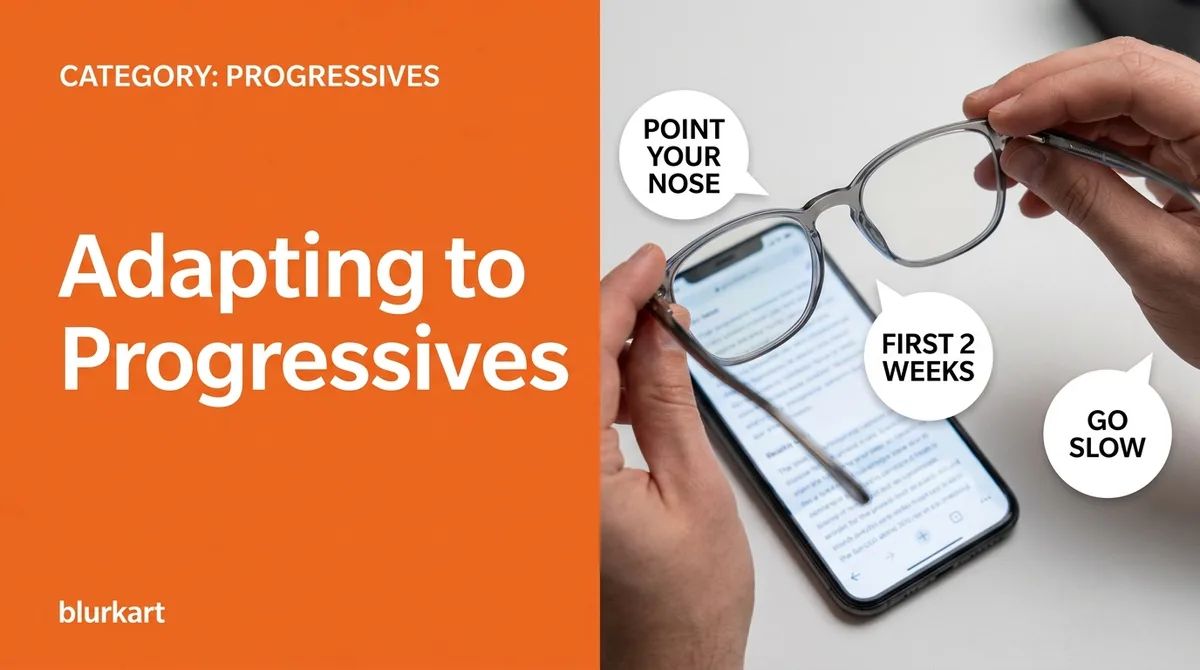
That tilting-floor feeling is normal
You put on your first progressives, take a step, and the floor seems to tilt. Doorways wobble, and looking sideways feels a little like moving underwater. This is the famous progressive swim, and almost everyone feels some of it at first. The good news: it is temporary, and there are concrete ways to speed through it.
Why it happens
A progressive lens blends three powers into one surface with no line. To do that, it has a clear central corridor running top to bottom, with soft, slightly distorted zones on either side. When you glance sideways through those zones, straight lines seem to bend and the world appears to shift. Your brain simply has not yet learned to ignore those edges.
Adapting to progressives is less about your eyes and more about your brain learning where to look and what to tune out.
How long adaptation takes
Most people settle within one to two weeks of consistent wear. First-time progressive wearers may take a little longer, and a wider freeform design usually makes the process quicker and gentler.
Tips to adapt faster
- Wear them full-time. Switching back to old glasses resets the learning each time.
- Point your nose, not just your eyes, toward what you want to read.
- Use the right zone: top for distance, middle for the computer, bottom for the phone and books.
- Mind the stairs: drop your chin and look through the top of the lens when going down.
- Move your head more than your eyes at first; it becomes automatic quickly.
Which zone is for what
| Task | Where to look |
|---|---|
| Driving, TV, across a room | Through the top |
| Computer screen | Through the middle |
| Phone, reading, ledger | Through the lower part |
| Stairs and kerbs | Top, with chin dropped |
When to go back
Some swim is expected, but it should shrink day by day. If after two to three weeks the lenses still feel wrong, one eye seems off, or you cannot find a comfortable reading zone, return to where you bought them. The fitting height, the frame adjustment or the prescription can be checked. A good progressive, correctly fitted and worn full-time, should end up feeling like no lens at all.
A note on choosing next time
If you have struggled with progressives before, a wider freeform tier and a frame with enough height make a genuine difference. Mention your past difficulty when you order, so the lens and frame can be chosen to make adaptation as easy as possible.
Early mistakes that slow adaptation
- Switching back to old glasses whenever it feels awkward, which resets the learning.
- Moving only your eyes, not your head, so you keep landing in the soft side zones.
- Reading through the top of the lens out of habit, then concluding the lenses are wrong.
- Wearing them part-time, which stretches a two-week adjustment into months.
What good adaptation looks like
Healthy adaptation is a steady, day-by-day improvement: the swim shrinks, the reading zone becomes easy to find, and within a couple of weeks you stop thinking about the lenses at all. Trouble looks different: vision that is clearly wrong from day one, one eye that never settles, or no improvement after two to three weeks. The first is normal and passes; the second needs a recheck of the fit, the fitting height or the prescription. Knowing the difference stops you giving up on lenses that just needed a few more days.
Shop the lenses mentioned in this guide
- Essilor Varilux Liberty 3.0 Crizal Easy Pro – Progressive Lens (Pair): a wide-corridor progressive that is gentle for first-time wearers
- ZEISS Progressive SmartLife Pure 1.5 – DuraVision Platinum UV (Pair): a ZEISS freeform design for an easier first pair
- Essilor Varilux Comfort Max Crizal Rock – Progressive Lens (Pair): a comfort-focused progressive for everyday wear
Keep reading
- Switching From Single Vision to Progressives: What to Expect
- Progressive Lenses and Frame Choice: Why Height and Shape Matter
- Why new glasses feel wrong for the first week
- Progressive Lens Tiers Compared: Standard, Premium and Elite
Not sure which lens suits you? Book a free eye test at our Pulchowk or Boudha branch.
Frequently asked
- How long does it take to get used to progressive lenses?
- Most people adapt within one to two weeks of full-time wear. First-time wearers may take a little longer. Wider freeform designs usually shorten the adjustment period.
- Is the swimmy feeling a sign the lenses are wrong?
- Usually not. Some swim is normal while your brain learns the lens. But if vision is clearly wrong, one eye is off, or it has not settled after two to three weeks, go back so the fit and prescription can be checked.
- Should I switch back to my old glasses while adapting?
- No. Switching back and forth slows adaptation. Wearing the progressives full-time helps your brain learn them faster. Keep the old pair only as an emergency backup.
- Why do stairs feel tricky in new progressives?
- The reading zone sits at the bottom of the lens, so looking down through it blurs the floor and stairs. Drop your chin and look through the top of the lens for stairs until it becomes automatic.
- Can anything make adaptation easier?
- Yes: full-time wear, pointing your nose at what you read, using a properly fitted frame, and choosing a wider freeform design. A good fitting height for your frame also makes a real difference.