
Sunglasses for kids are not a fashion item
Children receive a large share of their lifetime UV exposure before eighteen, and a young eye's lens filters less of it than an adult's. Sunglasses for kids need a genuine UV400 lens, polycarbonate for safety, and a frame that actually stays on. A dark tint with no UV filter is worse than no sunglasses at all.
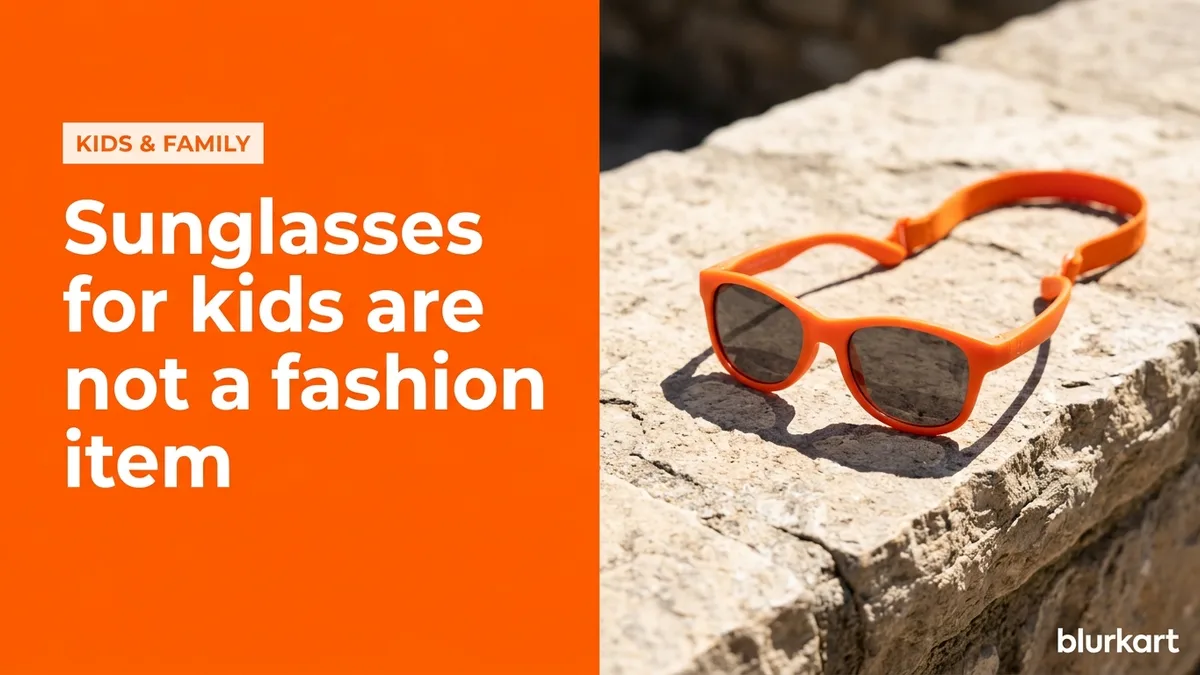
Sunglasses for kids get treated as an accessory, something for a photo at the lake. The biology says otherwise, and in Nepal the case is stronger than in most places.
Why sunglasses for kids matter more than for adults
Two things stack up. A child's crystalline lens is clearer than an adult's and filters less ultraviolet, so a greater proportion of what arrives at the eye reaches the retina. And children are outside far more than adults, at the times of day when the sun is highest.
Put those together and a large share of a person's lifetime UV exposure lands before they turn eighteen. UV damage to the eye is cumulative and does not repair, and it contributes to cataract and macular problems decades later. Nothing dramatic happens on any given afternoon, which is exactly why it gets ignored.
Altitude makes it worse. UV increases with elevation, so a child in Kathmandu Valley is getting more than one at sea level, and considerably more on a trek or in snow. Kathmandu winter sun covers why the cold months are deceptive.
What to look for
UV400, stated. This is the only specification that matters and it is not the same as dark. Look for it on the label, and if there is no label, assume there is no filter. We test any pair free on a UV meter at either showroom, including ones bought elsewhere, and it takes a few seconds.
Polycarbonate lenses. Children's eyewear gets dropped, sat on and hit by footballs. Polycarbonate deforms where plastic cracks and glass shatters. The lens material guide covers the differences.
A frame that stays on. Flexible temple arms, a wraparound curve for side coverage, and for younger children a strap. Sunglasses that slide off get left at a picnic spot.
Proper coverage. Larger lenses and a slight wrap block light coming from the sides, which small round frames do not.
What to refuse
The unlabelled dark pair from a street rack. This is the one that does harm rather than nothing. A dark lens with no UV filter makes the pupil dilate, and a wider pupil admits more ultraviolet than a squinting eye in bright sun would. You have made the situation worse while feeling responsible. Cheap roadside sunglasses goes into the detail.
Also skip toy sunglasses with moulded plastic lenses. Those are costume, and the optical quality can be poor enough to cause eye strain on its own.
If your child already wears glasses
You have three options. Prescription sunglasses as a second pair, which is the most comfortable and the most likely to get worn. Clip-ons over the existing frame, cheaper but easy to lose. Or photochromic lenses in their everyday pair, which darken outdoors and mean one pair to keep track of, a real advantage with a child.
Photochromic is usually the practical winner for school-age children, with the caveat that it does not darken much behind a car windscreen. How fast they darken has the honest timings.
The habit matters more than the pair
Sunglasses only protect when worn, and children copy adults. A parent who wears theirs on the walk to school will get much further than one who explains ultraviolet.
Bring the whole family to either showroom, Pulchowk or Boudha. Eye tests are free, UV testing is free, and sunglasses start at NPR 999 with UV400 on every pair we sell.
Getting a child to keep them on
The specification is the easy part. Compliance is the whole problem, and it comes down to comfort and ownership.
Let the child choose the frame from a shortlist you have already filtered for UV400 and fit. A pair they picked gets worn; a pair chosen for them gets left on a bench. Check the fit properly, because the commonest reason a child pulls sunglasses off is that the arms pinch behind the ears, not that they dislike them.
Then attach them to the outing rather than to a rule. Sunglasses that live in the bag that goes to the park become part of going to the park. And wear yours, because nothing works as well as a parent doing the same thing without comment. Children copy behaviour far more reliably than they follow instructions about it.
Frequently asked
- Are cheap sunglasses bad for children?
- A cheap pair with a real UV400 lens is fine. A cheap dark pair with no filter is actively harmful, because the tint makes the pupil open wider and admit more ultraviolet than bare eyes would.
- At what age can a child wear sunglasses?
- As soon as they will keep them on, which for many is around two or three. For babies and toddlers who pull everything off, a wide-brimmed hat does a large part of the job.
- Bachcha lai sunglass chahincha ra?
- Chahinchha. Sano umer ma aankha le UV lai kam roknchha ra bachcha bahira dherai bela bitauchhan. UV400 lekheko hunu parchha, ra lens polycarbonate ko. Kunai pani sunglass hamro showroom ma nihsulka UV meter ma janch garidinchhau.