
Do cheap roadside sunglasses damage your eyes?
Cheap sunglasses are harmful only when the lens is dark but has no ultraviolet filter. The tint makes your pupil open wider, and a wider pupil lets more UV reach the lens and retina than bare eyes would. A cheap pair with a genuine UV400 lens is perfectly safe; the problem is that a sticker is not proof.
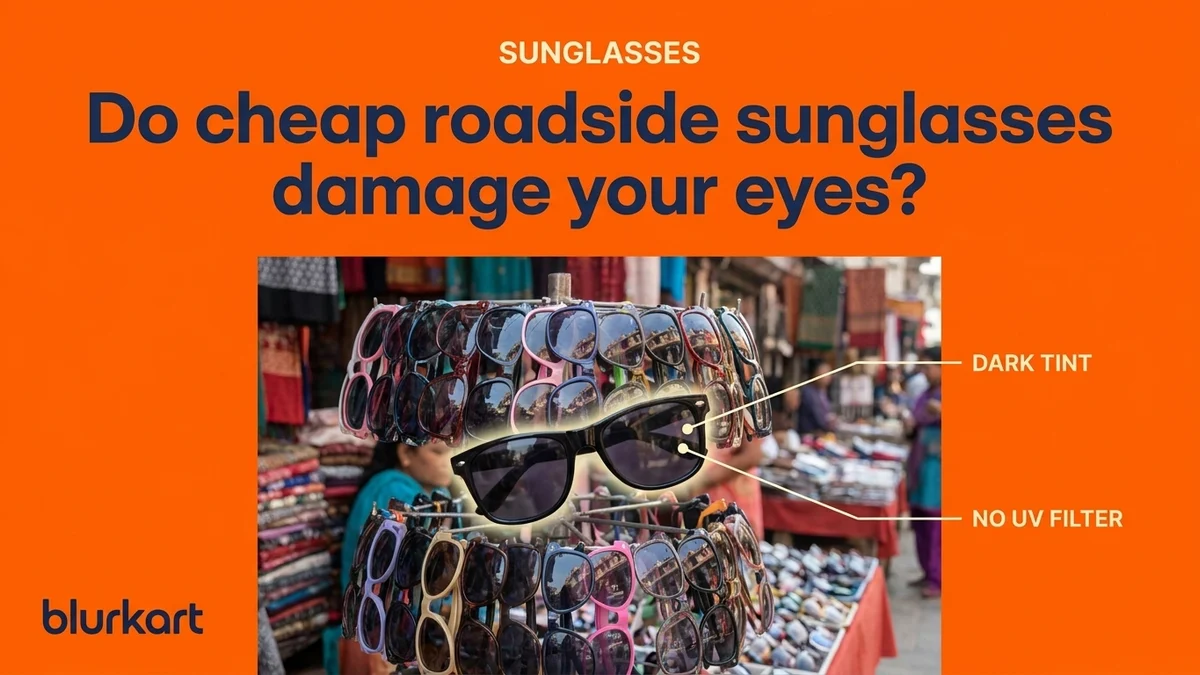
Cheap sunglasses damage your eyes in one specific case: when the lens is dark but blocks no ultraviolet. In bright light your pupil shrinks to protect itself. Put a dark lens in front of it and the pupil opens back up, because the eye thinks the light has dropped. If that lens has no UV filter, ultraviolet now pours through a wide-open pupil, which is worse than wearing nothing.
A cheap pair with a genuine UV400 lens is completely fine. The problem is telling the two apart.
What cheap sunglasses at NPR 300 usually buy you
A moulded acrylic or thin polycarbonate lens, tinted in the mass, with a sticker on it. The tint is a dye. Ultraviolet filtering is a separate additive or coating, and it costs the maker money, so on the cheapest pairs it is often simply absent.
The lens optics are the second issue nobody mentions. A cheaply moulded lens has uneven thickness, which bends light unpredictably and makes straight edges look slightly curved. Your eyes compensate, and that effort is the headache some people get after an hour in new cheap sunglasses. It is not UV; it is distortion.
How to check any pair
For polarisation, hold the glasses in front of a phone screen and rotate them 90 degrees. If the screen goes black through the lens, they are polarised.
For ultraviolet, there is no home test worth trusting. Ultraviolet is invisible and no app measures it through a lens. Bring the pair to either of our Lalitpur showrooms and we put it on the UV meter on the counter. It takes ten seconds and we do not charge for it, whether you bought the pair from us or from a stall on New Road. We have measured plenty of confident-looking UV400 stickers at zero.
What the damage actually looks like
Ultraviolet damage to eyes is slow and adds up over decades. The two conditions we see most in the Valley are cataracts, where the lens inside the eye clouds, and pterygium, a wedge of tissue that creeps onto the cornea from the corner of the eye. Pterygium is so common among people who work outdoors in Nepal that many treat it as normal ageing. It is not. It is sun and dust, and it is preventable.
Short, intense exposure has a faster version. A day on snow without protection causes photokeratitis, essentially sunburn of the cornea, which arrives six to twelve hours later and feels like sand in the eyes. Our post on why Kathmandu winter sun is stronger than you think covers why altitude makes this worse here than at sea level.
When cheap is genuinely fine
When the UV400 is real. Ultraviolet protection does not improve with price once it is actually in the lens. Our own cheapest sunglass, the Stella at NPR 999, blocks exactly the same ultraviolet as the Icon Wayfarer at NPR 6,800. What the extra money buys is frame quality, lens optics without distortion, polarisation, and a pair that survives more than one season.
So the honest advice is not "spend more". It is "verify, then spend whatever you like on the frame".
Sasto sunglass: what customers ask us
"Kalo bhaye ta ramro ho ni?" Darkness is only tint. It tells you nothing about ultraviolet. A light grey lens with UV400 protects far better than a near-black lens without it.
"Sticker ma UV400 lekhieko chha ta." The sticker costs one rupee to print. Ask for a meter reading instead, at our shop or anywhere with a meter.
"Bachcha lai sasto sunglass kinidina hunchha?" Only with verified UV400. Children's eyes let more ultraviolet through to the retina than adult eyes, so an unfiltered dark lens on a child is the worst version of this problem.
"Nepal ma kun ma bharosa garne?" Any shop that will measure the pair in front of you. That is the test of the seller, not of the price tag.
What to do with the pair you already own
Bring it in. If it measures UV400, keep wearing it with our blessing. If it measures zero and it is dark, stop wearing it in bright sun, because squinting is safer. If you need a power in the lens, prescription sunglasses in Nepal covers the four ways to do it. We would rather check a pair for free than sell you something you did not need, and the Unisex Wayfarer at NPR 1,800 is there if the answer turns out badly.
Frequently asked
- Can I test sunglasses for UV protection at home?
- Not reliably. Ultraviolet is invisible and no phone trick measures it. Bring the pair to either Lalitpur showroom and we check it on a UV meter in ten seconds, free.
- Is it better to wear no sunglasses than cheap ones?
- If the cheap pair is dark with no UV filter, yes, squinting is safer. If it has a real UV400 filter, the cheap pair is fine.
- What damage does UV actually do to eyes?
- Cumulative exposure contributes to cataracts and to pterygium, the fleshy growth on the white of the eye that is very common among people who work outdoors in Nepal. Short intense exposure on snow causes photokeratitis, a painful corneal burn.
- Sasto sunglass lagayo bhane aankha bigrinchha?
- Only if the lens is dark without a UV filter. That combination opens the pupil and lets more ultraviolet in than no glasses at all. A cheap pair with real UV400 protection is safe.