
How to tell a real polarised lens from a fake one
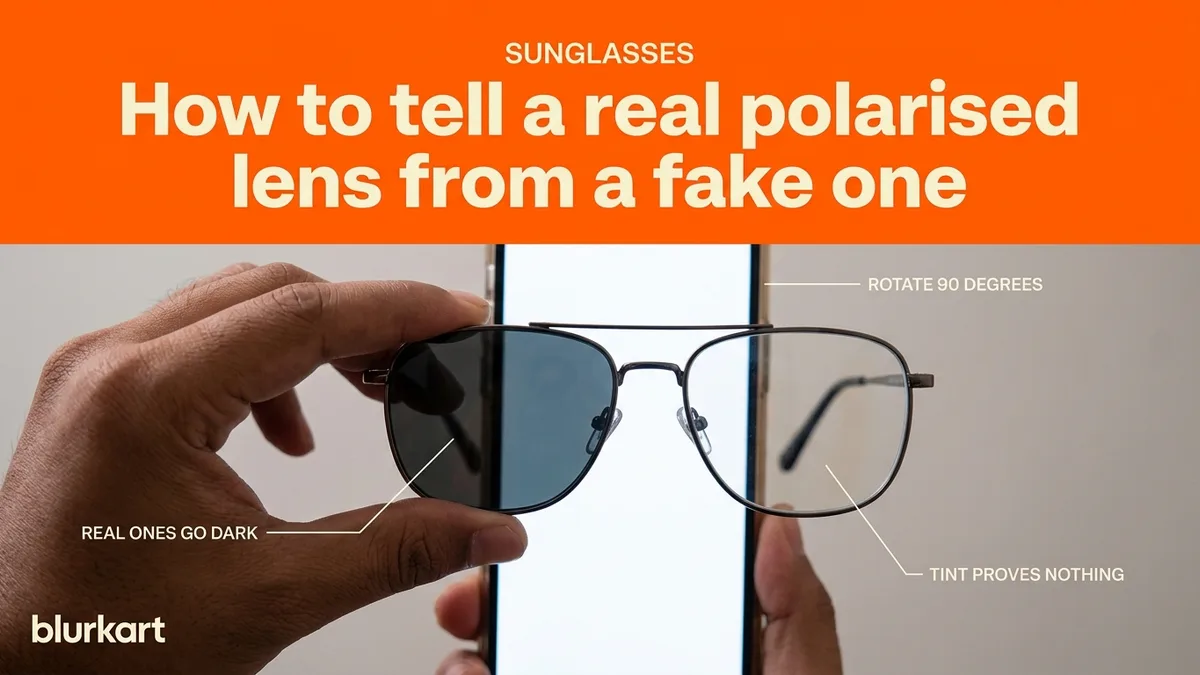
Hold the lens in front of a phone screen and rotate it ninety degrees. A real polarised lens goes dark or black. Or cross two lenses at ninety degrees and look through both; real polarisation blacks out. Darkness alone proves nothing, and polarisation is not the same as UV protection.
Finding a real polarised lens in a market stall is guesswork unless you test it, and a sticker saying POLARIZED costs a seller nothing. Two tests settle it in under a minute, and you can do both before you hand over money.
Test one: the phone screen
An LCD phone or laptop screen already emits polarised light, which makes it a free test rig.
Turn the screen brightness up and show a white image. Hold one lens of the sunglasses in front of your eye and look at the screen through it. Now rotate the glasses ninety degrees, so they go from level to sideways.
A real polarised lens will go noticeably dark, often almost black, at one of those angles. A lens that is merely tinted stays exactly the same brightness however you turn it.
This works because the lens filter and the screen filter either line up or cross. When they cross, almost no light gets through.
Test two: cross two lenses
If there is a second pair to hand, hold the two pairs in front of each other, one lens overlapping the other, and look through both. Rotate one pair ninety degrees.
If both are genuinely polarised, the overlap goes black at ninety degrees. If one is fake, the overlap just gets a bit darker, the way two pieces of sunglass would.
In a shop you can test a pair against a pair you already trust.
What darkness does not tell you
This is where most money gets wasted. Tint is shading. Polarisation is a directional filter. UV protection is a third, separate thing. A lens can have any combination of the three.
The dangerous combination is dark with no UV filter, because a dark lens makes your pupil open wider and admit more ultraviolet than bare eyes would. That is not an accessory failing to help, it is a purchase that made things worse. Cheap roadside sunglasses covers that in full.
So the buying order is: UV400 first, always. Polarisation second, if you drive or spend time near water or snow. Tint colour and darkness third. What the sticker means takes the labels apart.
When polarised is the wrong choice
Polarisation is not a strict upgrade. It cuts light reflecting off horizontal surfaces, which is exactly what makes wet tarmac, water and snow so punishing. That is a real benefit on the road.
The cost is that it also filters LCD screens. Car dashboards with digital displays, phone screens in landscape, some ATM and fuel-pump displays can go dark or show rainbow patterns. Pilots often avoid polarised lenses for this reason, and so do some machine operators.
If you spend your day checking a phone mounted on a handlebar, try before you commit. Driving sunglasses goes into the Nepali road version of the trade-off.
The test we do for you
A UV meter reading takes a few seconds and is not something you can fake or eyeball. Bring any pair to either showroom, Pulchowk in Lalitpur or Boudha in Kathmandu, and we will test it free, including pairs bought somewhere else. If the lens has no filter we will tell you, and we will not pretend otherwise to sell you a replacement.
Every sunglass we sell carries a UV400 lens as a minimum, starting at NPR 999, and polarised options are marked. Browse the sunglasses range, or bring the pair you already own and find out what it actually is.
Buying a real polarised lens without guessing
Do the phone test in the shop, before paying, with the seller watching. It takes ten seconds and it is not rude; it is the same test any optician would do. A seller confident in the stock will not mind.
Be sceptical of price as a signal in both directions. A cheap pair can be genuinely polarised, because the film is not the expensive part of a lens. An expensive pair can be tinted only. The test tells you; the price does not.
Then check the thing the test cannot show you. Polarisation and UV filtering are separate properties, and only a meter reads the second one. Bring the pair to either showroom and we will put it on the UV meter free, whoever sold it to you. That is the reading that decides whether the purchase protects your eyes or just dims the world.
Frequently asked
- Does polarised mean UV protected?
- No. Polarisation is a filter that cuts horizontally reflected glare. UV protection is a separate coating or material property. A lens can be polarised with poor UV filtering, or UV400 with no polarisation. You want UV400 first.
- Is polarised always better?
- Not always. It is excellent for driving, water and snow. It makes LCD dashboards, phone screens and some ATM displays hard to read, and pilots and some machine operators avoid it for exactly that reason.
- Polarised saccha ho ki naqli, kasari thaha paune?
- Mobile ko screen agadi lens rakhera nabbe degree ghumaunus. Saccha polarised bhaye kaalo hunchha. Duita lens lai kaatera herda pani kaalo hunchha. Kaalo tint le matra polarised bhanne pramanit gardaina.