
Night shift eye strain: a guide for BPO workers
Night shift eye strain is worse because your screen glows against a dim room, your blink rate drops further when tired, and air conditioning dries your eyes over a long shift. Light the room so the screen is not the brightest thing in it, use an anti-reflective coating, and keep lubricating drops on the desk.
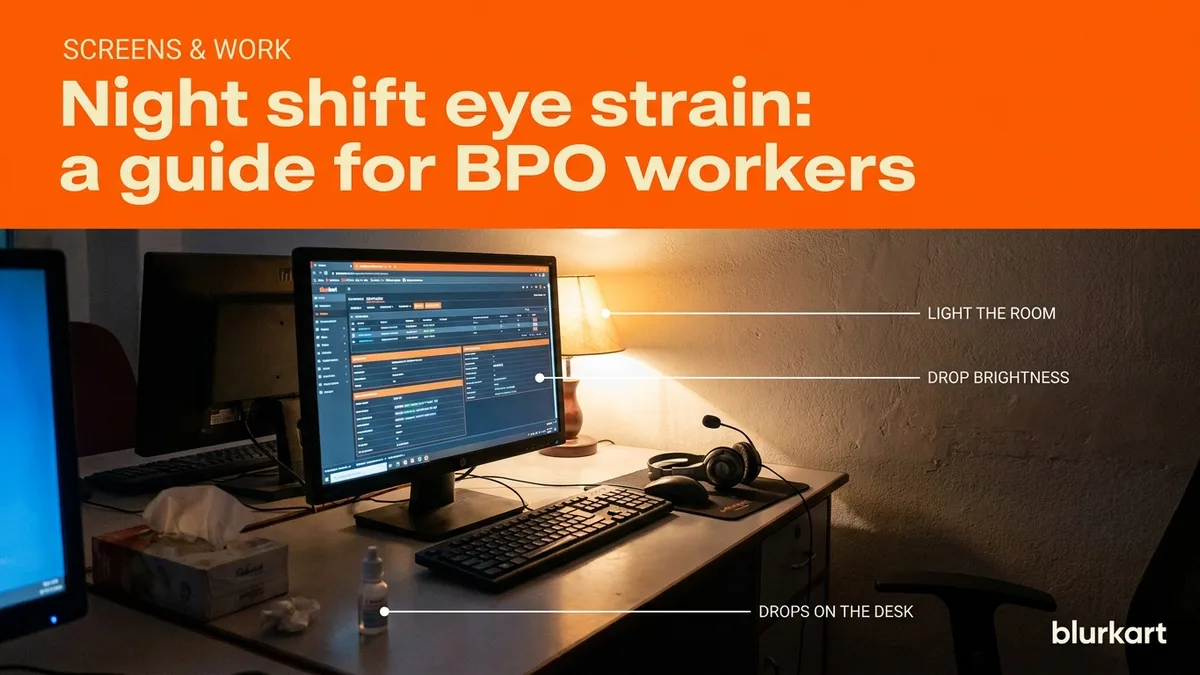
Night shift eye strain is not the same problem as daytime screen fatigue with the lights off. Several things stack up at once, and Nepali BPO and call centre floors tend to get the lighting exactly wrong.
Why night shift eye strain is worse
Contrast against a dim room. During the day your screen sits in a lit environment and your pupil stays at a stable size. At 3am in a half-lit office the screen is the brightest thing in the room by a wide margin, so your pupil keeps adjusting every time you look away and back.
Blink rate. You blink around 15 times a minute normally and roughly a third of that at a screen. Fatigue drops it further. Less blinking means a thinner tear film, and a thin tear film is the stinging most people describe as tired eyes.
Air conditioning, all night. Moving dry air across your face for eight hours evaporates the tear film faster than anything else in the room.
Accumulated focus. Hours at one fixed distance leave the focusing muscle tired, and that is where the dull ache behind the eyes comes from.
Fix the lighting first
The instinct is to work in the dark so the screen is easier to look at. It is the wrong instinct and it makes the contrast problem worse.
Light the room enough that the screen is not the brightest object in it. The best arrangement for a night desk is a lamp behind the monitor, pointed at the wall, so you get soft reflected light around the screen rather than a glowing rectangle in a black void. This is called bias lighting and it costs very little.
Avoid overhead tube lights directly above the desk, which reflect off both the screen and your glasses. If your office has them and you cannot change it, angle the monitor so nothing is mirrored in it. Turn the screen off for a second and look at what appears in the black glass.
Then drop screen brightness to match the room you just lit. Dark mode vs light mode covers which theme suits which lighting; at night, dark mode genuinely helps.
The dryness problem
Keep preservative-free lubricating drops on the desk where you can see them, not in a bag. Drops you have to go and find do not get used.
Point the air conditioning vent away from your face. If you cannot, a small screen or even a repositioned monitor helps.
If you wear contact lenses on shift, this is the hardest combination there is. A long night in air conditioning dries lenses badly, and lenses that are uncomfortable at hour six are why people end up sleeping in them. Dailies usually cope better than monthlies here. Dry eyes and contact lenses covers it, and do not sleep in them covers the risk if a shift runs long.
What lens actually helps
The anti-reflective coating, not the blue filter. Reflections off your own lenses from overhead lights and the screen behind you are a real source of the low-grade glare on a night floor, and a multi-coated lens cancels most of it. At Blurkart that is NPR 1,800 against NPR 750 for a basic blue coat.
Be sceptical of blue-light marketing aimed at night workers. If sleeping after a shift is the problem, blackout curtains and staying off a phone in the hour before bed do more than any lens. The evidence on blue light glasses is worth reading before spending.
The habit that costs nothing
Every twenty minutes, look at something about six metres away for twenty seconds. On a call floor, the far wall works. It is the one intervention that addresses the focusing fatigue directly, and it is free.
If your eyes ache rather than sting after all that, it is worth a test. Free at both showrooms, about ten minutes, and screen glasses start at NPR 999.
After the shift
Getting light right at the end matters as much as during. Wear sunglasses on the ride home if the sun is up, then keep the room properly dark to sleep, because daylight through thin curtains is what wrecks day sleep and tired eyes make the next shift worse.
Do not treat that as a reason to buy blue-blocking glasses for the commute. What you need on the way home is ordinary UV400 sunglasses, which you should have anyway.
Frequently asked
- Should night shift workers use blue light glasses?
- The blue filter is oversold. The anti-reflective coating in the same lens is what reduces glare and fatigue. If sleep after a shift is the concern, blackout curtains and avoiding screens in the hour before sleeping do far more.
- Why do my eyes hurt more at 3am than at 3pm?
- Three things stack: your screen glows against a dim room, blink rate falls further with fatigue, and you have been at one focus distance for hours. Air conditioning through the night adds dryness on top.
- Rati ko shift ma aankha dukhchha, k garne?
- Kotha lai puri andharo nabanaunus, screen sabbhanda ujyalo hunu hunna. Anti-reflective coating bhayeko lens lagaunus ra table mai lubricating drop rakhnus. Hareka bis minet ma bis second tadha herus.