
Blue Light Glasses: Do They Actually Work?
Blue light glasses reduce glare and feel more comfortable for long screen days, mostly because of the anti-reflective coating rather than the blue filter. There is no strong evidence that screen blue light damages the eyes. Screen distance, brightness and breaks matter more than the lens.
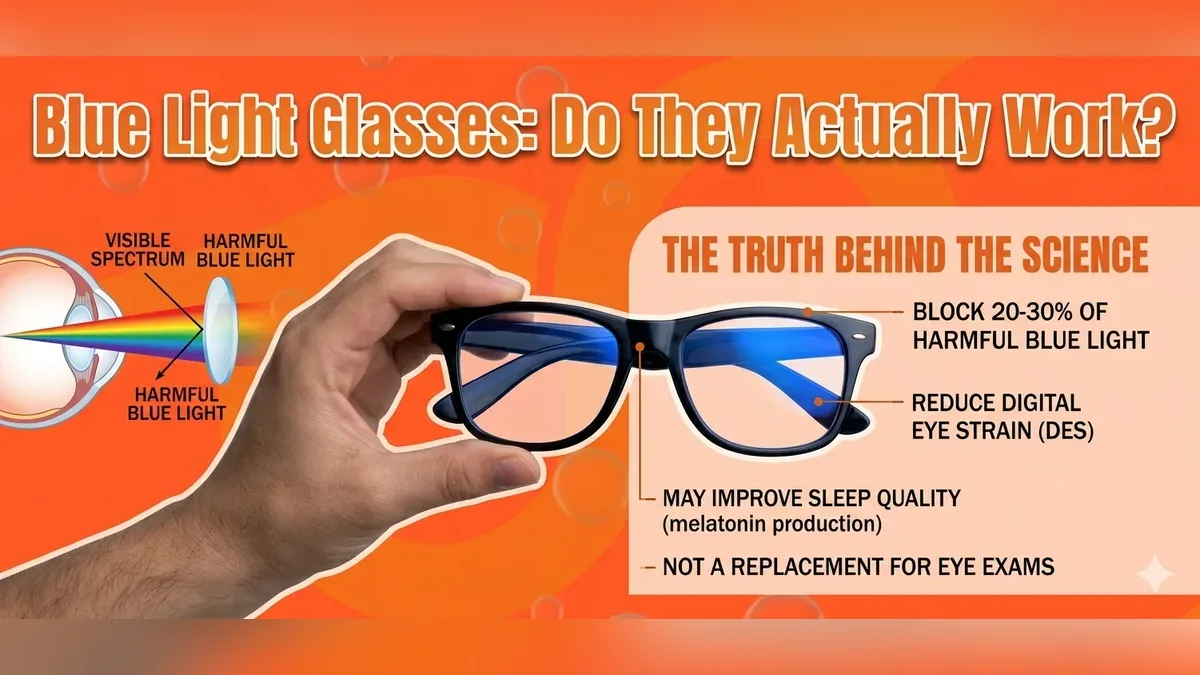
If you spend hours staring at screens, and who doesn't these days, you've probably heard about blue light glasses. But do they actually help?
What Is Blue Light?
Blue light is a high-energy visible (HEV) light emitted by screens, LED lighting, and the sun. It has a shorter wavelength and higher energy than other visible light.
The Digital Eye Strain Problem
Digital eye strain is real. Symptoms include:
- Dry, irritated eyes
- Blurry vision after screen time
- Headaches
- Difficulty sleeping
But here's the thing, most eye strain isn't caused by blue light itself. It's caused by reduced blinking and poor ergonomics.
What blue light filters do help with
Glare is the honest answer. The anti-reflective layer on a blue filtering lens cuts the reflections coming off the lens surface and bouncing back from the screen, and that is what most people feel as relief by evening.
Why your eyes actually hurt
Three things cause most screen discomfort, and none of them is the colour of the light.
Blinking. You blink around 15 times a minute normally and roughly half that while reading a screen. The tear film breaks up, and the eyes sting by late afternoon. This is worse in Kathmandu from November to March, when Valley humidity drops and rooms are dry.
Focus. Holding one distance for hours tires the focusing muscle, the same way holding any muscle still does. A screen closer than 50 cm makes it worse.
Glare. Reflections on the lens and on the screen force your eyes to work through a layer of scattered light all day. This is the one a lens can genuinely fix, and the fix is the anti-reflective coating rather than the blue tint.
What about sleep
Blue light in the evening does suppress melatonin, which is why the sleep claim gets repeated. The part that gets left out is dose. A phone at arm's length delivers a small fraction of the blue light you get from a cloudy afternoon outdoors, and the studies on filtering glasses for sleep are mixed and mostly small.
If you sleep badly, screen time in the last hour before bed, room lighting and caffeine are all bigger levers than a lens. We would rather say that than sell you a coating on a sleep promise.
What we would actually fit
For a desk worker, a lens with a proper double-sided anti-reflective coating. At Blurkart that is the multi-coated lens at NPR 1,800, and the blue filter comes with it rather than instead of it. The single-coated blue lens at NPR 750 is fine for a spare pair. The fully digital blue filter lens at NPR 2,990 is worth it on stronger prescriptions where edge thickness matters.
Our Recommendation
Our blue coat lens starts at NPR 750, and the multi-coated version at NPR 1,800 adds anti-reflective layers on both surfaces plus a hard scratch-resistant coat. The anti-reflective part is the one doing the work on glare, which is the real culprit behind screen-related eye fatigue.
Pair it with the 20-20-20 rule: every 20 minutes, look at something 20 feet away for 20 seconds.
The bigger wins are off the lens entirely. Our guide to setting up a desk that does not wreck your eyes covers distance, height and lighting, and the case for an anti-reflective coating explains the layer that does the real work. If you want a blue light frame anyway, the Premium Rectangle Frame with blue light protection is NPR 1,500.
What blue light glasses cost, and what to buy instead
A blue coat single vision lens at Blurkart is NPR 750. The multi-coated version at NPR 1,800 includes a proper anti-reflective stack, and the fully digital blue filter lens is NPR 2,990. Frames start at NPR 999, so a complete screen pair begins around NPR 1,749.
If you only take one thing: buy the anti-reflective coating rather than the blue filter. It is the layer with a measurable daily effect, and it is why the mid-priced lens usually feels better than the cheap one.
Before spending anything, move the monitor to arm's length, drop the brightness to match the room, and take a twenty second look into the distance every twenty minutes. Setting up a desk properly covers the rest, and if your eyes sting rather than ache the cause is dryness, which no lens fixes.
Frequently asked
- Do blue light glasses help you sleep better?
- The evidence is weak. Screen habits and room lighting in the hour before bed matter far more. We would rather tell you that than sell you a lens on a sleep claim.
- Is blue light from screens damaging my eyes?
- No study has shown retinal damage from normal screen use. Daylight contains much more blue light than any monitor.
- What should I buy instead?
- A lens with a good anti-reflective coating, which is the part that genuinely reduces glare and eye fatigue. Our multi-coated lens at NPR 1,800 includes it.
- Blue light glasses le saachai kaam garchha?
- For glare and long screen days yes, but mostly because of the anti-reflective coating rather than the blue filter. No study shows screen blue light damages the eye, and the sleep claims are weak. Screen distance, brightness and breaks do more than any lens will.