
Dry eyes and contact lenses in Kathmandu's dry season
From November to March the Valley's humidity drops sharply, and a soft contact lens loses water to the air faster than your tears replace it. The lens stiffens slightly and starts to rub, which is the stinging you feel by mid-afternoon. Silicone hydrogel materials, daily disposables and deliberate blinking all extend comfortable wearing time.
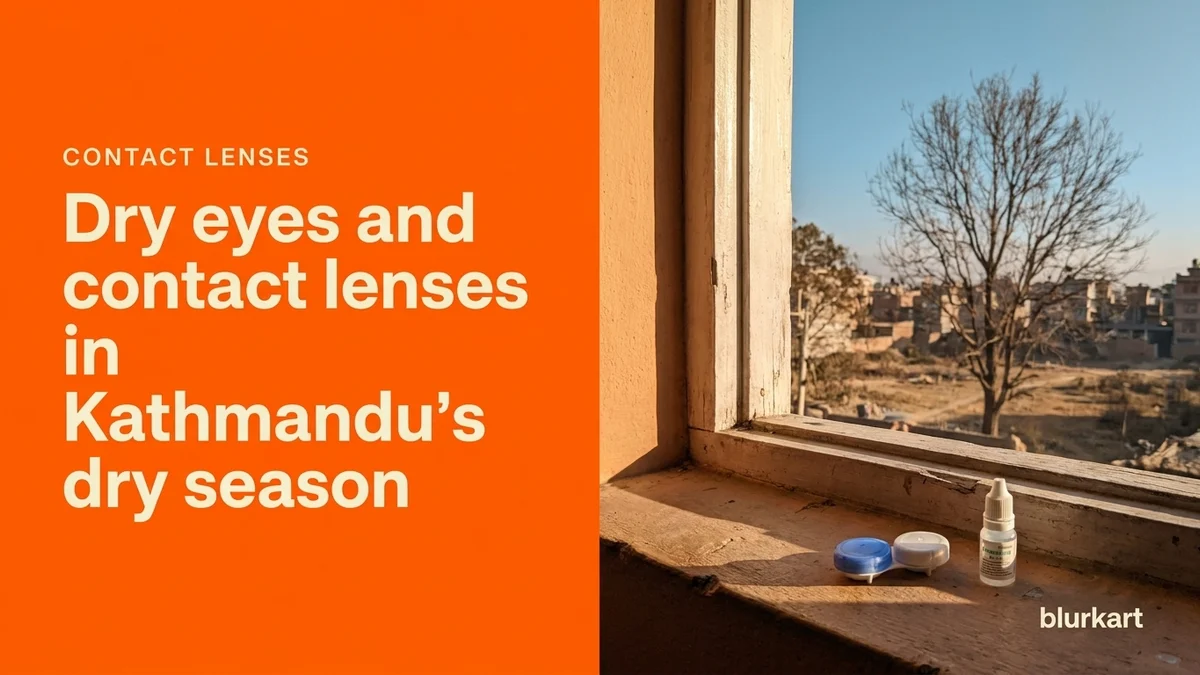
Dry eyes and contact lenses arrive together every winter here. Lenses that felt perfect in August start stinging by mid-afternoon in December, and the lens has not changed. The air has. From November through March the Kathmandu Valley is dry, and a soft contact lens is mostly water sitting on the surface of your eye.
Here is the mechanism, and what actually extends your comfortable hours.
Why the dry season does this
A soft lens holds water in its material, somewhere between 38 and 60 percent depending on type. When the surrounding air is dry, water evaporates from the lens surface. The lens replaces it by drawing from your tear film, and if your tears cannot keep up, the lens loses water, stiffens slightly, and starts to rub against the eyelid on every blink.
That rubbing is the gritty, stinging feeling that arrives around 3 pm. It is not an infection and it is not permanent, but it is a signal to change something.
Two Valley-specific factors make it worse. Winter air is dry to begin with, and indoor heating and fan-forced air dry it further. And dust season overlaps exactly with it, so the tear film is dealing with particles at the same time.
Dry eyes and contact lenses: material beats brand
Older hydrogel lenses rely almost entirely on water content for oxygen transmission, so a dehydrated hydrogel lens becomes uncomfortable quickly.
Silicone hydrogel materials pass oxygen through the silicone rather than only the water, so they can hold less water and still breathe. In practice they stay comfortable longer in dry air. The Bausch & Lomb PureVision2 monthly pack at NPR 4,400 and the ACUVUE OASYS six-lens pack at NPR 3,500 are the silicone hydrogel options we stock for exactly this problem.
If you wear an older hydrogel lens and struggle every winter, changing material is usually more effective than any drop.
Daily disposables help for a different reason
A monthly lens accumulates deposits over its life, and deposits on the surface make dehydration worse in the second half of the month. A daily lens starts every morning fully hydrated and deposit free.
For anyone who only struggles in the dry months, switching to dailies for the season is a reasonable compromise, using something like the SEED 1dayPure pack at NPR 3,900. Our cost comparison is in daily versus monthly contact lenses.
The screen problem on top
Blink rate roughly halves while reading a screen. For a lens wearer at a desk in winter, that is two drying forces at once, which is why office workers notice this far more than people who work outdoors.
Deliberate full blinks, a few at a time whenever you notice the sting, genuinely help. So does the 20-20-20 break habit from computer vision syndrome is real, and mostly fixable, because looking away tends to come with a blink.
Drops, used properly
Use rewetting drops labelled for contact lenses, ideally preservative free. Preservative-free vials can be used as often as you like. Bottled drops with preservatives are fine occasionally but not every hour.
Do not use redness-relief drops with lenses in. They work by constricting blood vessels, they mask what is happening rather than fixing it, and some interact with lens materials.
Jado ma lens: what customers ask
"Garmi ma thik thiyo, jado ma kina samasya?" Humidity. The lens dries faster than your tears can replace the water.
"Paani dherai piye hunchha?" Being properly hydrated helps a little, but this is mostly about the air around the lens rather than the water inside you.
"Din bhari lagauna sakinna, ke garne?" Shorten the day deliberately. Ten hours in December instead of fourteen in September is a sensible adjustment, not a failure.
"Lens phalna parchha ki?" Only if changing material, shortening hours and using drops all fail. Most people solve it with one of the three.
When it is not dryness
Dryness improves when the lens comes out. If your eye stays red, hurts, is sensitive to light, or vision stays blurry after removal, that is not dry season and it needs looking at the same day. Take the lens out and keep it, because it helps to see what you were wearing.
If this is your first winter in lenses at all, what the first week feels like sets expectations. Otherwise, come in for a fitting review. Changing material is free advice, the fitting is free, and it is a far better answer than quietly giving up on lenses every winter.
Frequently asked
- Can I use normal eye drops with contact lenses in?
- Only drops labelled for use with contact lenses, ideally preservative free. Ordinary redness-relief drops can interact with the lens material and make things worse.
- Which contact lenses are best for dry eyes?
- Silicone hydrogel materials in a daily disposable are the most forgiving combination, because the material holds water better and every day starts fresh.
- Should I stop wearing lenses in winter?
- Not necessarily. Shorten the wearing day, switch material, and keep glasses for evenings. If the eye stays red or sore, stop and come in.
- Jado ma lens lagauda aankha sukchha, ke garne?
- Shorten your wearing hours, switch to a daily silicone hydrogel lens, use preservative-free rewetting drops, and blink deliberately at screens. If redness or pain persists, take the lenses out and come in for a check.