
Computer vision syndrome is real, and mostly fixable
Computer vision syndrome is the set of symptoms that build over a screen day: sore or dry eyes, blurred text late in the afternoon, headaches and neck ache. It is caused by reduced blinking, sustained close focus, glare and poor posture rather than by the screen itself. Most of it is fixed by distance, lighting and breaks, at no cost.
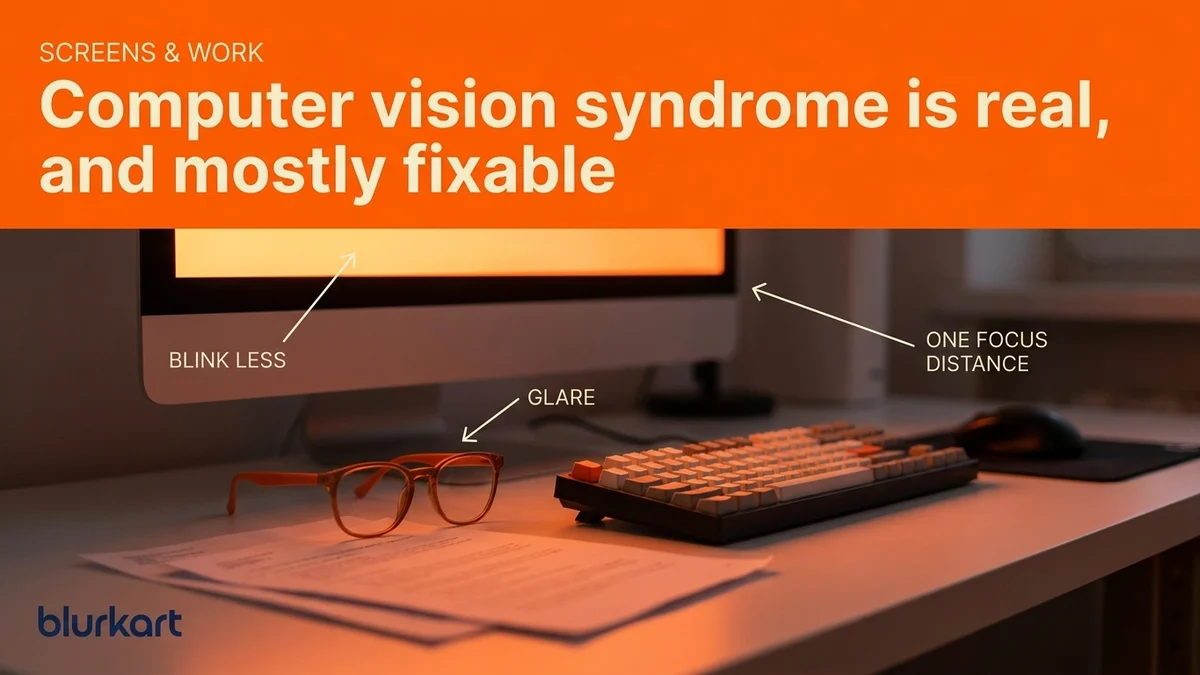
Computer vision syndrome is real, it has no lasting effect on your eyes, and most of it is fixable without buying anything. The symptoms are familiar to anyone who works a screen day in Kathmandu: eyes that sting by late afternoon, text that softens around 4 pm, a headache behind the eyes, and a neck that has quietly locked up.
Five things cause it. Here they are in the order worth fixing.
One: you stopped blinking
A person blinks roughly 15 times a minute in conversation and about half that while reading a screen. Each missed blink leaves the tear film to evaporate a little longer. By evening the surface of the eye is dry, and dry eyes sting, feel gritty and water paradoxically.
This is worse in the Valley from November to March, when humidity drops and rooms are dry. A conscious full blink whenever you notice the sting, and a glass of water on the desk, do more than any eye drop.
Two: one focus distance for hours
The muscle that focuses your eye is holding a contraction all day, the same way your shoulder would if you held a bag at one height for eight hours. That is why text blurs late in the day and clears after a break.
The 20-20-20 habit exists for this: every 20 minutes, look at something about 20 feet away for 20 seconds. Set a phone timer for the first week until it becomes automatic. It is the single most effective free fix we know.
Three: glare you stopped noticing
A window behind the screen makes you stare into brightness. A window behind you throws a reflection onto the screen. Overhead tube light does both. Your eyes work through that scattered light all day without registering it.
Put the window to your side. Point desk lamps at the wall or the keyboard, never at the screen. Match screen brightness to the room using a sheet of white paper as the reference: the screen should look about as bright as the paper, not like a torch.
Four: the desk is the wrong shape
Screen at arm's length, roughly 60 to 70 cm, with the top edge at eye level so you look slightly down. Laptops break both rules by design, which is why a laptop stand and a separate keyboard are the best small purchase a screen worker in Nepal can make. The full set of measurements is in how to set up a desk that does not wreck your eyes.
Five: an uncorrected prescription
This is the one that turns a manageable day into a painful one. A small amount of long-sightedness or astigmatism costs you nothing while walking around and everything while reading a screen, because the focusing muscle compensates continuously.
A lot of people discover at 35 that they have needed a mild lens for years. The test is free at both our Lalitpur showrooms, and it takes ten minutes.
Computer vision syndrome: where a lens genuinely helps
An anti-reflective coating removes the reflections bouncing between your lens surfaces and the screen, and that is a real, noticeable improvement, as we argue in is an anti-reflective coating worth the extra NPR. Our multi-coated lens at NPR 1,800 is the one we fit for desk workers, usually in something light like the Premium Rectangle Frame with blue light protection at NPR 1,500.
Over 40, an office lens that covers screen and desk distance often beats a full progressive at a desk, because the mid zone of a progressive is narrow.
The blue filtering part of the story is minor, and we say so honestly.
Computer chalauda aankha dukhne: common questions
"Screen le aankha bigarchha?" No. There is no evidence that normal screen use damages eyes. It causes symptoms, not damage.
"Ratri ma dark mode le farak parchha?" In a dark room, yes. In a bright room, a dark screen forces your pupils to fight the surroundings. Match the screen to the room instead.
"Din bhari kaam garne manche lai kun lens ramro?" Multi-coated single vision under 40, an office lens over 40, and in both cases a proper anti-reflective layer.
"Eye drop halne ki?" Preservative-free rewetting drops are fine for dry days, and lens wearers should read dry eyes and contact lenses in the dry season. They treat the symptom; blinking and humidity treat the cause.
The order we would fix it in
Move the screen. Fix the lighting. Start the 20-20-20 habit. Give it a week. If the symptoms are still there, book the free eye test, because at that point it is your prescription rather than your desk. A frame like the Premium Square Acetate at NPR 1,500 with a multi-coated lens is what most desk workers walk out with, but only after the free fixes have had their chance.
Frequently asked
- Is computer vision syndrome permanent?
- No. It causes no lasting damage to the eye. The symptoms come and go with your habits and setup, which is why changing the setup fixes it rather than treating it.
- Do I need special computer glasses?
- Many people do not. If you are over 40, or already wear glasses, an office lens or an anti-reflective coating helps a lot. Under 40 with no prescription, fix the desk first.
- Why is my vision blurry only at the end of the day?
- The focusing muscle has held one distance for hours and is slow to relax. It clears after a break or a night's sleep. If it does not clear by morning, get tested.
- Computer chalauda aankha pola ra dukhchha, ke garne?
- Move the screen to arm's length, put the top edge at eye level, keep windows to the side, and look 20 feet away for 20 seconds every 20 minutes. If it still hurts after a week, get a free eye test; a small uncorrected power is a common cause.