
Exam season eye care for students in Nepal
Most exam-season eye trouble comes from lighting, distance and unbroken hours rather than from studying itself. Keep the book about 35 to 40 cm away, light the whole room rather than just the page, take a 20 second distance break every 20 minutes, and stop reading on a phone in a dark room.
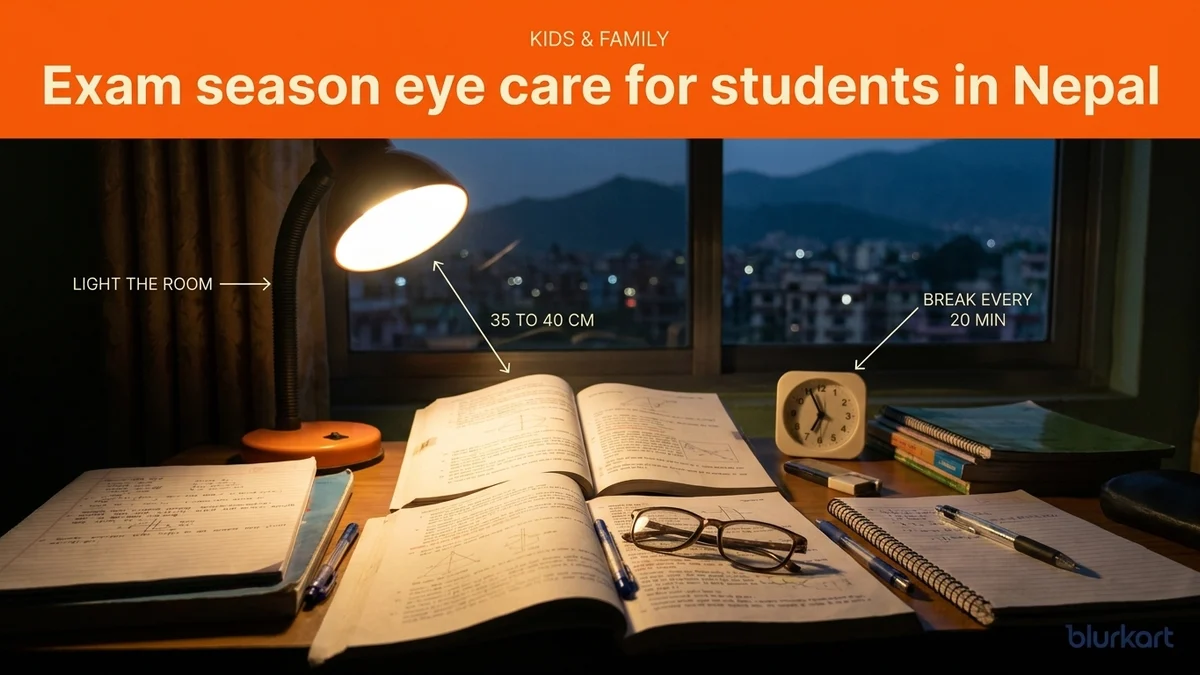
Eye care for students during exam season is almost always about lighting, distance and unbroken hours, not about studying too much. Studying does not damage eyes. It does make an uncorrected prescription impossible to ignore, which is why so many students in Nepal get their first glasses in the months before a board exam.
Here is what to change, in the order that helps most.
Eye care for students starts with the room, not the page
The most common study setup we hear about is a bright desk lamp in an otherwise dark room. That creates a pool of light with darkness around it, and your pupils spend the evening adjusting between the two.
Light the room with a ceiling light and add the desk lamp on top. Point the lamp at the page from the side opposite your writing hand, so your hand does not cast a shadow across what you are reading.
If the power is out and you are on an inverter with dim light, take more frequent breaks rather than leaning closer, which is the instinctive and wrong response.
Distance and posture
Hold a book about 35 to 40 cm from your eyes, roughly elbow to knuckle. Closer than that and the focusing muscle works much harder for no gain in clarity.
Raise the book or prop it on a stand rather than bending your neck over a flat desk. The neck ache students report at the end of a study day is posture, and it feeds the headache.
Breaks, the version that works
Every 20 minutes, look at something about 20 feet away for 20 seconds. Out the window is ideal; across the room is fine.
This works because the focusing muscle has been holding one contraction. Twenty seconds of distance lets it release. It is free, it takes almost no time out of a study session, and it is the single most effective thing on this page. Our longer explanation is in computer vision syndrome is real, and mostly fixable.
The phone in the dark
The worst habit of exam season is finishing a study block and then reading a phone in bed with the lights off. A bright screen against a dark room forces maximum pupil adjustment, close distance keeps the focusing muscle contracted, and blink rate falls further because of the screen.
If you are going to do it, turn on a lamp. It sounds trivial and it removes most of the strain.
Screens for study, set up properly
More study happens on laptops now than on paper. The same rules apply as for any screen day: arm's length, top edge at eye level, window to the side, screen brightness matched to the room. A laptop stand and a separate keyboard fix the two worst problems at once. The measurements are in how to set up a desk that does not wreck your eyes.
The signs that mean a test, not a break
Fatigue that clears after a night's sleep is normal. These are not:
- Squinting at the board or at notes.
- Sitting progressively closer to the TV or the board over a term.
- Tilting or turning the head consistently to one side to read.
- Losing the line while reading, or skipping words.
- Headaches that arrive every study evening and clear on weekends.
Any of those means an eye test rather than more effort. It is free at both our Lalitpur showrooms, takes about ten minutes, and if a small power is found, a light pair like the Blurkart Cyber-Shield at NPR 999 or the Premium Rectangle Frame at NPR 1,200 is not a big expense in an exam year.
Padhne bela ko aankha: what parents and students ask
"Dherai padhda aankha bigrinchha?" No. It causes tiredness, not damage. The tiredness is a signal to change the setup, not to study less.
"Chasma lagayo bhane power badhchha?" No. Correcting vision is what a developing visual system needs. Leaving it uncorrected is what causes problems.
"Exam agadi test garne bela ho?" Before the study term starts, ideally. A student discovering they need glasses two days before the exam is the version nobody wants.
"Blue cut chasma chahinchha?" Not especially. The anti-reflective coating is the useful part, and good lighting matters more than either. We were honest about this in do blue light glasses actually work.
A study-week checklist
Room light plus desk lamp. Book at 35 to 40 cm, propped up. Twenty second distance break every twenty minutes. Lamp on if the phone comes out at night. Sleep, because a tired body makes tired eyes worse.
Do all that for a week. If the headaches are still arriving every evening, the cause is not the timetable, and ten free minutes with an optician will tell you what it is.
Frequently asked
- Does studying too much damage your eyes?
- No. Long near work causes fatigue, not damage. The tiredness is real and it fades with breaks and sleep.
- Is reading in dim light bad for the eyes?
- It does not damage them, but it makes the focusing muscle work harder and brings on headaches faster. Good even lighting genuinely helps during exam months.
- My child gets headaches while studying. Is it the eyes?
- Often. An uncorrected small prescription shows up exactly when near work increases. A free test rules it in or out in ten minutes.
- Padhda tauko dukhchha, aankha ko samasya ho?
- It can be. Uncorrected power shows up when study hours increase. Fix the lighting and distance first, and if headaches continue after a week, get the free eye test.