
Glasses that sit right under a helmet
Glasses work under a helmet when the temples are thin, straight and flexible rather than thick and curved. Put the helmet on first, then slide the glasses in along the temple channel. Thick acetate arms are what cause the pressure headache riders blame on the helmet, and a flexible TR90 frame usually solves it.
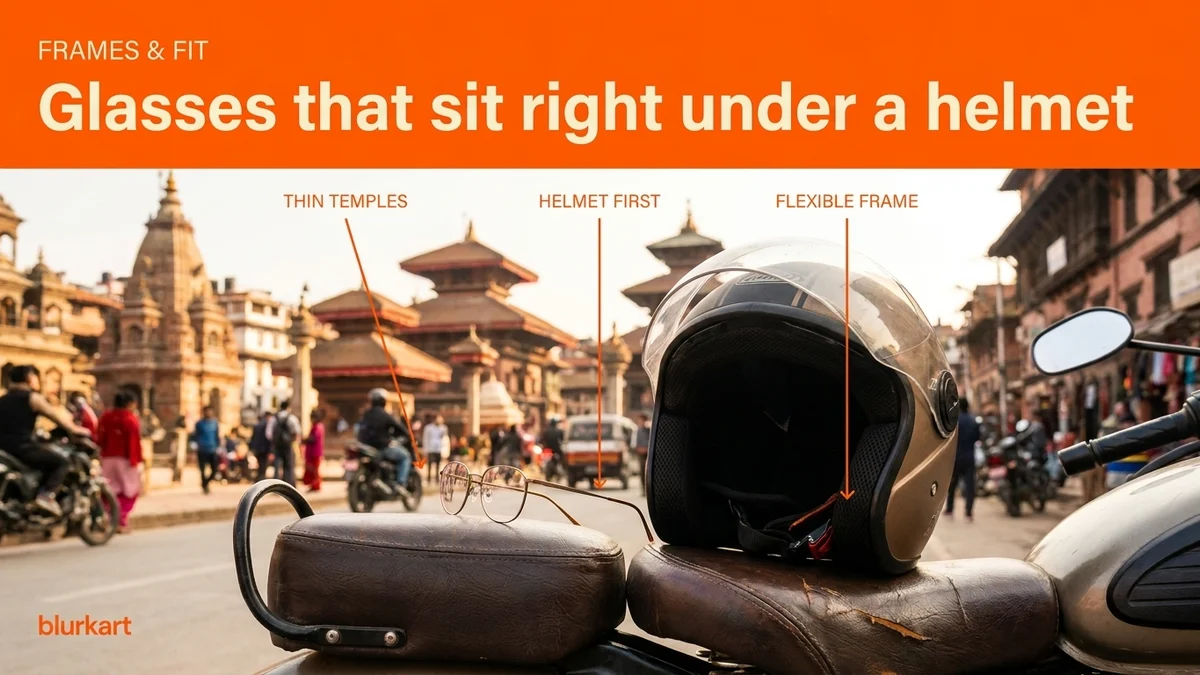
Glasses fit under a helmet when the temple arms are thin, straight and flexible. That is nearly the whole answer. The frames that hurt after twenty minutes on a bike are the ones with thick acetate arms and a strong curve behind the ear, because the helmet padding presses them into the side of your head.
Written for everyone riding a two-wheeler through Kathmandu with a prescription, which is a lot of you.
Glasses under a helmet: what to look for in a frame
Thin temples. This is the single biggest factor. A 2 mm metal or TR90 arm slides into the helmet channel; a 6 mm acetate arm has nowhere to go and transfers the padding pressure straight to your skull.
A straight or gently curved temple. Aggressive curl behind the ear catches on the helmet lining every time you put it on and slowly bends out of shape.
Flexible material. TR90 bends and returns. Metal bends and stays bent. Acetate is stiff and snaps at the hinge under repeated sideways force. For riders we reach for TR90 or a thin metal frame like the Premium Round Metal Frame at NPR 999, and our comparison of materials is in acetate versus metal versus TR90.
Spring hinges, because a rider's frame gets pulled and twisted far more than a desk worker's.
The order matters
Helmet on first. Then slide the glasses in from the front, running the temples along the channel above your ears.
Most people do it the other way round, and the helmet drags the temple arms across their ears on the way down. That is uncomfortable, it bends the frame a little each time, and over a year it is why the glasses no longer sit straight.
Reverse it when taking them off: glasses out first, then helmet.
Fogging is mostly the visor
Riders blame their lenses, but the visor usually fogs first because it is the coldest surface and it traps your breath. In Kathmandu winter mornings both can go at once at a traffic light, which is the worst moment for it.
What helps: crack the visor open a centimetre when stationary, use an anti-fog film or spray on the visor, and choose a lens with a hydrophobic coating so lens fog clears in seconds rather than minutes. Our ranked fixes are in fixes for fogging glasses.
Dust and the daily clean
A rider's lenses collect more road dust than anyone else's, and dust plus a dry wipe is how lenses get scratched. Rinse before wiping, every time. The full routine is in how to clean glasses without scratching them.
Keep a hard case under the seat rather than tossing the glasses in a bag, and never leave them on the seat in May; a bike seat in direct sun gets hot enough to warp an acetate frame.
When contacts are the better answer
For long rides, daily contact lenses remove every problem in this post at once. No temple pressure, no fogging lenses, no dust film, and any sunglasses you like over the top including a wraparound.
The trade-off is dryness from wind and the dusty commute, which is why we suggest daily disposables rather than monthlies for riders, and glasses for the evening. A pair like the Premium Rectangle Frame at NPR 1,200 as the off-bike pair covers that.
Helmet ra chasma: what riders ask us
"Helmet lagauda chasma le kaan dukhauchha." Thick temples plus padding. Thinner arms, and we can open the temple angle slightly so they sit further from the skull.
"Full face ki half face ramro?" Full face protects better and fogs more. Either works with thin temples; half face is easier for glasses and worse in dust.
"Sunglass power sahit banauna milchha?" Yes, and for riding a flatter frame is better than a heavy wrap, which we explain in prescription sunglasses in Nepal.
"Chasma bangieko chha, milauna milchha?" Bring it in. Straightening and refitting is free, and for riders we recommend doing it every few months rather than waiting until it is obvious.
What we would set you up with
A light TR90 or thin metal frame with spring hinges and a multi-coated hydrophobic lens, adjusted with the helmet you actually wear. Bring the helmet to the fitting if you can. It takes five minutes and it is the difference between glasses you ride in and glasses you take off at the first traffic light.
Frequently asked
- Should I put the helmet or glasses on first?
- Helmet first, then slide the glasses in along the channel above your ears. Putting the helmet on over glasses drags the temples across your ears and bends the frame over time.
- Why do I get a headache after riding with glasses?
- The helmet padding presses the temple arms into the side of your head. Thinner, more flexible temples fix it. Bring the frame in and we can also open the temple angle slightly.
- Do glasses fog inside a helmet?
- The visor usually fogs first because it is colder. For the lenses, an anti-fog film or a hydrophobic lens coating helps, and cracking the visor at a stop clears both.
- Helmet bhitra chasma lagauda dukhchha, ke garne?
- The temple arms are too thick. Switch to a thin TR90 or metal frame, put the helmet on first and slide the glasses in, and have the temple angle adjusted free at our showroom.