
Why glasses slide down, and the bridge that fixes it
Glasses slide because the bridge is too wide or sits too high for your nose, not because the frame was cheap. Metal frames with adjustable nose pads solve it in a minute at the counter. In acetate frames, a keyhole bridge or an Asian fit design with a lower, wider bridge and higher pads is the fix.
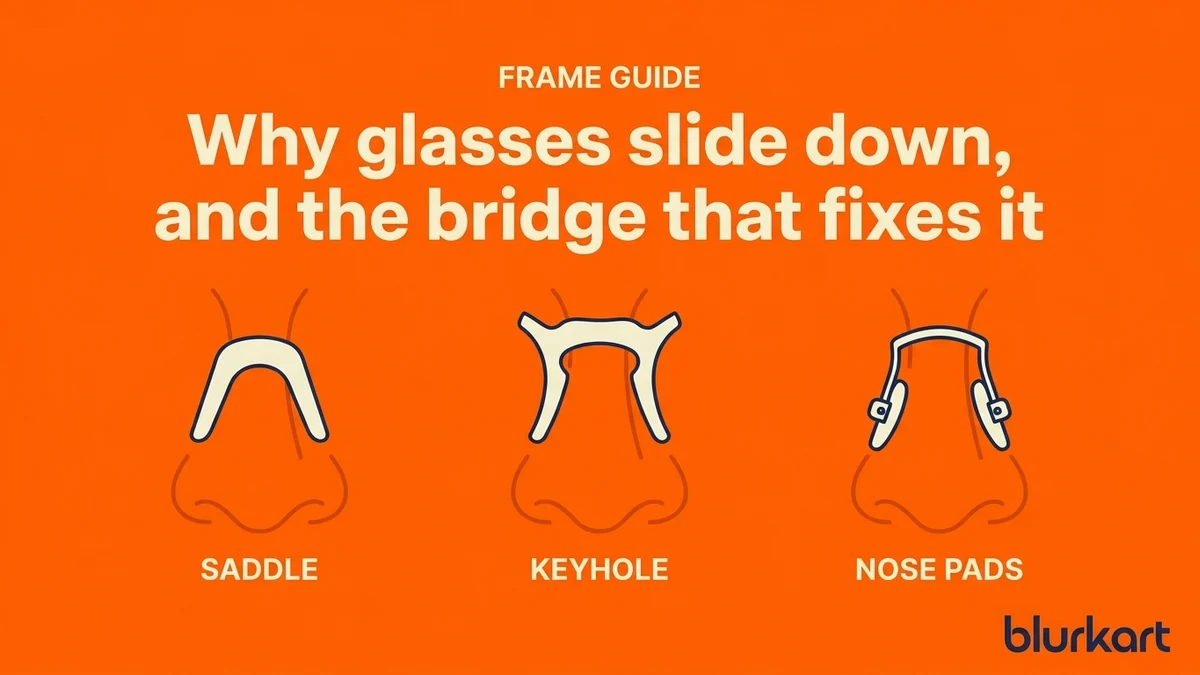
If your glasses slide down your nose all day, the frame is not cheap and you are not doing anything wrong. The bridge is the wrong shape or size for your nose. It is one of the most common fit problems we see across the counter in Lalitpur, and in most cases it takes about a minute to fix.
Why glasses slide down so often here
A large share of the frames sold in Nepal are designed around a nose bridge that is higher and narrower than many Nepali faces have. When the bridge sits too high, the frame perches and gravity does the rest. When it is too wide, there is nothing holding it at all.
The result is the same: pushing the glasses up dozens of times a day, marks on the nose, and a frame that ends up too far down to look through properly, which quietly causes eye strain on top of the annoyance.
Fix one: adjustable nose pads
Metal frames carry small pads on flexible arms. Those arms can be squeezed closer for a narrower nose, spread wider, angled, and raised or lowered. An optician can set them to almost any nose in under a minute.
This is the most adaptable option and the reason we often recommend a metal frame like the Premium Round Metal Frame at NPR 999 to anyone who has struggled with sliding before. Pads are also replaceable when they yellow or harden.
Fix two: a keyhole bridge
Most acetate frames use a saddle bridge, a smooth curve that sits across the top of the nose and spreads weight along it. That works beautifully on a higher bridge and slides on a flatter one.
A keyhole bridge is shaped like an old keyhole and rests against the sides of the nose instead of the top. For a lower bridge it grips where there is something to grip, and it spreads weight better, which also reduces the red marks people complain about.
Fix three: an Asian fit frame
Some makers produce a version of a frame with a lower, wider bridge, pads that sit higher, and more forward tilt in the temples. The effect is that the frame sits further from the face, so lenses do not rest on cheeks and eyelashes do not brush the lens.
The name varies by brand and the design is not universal, so the practical approach is to tell us the problem rather than ask for a label. We will pull the frames in the shop that actually sit correctly on your face.
What to ask for in a shop
Do not ask for a cheaper or a tighter frame. Ask three specific things:
- A smaller bridge number. The second number inside the temple arm is the bridge in millimetres; if your current pair is 20, try 16 or 17. Our guide to what 52-18-140 means explains where to read it.
- Adjustable nose pads, if you are open to a metal frame.
- A keyhole bridge, if you want acetate.
Then have the frame adjusted on your face before you leave, not after a week of annoyance.
Weight is the other half
A heavy frame slides sooner because there is more mass for the same grip. A thick acetate front can weigh 30 grams against under 15 for a light metal or TR90 frame. If your last pair left deep marks and slid, going lighter helps as much as changing the bridge, as we covered in acetate versus metal versus TR90.
Chasma jharne samasya: what customers ask
"Sasto chasma bhayera jhareko ho?" No. Price has nothing to do with it. Expensive frames slide just as readily if the bridge is wrong.
"Aafai banauna milchha?" Nose pads can be squeezed gently by hand, but bending them too far snaps the arm, and acetate needs controlled heat. Bring it in; adjustment is free.
"Arko pasal bata kineko chasma pani milauchha?" Yes. We adjust any frame, ours or not, at no charge.
"Naak ma daag basyo ni?" That is weight plus pressure in one spot. Lighter frame, wider pads or a keyhole bridge all reduce it, and silicone pad replacements cost very little.
What to do today
Bring the pair you already own to either Lalitpur showroom. Most sliding is solved with an adjustment while you wait. If the bridge is simply too big to rescue, we will show you what fits and why, including the option to fit your existing lenses into a better-shaped frame like the Premium Rectangle Frame at NPR 1,200 rather than buying lenses again.
Frequently asked
- Can any glasses be adjusted to stop sliding?
- Metal frames with nose pads, almost always. Acetate frames can be heated and reshaped a little, but if the fixed bridge is badly oversized, the honest answer is a different frame.
- What is a keyhole bridge?
- A bridge shaped like an old keyhole that rests against the sides of the nose rather than sitting on top of it. It suits lower or flatter bridges and spreads weight better.
- What does Asian fit mean?
- A frame designed with a lower, wider bridge, raised nose pads and more forward tilt, so the lenses sit away from cheeks and eyelashes. It suits many Nepali faces better than a standard fit.
- Chasma naak bata jharchha, ke garne?
- The bridge is too wide or too high. Bring the frame to either Lalitpur showroom and we adjust it free; if it is acetate with a fixed bridge that is badly oversized, we will show you frames with a smaller bridge or adjustable pads.