
Gaming glasses: marketing or useful?
Gaming glasses are usually a lightly tinted lens sold on blue-light claims the evidence does not support. What genuinely reduces fatigue in a long session is the anti-reflective coating, correct screen distance and blinking. If you need correction, a proper screen prescription helps far more than any gaming label.
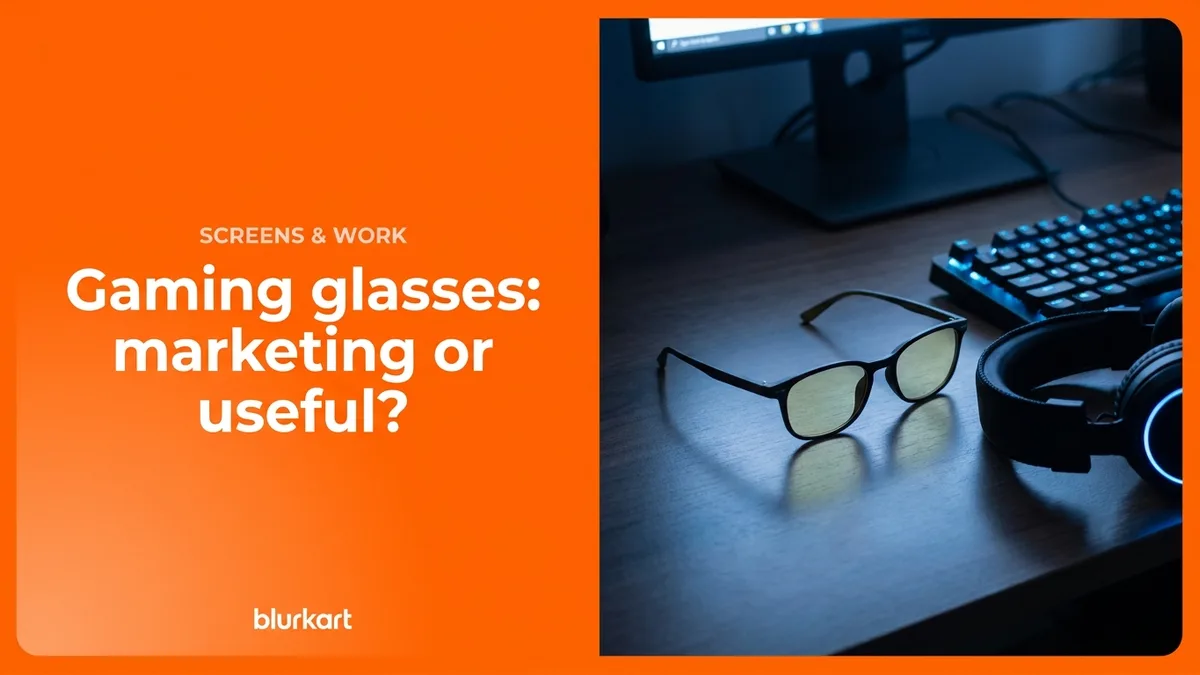
Gaming glasses are sold hard, usually with a yellow tint, an aggressive frame and a claim about blue light and reaction times. Some of it is real and most of it is not, and the split is easy to describe.
What gaming glasses claim and what holds up
The blue light claim. The core marketing line is that screens emit harmful blue light and the lens filters it. No study has shown that blue light from screens damages the retina, and daylight contains far more of it than any monitor. The sleep argument is weaker than advertised too: screen habits and room lighting in the hour before bed matter far more than a lens. We went through this in whether blue light glasses actually work.
The reaction time claim. There is no plausible mechanism and no credible evidence. Treat it as a signal about the seller.
The anti-reflective coating. This one is real. A multi-layer anti-reflective lens stops light bouncing off the front and back surfaces of the lens, which is what produces the low-grade glare that makes a four-hour session tiring. Most of the comfort people genuinely report from gaming glasses comes from here, not from the tint.
The tint has a cost
A yellow or amber tint shifts every colour you see. For a competitive shooter, a colour-graded game, or anything where you are judging shades, that is a real disadvantage rather than a neutral trade.
It also tends to be the cheapest part of the product to add, which is why it is on the box.
What to buy instead
If you do not need vision correction: a zero-power lens with a proper multi-coated anti-reflective finish. At Blurkart that is NPR 1,800 for the lens plus a frame from NPR 999. Clear, no colour shift, and the part that actually works.
If you do need correction: get the prescription right for screen distance rather than buying a gaming label. Your monitor sits about 60 to 70 centimetres away, which is neither reading distance nor infinity. Under 40 your own focusing handles that. Over 40 it increasingly does not, and a lens set for that distance is a much bigger improvement than any tint. Whether you need computer glasses covers it, and office lenses cover the wide-zone version.
What helps more than any lens
Blinking. You blink about a third as often at a screen, which dries the tear film. If your eyes sting rather than ache, that is the cause and no lens fixes it. A preservative-free lubricating drop does.
Distance and height. Monitor at roughly arm's length, top of the screen at or just below eye level.
Brightness matched to the room rather than glowing against a dark wall. Dark mode vs light mode covers that properly.
Breaks. Every twenty minutes, twenty seconds looking at something about six metres away. On a long session, actually stand up occasionally. Desk setup has the rest.
The frame matters more than the marketing
For long sessions with a headset, the frame is the thing you will actually notice. Thin temple arms sit far more comfortably under headphone cushions than thick acetate, which presses the arm into your skull and gives you an ache within an hour. That is a genuine gaming-specific requirement, and it has nothing to do with the lens.
Come to either showroom with your headset if you want to check it properly. The eye test is free, and screen glasses start at NPR 999 for the frame.
What to check on the box
Ask three questions of any pair sold as gaming glasses. Does it have a multi-layer anti-reflective coating, named as such rather than described as anti-glare? Is the lens clear or tinted, and if tinted, are you willing to accept the colour shift? And what is the frame width, because a frame too wide for your face slides no matter what the lens does.
If the seller cannot answer the first one, the product is a tint in a frame.
Worth knowing that a plain prescription or zero-power lens with a good coating is the same product without the branding, usually cheaper, and available in a frame you would actually wear outside the house. That is what we would fit.
Frequently asked
- Will gaming glasses improve my reaction time?
- No. There is no mechanism for a tint to make you faster, and nothing credible shows it. If a marketing page claims a competitive edge, that is the point to stop reading.
- Is the yellow tint bad for gaming?
- It shifts colour perception, which is a real downside if colour accuracy matters to you, in a competitive shooter or anything art related. A clear lens with a good anti-reflective coating avoids the trade entirely.
- Gaming glasses le saachai kaam garchha?
- Pahenlo tint le dherai kaam gardaina. Anti-reflective coating le chai screen ko chamak ghatauchha ra tyo nai sachho phaida ho. Blurkart ma multi-coated lens NPR 1,800 ma paincha.