
Anti-reflective coating: is it worth the extra NPR?
Yes for anyone who drives at night, works at a screen or is photographed often. An anti-reflective coating lets about 8 percent more light through the lens and removes the ghost images from headlights and monitors. At Blurkart it is the difference between the NPR 750 basic lens and the NPR 1,800 multi-coated lens.
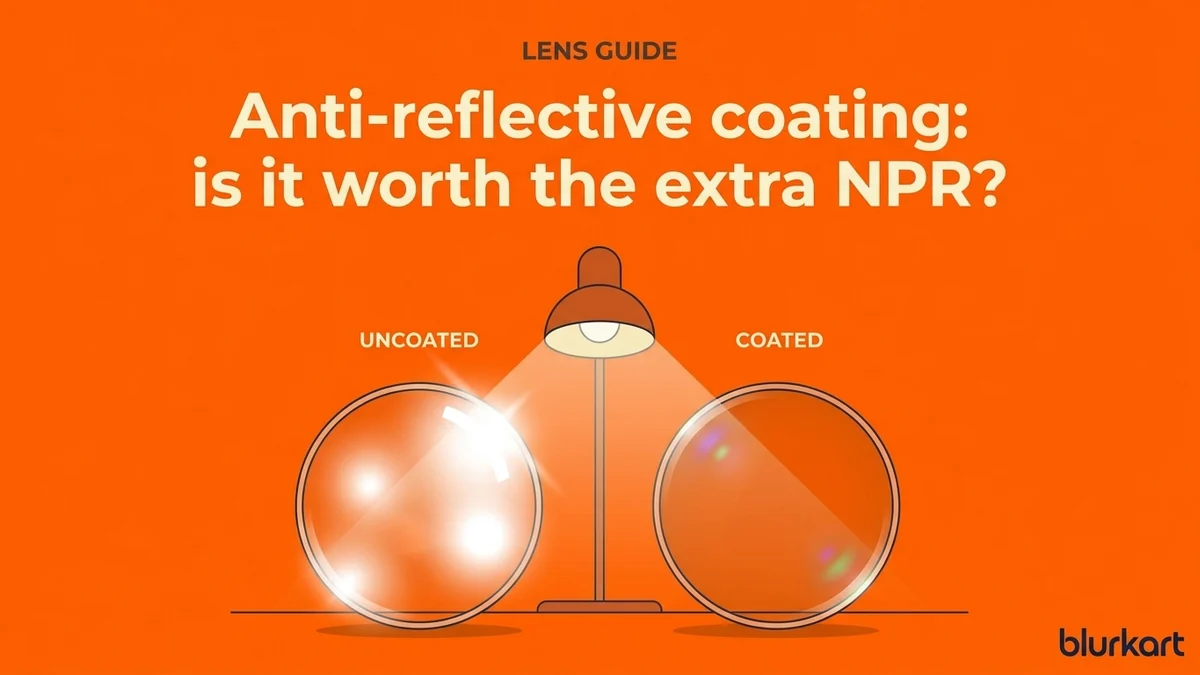
An anti-reflective coating is worth the extra money for almost everyone who wears glasses all day, and it is close to essential if you drive at night or sit at a screen. It removes the reflections you see on the lens and, more importantly, the ones that bounce around inside it. At Blurkart it is the difference between the NPR 750 basic lens and the NPR 1,800 multi-coated one. The only pair that can skip it is the spare in the drawer.
What the coating does
A bare plastic lens reflects around 8 percent of the light that hits it, split between the front and back surfaces. That light does two annoying things. It bounces back at the viewer, so people see white rectangles where your eyes should be. And it bounces around between the surfaces, producing faint ghost images and halos, which you notice most as starbursts around headlights and street lamps.
An anti-reflective coating is a stack of microscopically thin layers that cancel those reflections. A good one brings reflection below 1 percent. More light reaches your eye, contrast improves, and the ghosts disappear.
Where you feel the difference
Night driving
Oncoming LED headlights on the Ring Road are the test. Without a coating each light grows a halo and a streak. With one, it is a point of light again. This is the single most common reason customers come back to say thank you.
Screens
Monitors, phones and the overhead tube light all reflect off an uncoated lens, and you look through those reflections all day without registering them. Removing them is a large part of why coated lenses feel less tiring by evening. The other half is the desk itself, which we cover in setting up a desk that does not wreck your eyes.
Video calls and photos
On a call, an uncoated lens shows the other person your screen. With a camera flash, the lens goes white. Coated lenses look nearly invisible in both. For anyone who is on camera for work, this alone justifies the cost.
Anti-reflective coating prices at Blurkart
Our single vision lens tiers are priced by their coatings:
- Blue coat, single coated: NPR 750. An anti-reflective layer on one surface with a mild blue filter.
- Multi-coated blue coat: NPR 1,800. Anti-reflective on both surfaces, a hard scratch-resistant layer, and a hydrophobic top coat that sheds water and fingerprints.
- Blue filter, fully digital: NPR 2,990. The same multi-coating on a digitally surfaced lens with the filter built into the material.
The NPR 1,800 option is the one we fit most, and it is where the coating stops being a nice extra and becomes the reason the lens feels good. It goes into any frame, including a budget one like the Premium Rectangle Frame at NPR 1,500.
The catch: coatings need care
A coating is a surface layer, and a dry wipe with a shirt drags dust across it. Rinse first, then soap, then microfibre; the full routine is in our post on cleaning glasses without scratching them. Treat it well and a good coating lasts the life of the lens. Treat it badly and it crazes in a year, which is what happened to the peeling pairs people bring us from elsewhere.
When to skip it
A backup pair you keep for emergencies. Reading glasses used ten minutes a day. Children's first pairs that will be outgrown in a year, where the impact resistance of the lens matters more than its coating. Everything else, coat it.
Anti-glare chasma in Nepal: the names get confusing
In Nepal the same coating gets called anti-glare, anti-reflective, AR, ARC and sometimes just "coating". They are all the same thing. "Blue cut" is a different, extra layer that filters some blue light, and it usually comes on top of an anti-reflective coating rather than instead of it.
What to ask for in a shop, in plain words: "anti-glare coating dubai side" for the double-sided version, and "hard coat pani chha?" for the scratch-resistant layer. If a shop offers anti-glare for NPR 300, it is a single thin layer that will craze within a year. A proper multi-layer coating on both sides costs more to make, which is why ours sits at NPR 1,800 and not NPR 300.
The night-driving test is the honest one. If oncoming headlights on the Ring Road have grown halos, your lenses either have no coating or a worn one.
If your current lenses have no coating and you have wondered why night driving feels harder than it used to, that is likely why. Replacement lenses go into your existing frame, and the test to confirm the power is free at both Lalitpur showrooms.
Frequently asked
- Why do coated lenses have a green or purple tint?
- That is residual reflection from the coating layers. A faint green sheen is normal and it is the sign the coating is there.
- Does AR help with headlights at night?
- It is the single biggest improvement for night driving. Halos and starbursts around oncoming LED headlights drop noticeably.
- Can a coating be added to my existing lenses?
- No. It is applied during manufacture. Replacement lenses with the coating start at NPR 1,800 and fit into your current frame.
- Is blue coat the same as anti-reflective?
- Our blue coat lenses are anti-reflective coatings with a blue-filtering tint added. The anti-reflective part is what most people actually benefit from.
- Anti-glare chasma ko price kati ho?
- At Blurkart a single-sided anti-reflective lens is NPR 750, the double-sided multi-coated lens with a hard coat is NPR 1,800, and the fully digital version is NPR 2,990. Lenses fit into your existing frame.