
Anti-glare screen protectors or anti-glare glasses?
A matte anti-glare screen protector scatters reflections coming off the screen, at the cost of slightly softer text. An anti-reflective lens coating removes reflections off your glasses, which a protector cannot touch. If you wear glasses, the coating is the higher-value fix; if you do not, the protector is the only option of the two.
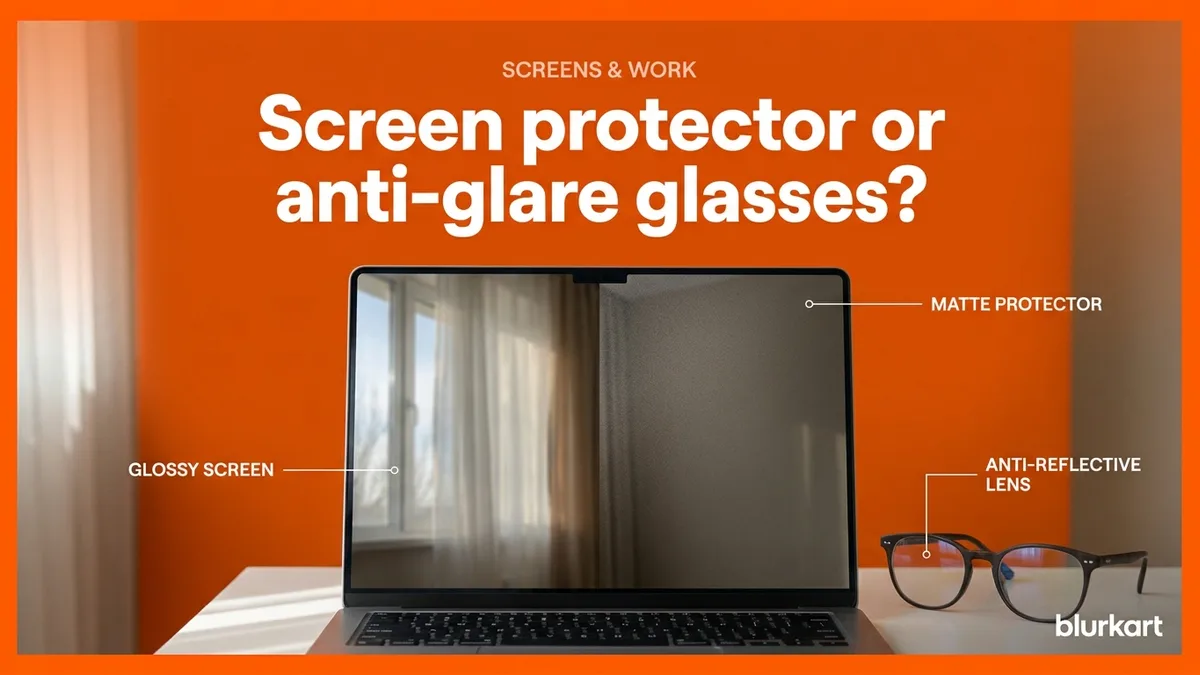
Anti-glare screen protectors and anti-reflective lens coatings get compared as if they are competing products. They are not. They deal with two different reflections, and knowing which one is bothering you decides which to buy.
What anti-glare screen protectors do
A matte protector has a slightly textured surface. Instead of bouncing a window or a ceiling light back at you as a sharp bright rectangle, it scatters that reflection in every direction so it becomes a faint haze.
That works well against a specific and very common complaint: a window or a tube light reflected in the screen, sitting on top of what you are trying to read.
The cost is that the same scattering happens to the light forming the image. Text looks slightly softer and colours slightly less punchy than on a glossy screen. On a high-resolution display most people adapt within a day. On a low-resolution one it is more noticeable.
What an anti-reflective lens coating does
This treats a reflection the protector cannot reach: the one bouncing off your own glasses.
If you wear glasses, light from behind and beside you hits the back surface of your lenses and bounces forward into your eye. Light in front hits the front surface and bounces away, which is why photographs show two white discs instead of your eyes. Both reduce contrast on whatever you are looking at.
A multi-layer anti-reflective coating cancels most of that. It is the same layer that stops headlights smearing at night, and it is the single lens upgrade with the most noticeable daily effect. Lens coatings explained goes through each layer.
Which one to buy
If you wear glasses, start with the coating. Reflections off your lenses are usually the larger share of the glare, and a screen protector does nothing about them. At Blurkart a multi-coated single vision lens is NPR 1,800 against NPR 750 for a basic blue coat, and that gap is the coating.
If you do not wear glasses, the protector is your only option of the two, and a good matte one is worth having if you sit near a window.
Both together is fine and does help, as long as you accept slightly softer text.
The free fix to try first
Before buying either, move the screen. Most glare in Nepali offices and homes comes from a window directly behind or directly in front of the monitor.
Put the window to the side instead. Angle the screen so no light source is reflected in it, which you can check in ten seconds by turning the monitor off and looking at what appears in the black surface. Whatever you see there is what you are fighting all day.
Also drop the brightness until the screen matches the room rather than glowing against it. That costs nothing and solves a surprising share of what people buy products for. Desk setup covers position and height.
If none of that works
Then the problem is probably not glare. Eyes that sting are dry, from blinking about a third as often at a screen, and no coating or protector fixes that. Eyes that ache are usually a focusing problem, which after about 40 often means the screen sits at a distance your eyes no longer manage comfortably.
Computer vision syndrome separates the symptoms, and whether you need computer glasses covers the prescription side. The eye test is free at both showrooms and screen glasses start at NPR 999.
Matte or glossy protector
If you go the protector route, the choice is matte or glossy, and it is a genuine trade rather than a quality difference.
Matte scatters reflections and softens text slightly. It suits a desk near a window, an office with overhead tubes, and anyone who works from the same seat all day.
Glossy keeps text crisp and colours accurate but mirrors everything behind you. It suits a controlled lighting setup, or anyone doing colour work where accuracy matters more than glare.
Whichever you pick, clean it the way you would a lens: never dry wipe a dusty surface. A scratched matte protector scatters light unevenly, which is worse than no protector at all, and unlike a lens there is no argument for keeping a damaged one since replacing it costs very little.
Frequently asked
- Do matte screen protectors reduce sharpness?
- Yes, slightly. The matte surface scatters light in every direction, including the light forming the image, so text looks a touch softer. On a high-resolution screen most people stop noticing within a day.
- Which should I buy first?
- If you wear glasses, the anti-reflective coating, because reflections bouncing off your own lenses are usually the bigger source of glare and a protector does nothing about them. If you do not wear glasses, the protector.
- Screen protector ki anti-glare chasma, kun kinne?
- Chasma lagaunuhunchha bhane anti-reflective coating nai pahila. Tyo coating le chasma ma parne pratibimba hataunchha, jun screen protector le gardaina. Chasma lagaunuhunna bhane matte protector thik.