
Do you need computer glasses if you already wear glasses?
If you already wear single vision glasses, you usually do not need a separate computer pair. Add an anti-reflective coating instead. A dedicated screen pair genuinely helps two groups: people over about 40 whose reading add fights their screen distance, and progressive wearers who end up tilting their head back all day.
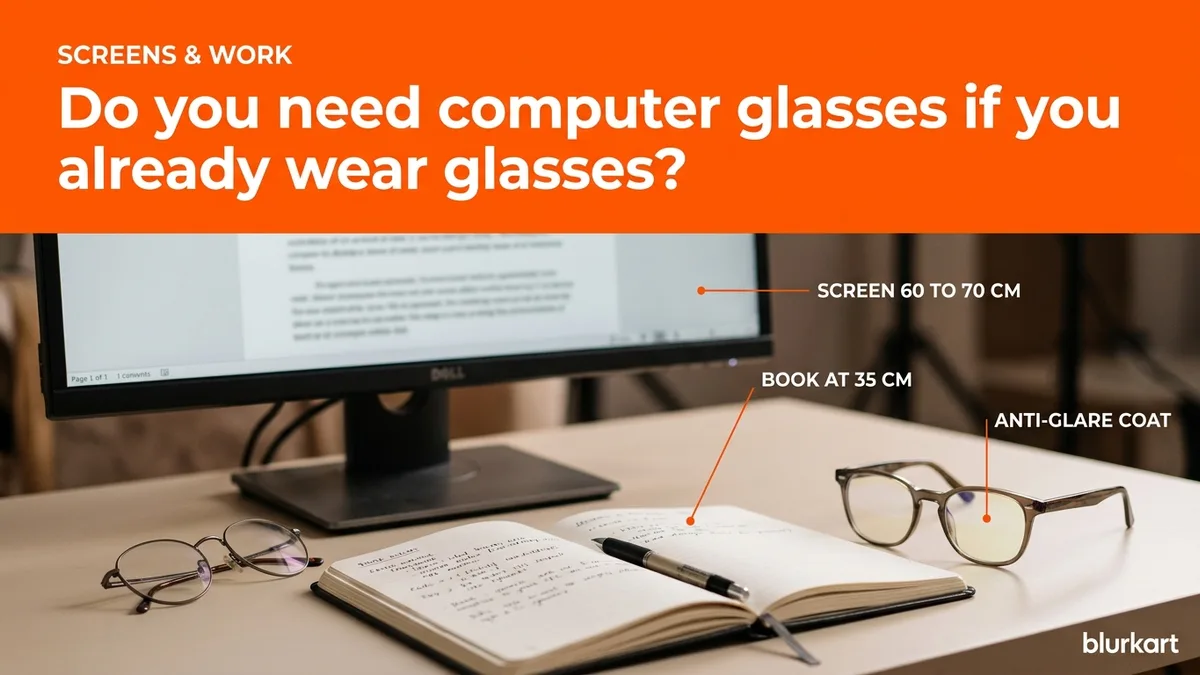
Whether you need computer glasses if you already wear glasses depends almost entirely on your age and what kind of lens you are in. For a lot of people the honest answer is no, and the shop that tells you otherwise is selling.
If you wear single vision and you are under about 40
You probably do not need a second pair. Your existing lens already corrects your distance error, and a young eye focuses across the range from screen to wall without help.
What you may need is a better coating. An anti-reflective multi-coated lens stops light bouncing off the front and back surfaces of your lens, which is a large part of why a screen day leaves your eyes aching. At NPR 1,800 for a multi-coated single vision lens, that is a cheaper and more effective fix than a whole second pair.
Be sceptical about blue filtering specifically. The comfort people report from blue light glasses comes mostly from the anti-reflective layer rather than the blue filter, and no study shows screen blue light damages the eye. We went through the evidence in whether blue light glasses actually work.
If you are over about 40
This is where a separate pair earns its place. After 40 the eye's own focusing stiffens and you get a reading add. The problem is that a screen is not at reading distance. A book is about 35 centimetres away, a monitor about 60 to 70.
So a reading pair makes the screen slightly blurry, and a distance pair makes it slightly blurry the other way. You end up shuffling your chair. A dedicated screen pair set for that intermediate distance fixes it properly, and people who make the switch usually describe the difference as larger than they expected. Reading glasses for phones after 40 covers the near end of the same problem.
If you wear progressives
Watch your chin. Progressive lenses put the intermediate zone in a narrow band in the middle of the lens, so to see a monitor clearly you tilt your head back slightly. Over eight hours that becomes neck and shoulder pain, and people blame the chair.
The answer is an office lens, sometimes called a room or degressive lens. It gives up distance vision beyond a few metres in exchange for a much wider intermediate and near zone, so the whole screen is sharp without the head tilt. It is not a pair for driving, it is a pair for a desk.
What to try before buying anything
Three things that cost nothing and fix a surprising share of complaints.
Move the monitor to roughly arm's length, with the top of the screen at or just below eye level. Turn the brightness down until it matches the room rather than glowing against it. And take the twenty twenty twenty break: every twenty minutes, look at something about six metres away for twenty seconds.
Also check whether your eyes sting rather than ache. Stinging is usually dryness from reduced blinking at a screen, not a focusing problem, and no lens fixes that. Setting up a desk properly covers the rest.
Getting it right
Bring your current glasses and tell us how far your monitor actually sits, because we can measure a lens for that specific distance. The eye test is free at both showrooms and takes about ten minutes.
If a second pair is the answer, frames start at NPR 999 and a multi-coated lens is NPR 1,800, so a dedicated screen pair is around NPR 2,800. Browse the blue light and screen range to see the frames.
Computer glasses when you already wear glasses: the short version
Under 40 in single vision: no, add anti-reflective to what you have. Over 40 in reading glasses: probably yes, because your screen is further away than your book. In progressives with a chin that lifts at the monitor: yes, and ask about an office lens specifically rather than a generic computer pair.
Before any of that, check whether your eyes sting or ache. Stinging is dryness from not blinking enough at a screen, and no lens in the world fixes it. Aching is a focusing problem, and that is what a lens can help with.
Tell us how far your monitor sits and we will measure for that distance rather than guessing at a standard one.
Frequently asked
- Can I just add blue light filtering to my current glasses?
- Not to an existing lens; coatings are applied during manufacture. It means new lenses in your frame, which is often worth doing anyway if the old ones are scratched.
- Are computer glasses just glasses with a yellow tint?
- Some cheap ones are, and a yellow tint alone does very little. What helps is the anti-reflective coating, and for people over 40 a focal setup made for screen distance rather than reading distance.
- Chasma lagairakheko chhu, computer ko lagi arko chahincha?
- Dherai jaso chahinna. Anti-reflective coating bhayeko lens le nai thulo farak pardachha. Tara chalis barsa katepachhi screen ko duri alag hunchha, tyahaan chai alagai jodi le sahayog garchha.