
Reading glasses for phones after 40
Holding the phone further away to read it is the first sign of presbyopia. Phone distance is usually shorter than book distance, so a power chosen for books can feel too strong on a phone. Start low, around plus 1.00 in your forties, and increase only when you need to.
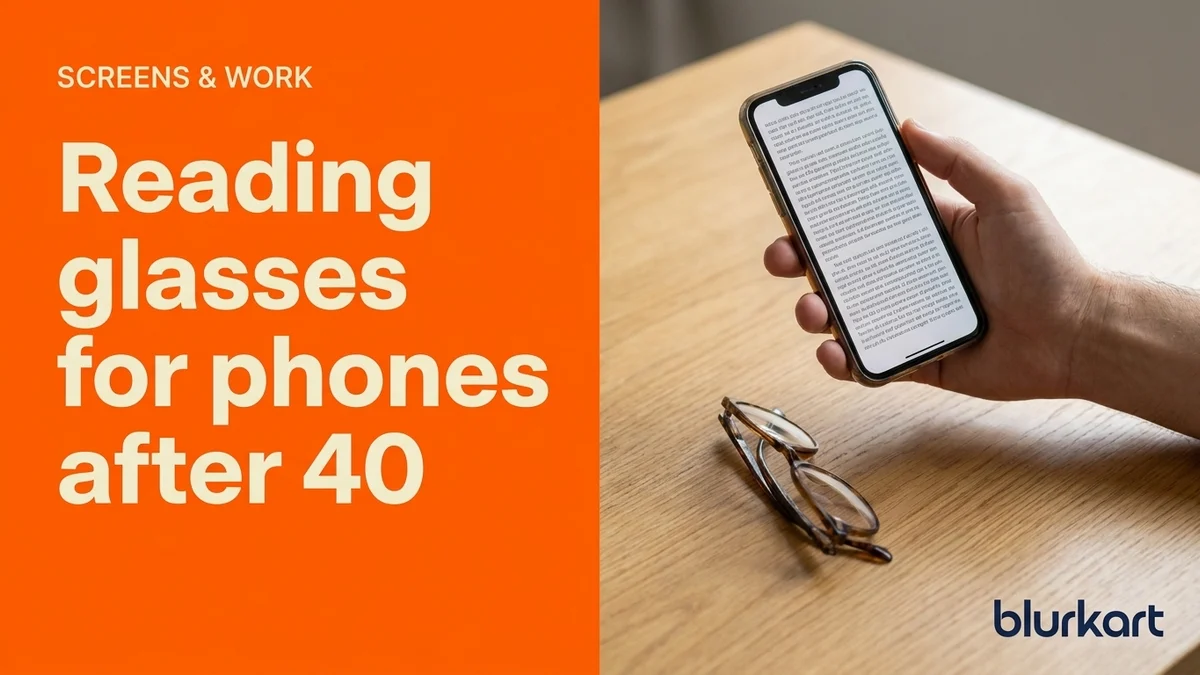
The first sign is not a book. It is moving your phone further from your face to read a message, usually in dim light, usually somewhere around 42. That is presbyopia, it happens to everyone, and reading glasses for phones need a slightly different approach than reading glasses for books.
Phone distance is its own distance
A book sits around 40 cm away. A phone can sit anywhere from 25 cm, held close in bed, to 45 cm, held at arm's length once the text gets hard.
Reading power is calculated for a working distance. Choose a power for 40 cm and use it at 25 cm and everything feels too strong and too close. Choose for close phone use and a book at arm's length goes soft.
Practical approach: decide where you actually hold things. If your phone is the main near task, measure that distance honestly rather than the textbook one, and tell us the number. It changes the power we give you.
Reading glasses for phone use: typical starting powers
Rough guide, and only a guide:
- Early forties: plus 1.00
- Mid forties: plus 1.25 to plus 1.50
- Around fifty: plus 1.75 to plus 2.00
- Mid fifties and beyond: plus 2.00 to plus 2.50, then it stabilises
Start with the weakest power that lets you read comfortably. Jumping straight to a strong reader gives you crisp text at one exact distance and blur everywhere else, and it makes the adjustment period more abrupt when the next step comes.
What ready-made readers get wrong
Ready-made readers are convenient and cheap and they suit plenty of people. What they cannot do is account for three things.
Your two eyes are rarely identical. A reader puts the same power in both, so if your eyes differ by half a dioptre, one of them is always slightly wrong.
Astigmatism is not included at all. If you have any, no ready-made reader corrects it, and the text stays slightly soft no matter which strength you try.
Pupil distance is fixed, usually around 62 mm. If yours is 58 or 68, the optical centres sit off your pupils and your eyes work against a mild prism. That is the tired, pulling feeling some people get from readers and blame on the power, and it is the same issue we described in pupillary distance and how to measure it.
When to go made-to-measure
If a ready-made pair feels comfortable, use it. There is no prize for spending more.
Go made-to-measure when readers give you headaches, when your two eyes clearly differ, when you have astigmatism, or when you are using them for hours rather than minutes. A made-to-measure pair with a light frame like the Premium Round Metal Frame at NPR 999 and a proper anti-reflective coating is not expensive and it is a different experience over a long evening.
When readers are the wrong answer entirely
If your distance vision is also going soft, readers solve half the problem and create a swapping routine. That is the moment to consider a progressive, which handles distance, screen and phone in one lens. We compared the options in bifocal or progressive and in single vision or progressive lenses.
If your near work is mostly a computer rather than a phone, an office lens covering roughly 40 cm to 2 m is usually better than either.
Phone padhna ko chasma: what customers ask
"Power kati bata suru garne?" Usually plus 1.00 in the early forties. Come in and we measure rather than guess, because the free test also tells you whether anything else is changing.
"Sadhai lagauna parchha?" Only for near work. Reading glasses blur distance by design, so they come off for walking around.
"Chalis pachhi power badhdai janchha?" Yes, gradually, until around the late fifties when it settles. Expect a step every two to three years in that window.
"Ready-made kinda hunchha?" For light use, often yes. If you get headaches with them, that is your answer to come in.
What to do
Note how far you actually hold your phone, then book the free test at either Lalitpur showroom. We will tell you the power, whether one eye differs, whether astigmatism is in play, and whether readers or a progressive suit the way you actually spend your day. If ready-made readers are genuinely fine for you, we will say that too. And if the haze never quite clears whatever power you try, read early cataract signs people mistake for dirty glasses.
Reading power keeps moving for a few years after 40, so an old slip is rarely still right. A free eye test takes about ten minutes at either showroom.
Frequently asked
- Are cheap ready-made reading glasses bad for your eyes?
- They do not damage your eyes. They can be uncomfortable if your eyes need different powers, if you have astigmatism, or if the fixed pupil distance is far from yours.
- What power should I start with?
- Most people begin around plus 1.00 in their early forties and move up every few years. Start with the weakest power that lets you read comfortably at your normal distance.
- Why do my reading glasses work for books but not my phone?
- You probably hold the phone closer than a book, or further if the text is large. A power tuned to one distance can be wrong for the other, which is where an office or progressive lens helps.
- Chalis pachhi phone padhna gah ro bhayo, ke garne?
- That is presbyopia and it is normal. Start with a low power reading glass, around plus 1.00, and get a free eye test to check whether your distance vision needs anything too.
- Mobile herna chasma chahinchha bhane kasari thaha paune?
- Phone lai pahila bhanda tadha lagera herna thalnu bhayo, ya sanjha ma akshar dhamilo hunchha bhane reading power chahiyo. Nihsulka jaanch das minute ma hunchha.