
Lens Index Explained: 1.56 vs 1.61 vs 1.67 vs 1.74
Lens index measures how strongly a lens material bends light. A higher index means a thinner, lighter lens for the same power, at a higher price. For mild powers 1.56 or 1.61 is plenty; for strong powers 1.67 or 1.74 keeps lenses thin and comfortable. Match the index to your prescription, not the marketing.
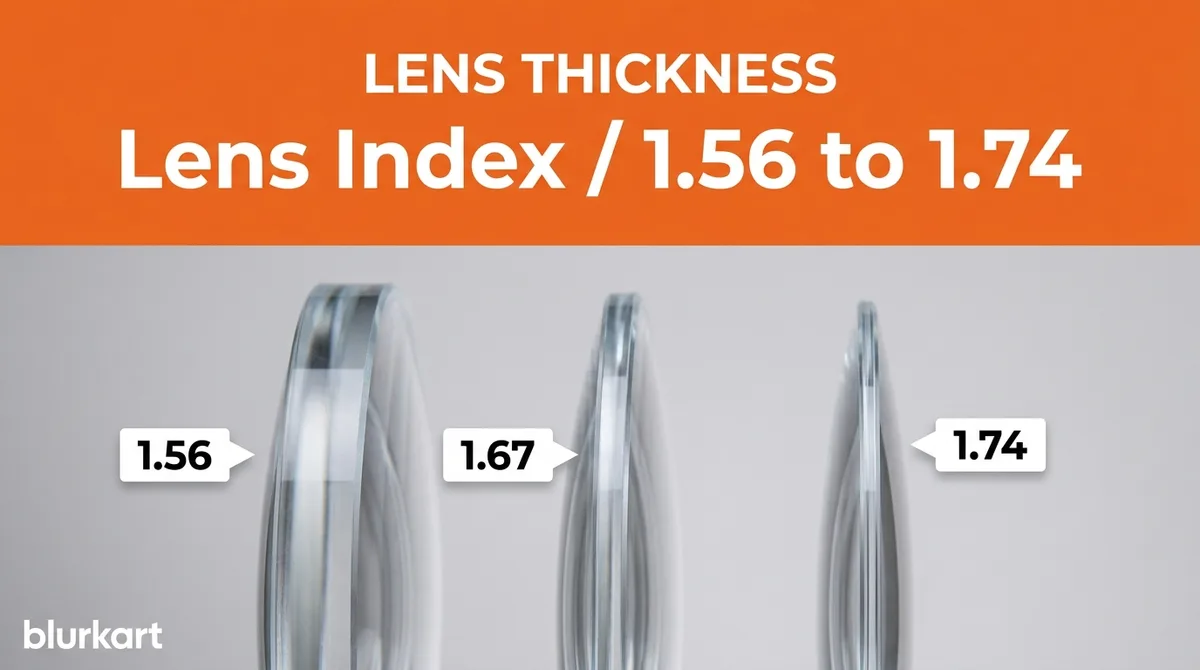
The one number that decides your lens thickness
When you order glasses, you will be asked, sometimes confusingly, which index you want. It is one of the most important choices you make, because it decides how thin, how light and how expensive your lenses will be. Yet most people nod along without really knowing what the numbers mean.
Here is the whole idea in one sentence: a higher index bends light more strongly, so less lens material is needed for the same power, giving a thinner, lighter lens, for a higher price. For a deeper look at the thin end, see our guide to high index lenses.
What each index is for
1.56 - standard
A good, economical all-rounder for mild to moderate prescriptions. Lenses are a sensible thickness and the price is friendly. For a low power, this is often all you need. ZEISS ClearView 1.56 UVProtect is a good example.
1.61 - thin
Noticeably thinner than 1.56 for the same power. A popular middle choice for moderate prescriptions and anyone who wants a slimmer look without a big jump in cost.
1.67 - high index
Significantly thinner and lighter, built for strong prescriptions. If your power is high enough that standard lenses bulge at the edges, 1.67 makes a visible difference.
1.74 - ultra high index
The thinnest widely available option, for very strong prescriptions where keeping lenses slim and light really matters. It is the most expensive, and a specialist custom lens. See ZEISS ClearView 1.74 UVProtect.
Thinness versus power, at a glance
| Index | Best for (roughly) | Relative thickness | Relative cost |
|---|---|---|---|
| 1.56 | Mild power | Standard | Lowest |
| 1.61 | Mild to moderate | Thinner | Moderate |
| 1.67 | Strong | Much thinner | High |
| 1.74 | Very strong | Thinnest | Highest |
The trade-off nobody mentions
Higher index is not pure upgrade. As index rises, optical clarity at the edges can soften slightly, a property called Abbe value. For most people it is unnoticeable, but it is why buying more index than you need is pointless.
So the aim is not the highest number. It is the lowest index that still gives you comfortably thin, light lenses for your power. Over-buying index wastes money and gains you nothing visible.
Frame choice changes the maths
Thickness also depends on your frame. A smaller frame cuts less lens material away at the edges, so a strong prescription in a small frame looks thinner even at a lower index. A large or rimless frame exposes the edges, so a higher index helps more. This is why your optician considers your frame, not just your power, when recommending an index.
How to choose in Nepal
Ask for your quote broken down by index, so you can weigh the thinness gain against the price for your exact power. If your prescription is mild, resist the upsell to 1.74; 1.56 or 1.61 will serve you well. If it is strong, 1.67 or 1.74 is money well spent on comfort and looks. And pick your frame with thickness in mind, because the right frame can do some of the slimming for free.
Does a higher index change what you see?
Through the centre of the lens, no. Your prescription is your prescription, and the index does not change how well you see straight ahead. What can change slightly, at very high index, is edge clarity, because higher-index materials tend to split colours a touch more. For most wearers this is invisible, and a good anti-reflective coating keeps everything looking crisp. So think of index as a thickness-and-weight decision, not a vision-quality one, right up until the highest end.
A quick decision guide by power
- Up to around 2.00: 1.56 is plenty; lenses are thin anyway.
- Around 2.00 to 4.00: 1.61 for a slimmer look, especially in larger frames.
- Around 4.00 to 6.00: 1.67 to keep edges neat.
- Beyond 6.00: 1.67 or 1.74, ideally with an aspheric design.
Pair any of these with a sensible frame size and you get the slim look you want without paying for index you do not need.
Shop the lenses mentioned in this guide
- ZEISS ClearView 1.56 UVProtect – Single Vision FSV, DuraVision Platinum UV (Pair): a standard-index lens for mild prescriptions
- ZEISS ClearView 1.6 UVProtect – Single Vision FSV, DuraVision Platinum UV (Pair): a thinner mid-index choice for moderate prescriptions
- ZEISS ClearView 1.67 UVProtect – Single Vision FSV, DuraVision Platinum UV (Pair): a high-index lens for strong prescriptions
- ZEISS ClearView 1.74 UVProtect – Single Vision FSV, DuraVision Platinum UV (Pair): the thinnest option for very strong prescriptions
Keep reading
- How Thick Will My Lenses Be? A Power-to-Thickness Guide
- High index lenses: how to make a strong prescription look thin
- Aspheric Lenses: Flatter, Thinner and Better Looking
- Abbe Value: The Clarity Trade-Off of Very Thin Lenses
Not sure which lens suits you? Book a free eye test at our Pulchowk or Boudha branch.
Frequently asked
- What does lens index actually mean?
- It measures how strongly the lens material bends light. The higher the index, the more it bends, so less material is needed for the same power. That is why a higher index lens is thinner and lighter for the same prescription.
- Which lens index should I choose?
- Match it to your power. Mild prescriptions do fine with 1.56 or 1.61. Moderate to strong prescriptions benefit from 1.67, and very strong ones from 1.74. Your optician can recommend the lowest index that still looks and feels good for your power.
- Is a higher index always better?
- No. Higher index costs more and can slightly reduce optical clarity at the edges (a lower Abbe value). For a mild prescription, paying for 1.74 is wasted money and may even look no different from 1.61.
- Does high index reduce the weight too?
- Yes. Less material means a lighter lens, which is a real comfort gain for strong prescriptions, especially in larger frames that would otherwise feel heavy on the nose.
- Are all indexes available in Nepal?
- Common indexes are readily available on order. Very high index (1.74) is a specialist, custom lens and takes a little longer. Ask for a quote by index so you can compare the thinness gain against the price.