
Lens Options for Very High Power (-8.00 and Beyond)
For very high prescriptions (-8.00 and beyond), the slimmest result comes from combining a high index (1.67 or 1.74), an aspheric design, a small full-rim frame and careful fitting. For extreme powers, lenticular or blended designs keep weight down. Modern options make strong lenses far lighter and better looking than before.
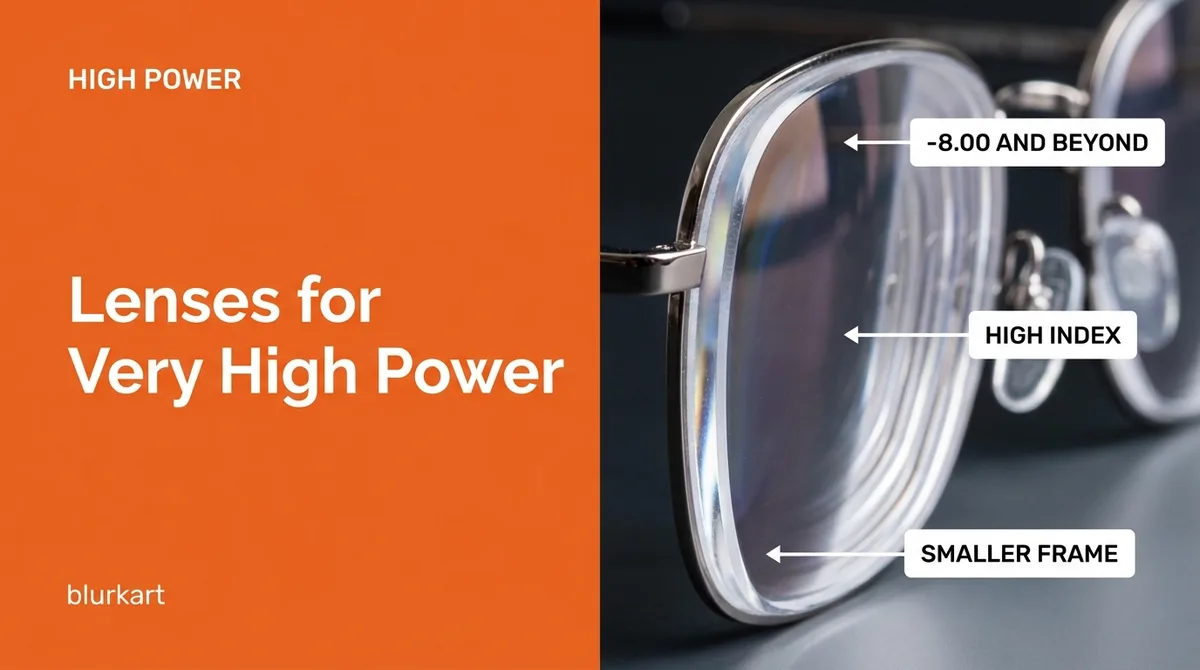
Strong prescriptions have come a long way
If you have a very high prescription, you may remember thick, heavy lenses that bulged out of the frame and made your eyes look small. That era is largely over. With the right combination of modern materials, designs and frame choices, even powers of -8.00 and beyond can be slim, light and good looking.
The core recipe
High index
Start with a high index: usually 1.67, or 1.74 for the strongest powers. This bends light more so less material is needed, directly cutting edge thickness.
Aspheric design
Add an aspheric curve, which flattens the lens and reduces the shrunken-eye look of strong minus powers, while improving edge clarity.
The right frame
Choose a small, full-rim frame. A minus lens is thickest at the edges, so a smaller frame trims that away and the rim hides what is left. This single choice can transform how a strong prescription looks.
For extreme powers: lenticular and blended designs
Beyond a certain strength, even high index has limits. Lenticular designs carry your full power only in a central zone, surrounded by a flatter carrier, to keep weight and thickness manageable. Blended versions soften the join for a better look. These are specialist, custom lenses for prescriptions that standard high-index cannot keep comfortable. Read more in our guide to lenticular and blended lenses.
Putting it together
| Goal | Choice |
|---|---|
| Thinner edges | High index 1.67 or 1.74 |
| Flatter, more natural look | Aspheric design |
| Hide the edge | Small full-rim frame |
| Extreme powers, less weight | Lenticular or blended |
| Sharp vision through the lens | Accurate centration |
Fitting is not optional at high powers
At strong powers, a small error in where the lens sits in front of your eye causes real blur and discomfort. Precise measurement and centration are part of the lens, not an extra.
So choose an optician comfortable with strong prescriptions, and expect careful measuring of your pupils and frame fit.
Getting it right in Nepal
Bring your full prescription and say up front that it is a strong one. Ask for a combination of the right high index and an aspheric design, choose a small full-rim frame, and request an estimate of the edge thickness before you order. If your power is extreme, ask whether a lenticular or blended design suits you. Done well, your strong prescription can look and feel far better than you might expect.
Weight, not just thickness
For strong prescriptions, weight matters as much as thickness. A heavy lens slides down the nose, leaves marks, and gets uncomfortable by evening. High-index materials are not only thinner, they are lighter, and a smaller frame removes even more material. If comfort over a long day is your priority, treat weight as a headline feature, not an afterthought, and choose the frame and index together with that in mind.
Caring for high-power lenses
Strong lenses represent a bigger investment, so protect them. Rinse before wiping to avoid scratching, use a microfibre cloth, keep them in a case, and avoid hot cars that stress coatings. A good anti-reflective coating is especially valuable on high-power lenses, because it improves light transmission and cuts the reflections that strong curves can create. Looked after well, a well-chosen high-power lens stays clear and comfortable for years.
Shop the lenses mentioned in this guide
- ZEISS ClearView 1.67 UVProtect – Single Vision FSV, DuraVision Platinum UV (Pair): a high-index lens for strong prescriptions
- ZEISS ClearView 1.74 UVProtect – Single Vision FSV, DuraVision Platinum UV (Pair): the thinnest option for the strongest powers
- ZEISS ClearView 1.67 BlueGuard – Single Vision FSV, DuraVision Platinum UV (Pair): a high-index lens with blue light filtering for screen-heavy days
Keep reading
- Lenticular and Blended Lenses for Extreme Prescriptions
- Lens Index Explained: 1.56 vs 1.61 vs 1.67 vs 1.74
- Aspheric Lenses: Flatter, Thinner and Better Looking
- How Thick Will My Lenses Be? A Power-to-Thickness Guide
Not sure which lens suits you? Book a free eye test at our Pulchowk or Boudha branch.
Frequently asked
- Can very strong prescriptions have thin lenses?
- Much thinner than before. Combining a high index such as 1.67 or 1.74 with an aspheric design and a small full-rim frame produces lenses far slimmer and lighter than old high-power lenses. Extreme powers may also use lenticular designs.
- What frame is best for a very high prescription?
- A small, full-rim frame. It trims away the thick outer edge of a strong minus lens and hides what remains behind the rim. Large and rimless frames are the hardest for very high powers.
- What is a lenticular lens?
- A lens that carries your full power only in a central zone, with a flatter carrier around it, to keep weight and thickness down at extreme powers. It is a specialist option for prescriptions beyond what standard high-index can handle comfortably.
- Will high power lenses still be heavy?
- Modern high-index and aspheric designs greatly reduce weight, and a small frame helps further. They are lighter than old glass or standard lenses, though an extreme prescription will always weigh a little more than a mild one.
- Are these options available in Nepal?
- High index and aspheric lenses are available on order. Very specialised designs like lenticular take longer and are custom. Discuss your exact power with an optician experienced in strong prescriptions.