
How Thick Will My Lenses Be? A Power-to-Thickness Guide
Lens thickness depends on three things: your prescription power, your frame size and shape, and your lens index. Stronger power means thicker lenses, bigger frames expose more edge, and a higher index thins them back down. Choose a smaller frame and the right index to keep strong prescriptions slim.
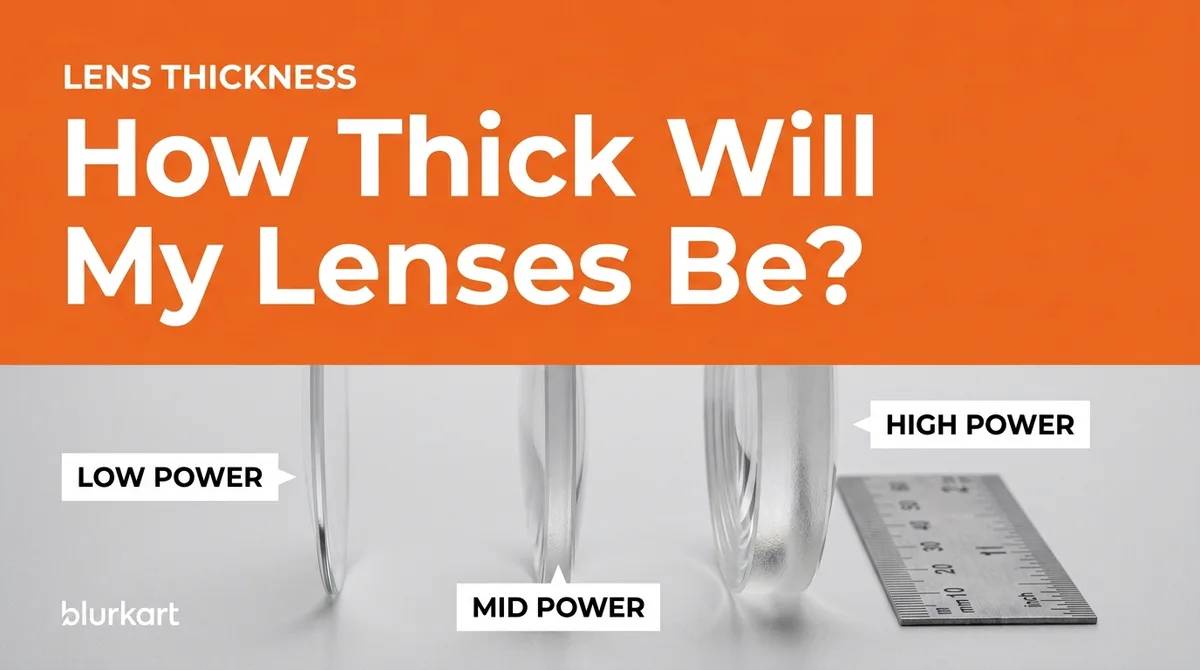
The bottle-bottom worry
Almost everyone with a strong prescription has feared it: lenses so thick they look like the bottoms of glass bottles. The good news is that thickness is predictable. Once you understand the three things that drive it, you can plan your glasses to stay slim, no surprises at collection time.
The three factors
1. Your power
This is the big one. Minus (near-sighted) lenses get thick at the edges, and the stronger the minus, the thicker the rim. Plus (far-sighted) lenses get thick in the centre and bulge forward. Either way, more power means more material.
2. Your frame
Frame size and shape decide how much of that thickness shows. A smaller frame cuts away the outer lens, which is exactly where a minus lens is thickest, so edges look slimmer. A large or rimless frame keeps and exposes those edges.
3. Your index
A higher index bends light more, so less material is needed and the lens thins down for the same power. This is the main tool for taming strong prescriptions, for example ZEISS ClearView 1.67.
A rough guide to what to expect
| Power (minus) | In a standard lens | Smart choice |
|---|---|---|
| Up to about 2.00 | Thin everywhere | 1.56 is fine |
| About 2.00 to 4.00 | Edges start to show | 1.61, smaller frame |
| About 4.00 to 6.00 | Noticeable edge | 1.67, small full-rim frame |
| Beyond 6.00 | Thick without help | 1.67 or 1.74 + aspheric |
These are general guides, not promises; your exact result depends on all three factors together.
How to keep strong lenses slim
- Choose a smaller frame with less lens area at the edges.
- Go full-rim rather than rimless to hide the edge.
- Pick the right index for your power, not more, not less.
- Add an aspheric design for a flatter profile at high powers.
- Centre the lenses well, which a careful fitting ensures.
The frame you fall in love with and the lens that looks slim are not always the same. For strong prescriptions, let thickness guide the frame shortlist.
Ask before you pay
For any strong prescription in Nepal, ask your optician to estimate the edge thickness for your chosen frame and index before you order. A two-minute conversation, and perhaps a comparison of indexes, prevents the disappointment of collecting glasses that look heavier than you hoped. Thickness is controllable, as long as you plan for it up front.
Minus and plus: where the thickness hides
It helps to know where to look. A minus (near-sighted) lens is thin in the centre and thick at the edges, so edge-hiding tricks like a small full-rim frame work well. A plus (far-sighted) lens is the reverse: thick in the centre, thinner at the edge, so the bulge is at the front and an aspheric design helps most. Knowing your sign tells you which strategy matters for your glasses.
Questions to ask before you order
- Roughly how thick will the edge (or centre) be in this frame?
- Would a smaller frame noticeably improve the look?
- Is the index you are quoting the right match for my power?
- Would an aspheric design help for my prescription?
A minute spent on these questions prevents the most common disappointment: collecting glasses that look heavier than you pictured.
Shop the lenses mentioned in this guide
- ZEISS ClearView 1.56 UVProtect – Single Vision FSV, DuraVision Platinum UV (Pair): a standard-index lens for low powers
- ZEISS ClearView 1.6 UVProtect – Single Vision FSV, DuraVision Platinum UV (Pair): a thinner lens for moderate minus powers
- ZEISS ClearView 1.67 UVProtect – Single Vision FSV, DuraVision Platinum UV (Pair): a high-index lens to slim strong prescriptions
- ZEISS ClearView 1.74 UVProtect – Single Vision FSV, DuraVision Platinum UV (Pair): the thinnest option for very strong powers
Keep reading
- Lens Index Explained: 1.56 vs 1.61 vs 1.67 vs 1.74
- Aspheric Lenses: Flatter, Thinner and Better Looking
- Lens Options for Very High Power (-8.00 and Beyond)
- Minus or plus: what your numbers say about your eyes
Not sure which lens suits you? Book a free eye test at our Pulchowk or Boudha branch.
Frequently asked
- What makes lenses thick?
- Mainly your prescription power. Strong minus powers get thick at the edges, strong plus powers get thick in the centre. Frame size and lens index then make that thickness look better or worse.
- Do bigger frames make lenses thicker?
- They make the edges more visible. A larger frame keeps more of the outer lens, where a minus lens is thickest, so the edge looks chunkier. A smaller frame trims that away and looks slimmer for the same power.
- How much can a high index thin my lenses?
- Quite a lot for strong prescriptions. Moving from standard to high index can visibly reduce edge thickness. The stronger your power, the bigger the improvement you will see.
- Can I see how thick they will be before ordering?
- Roughly, yes. Your optician can estimate edge thickness from your power, chosen frame and index, and many can show a comparison. Ask before you pay, especially for a strong prescription.
- Are rimless frames bad for strong prescriptions?
- They expose the lens edges fully, so a strong minus lens can look thick in rimless. It is still possible with a high index and careful choices, but a small full-rim frame hides edges better.