
Aspheric Lenses: Flatter, Thinner and Better Looking
Aspheric lenses use a gradually changing curve instead of a single spherical one, so they sit flatter and thinner, reduce edge distortion, and lessen the magnified or shrunken-eye look of strong prescriptions. They suit higher powers and anyone wanting a slimmer, more natural appearance.
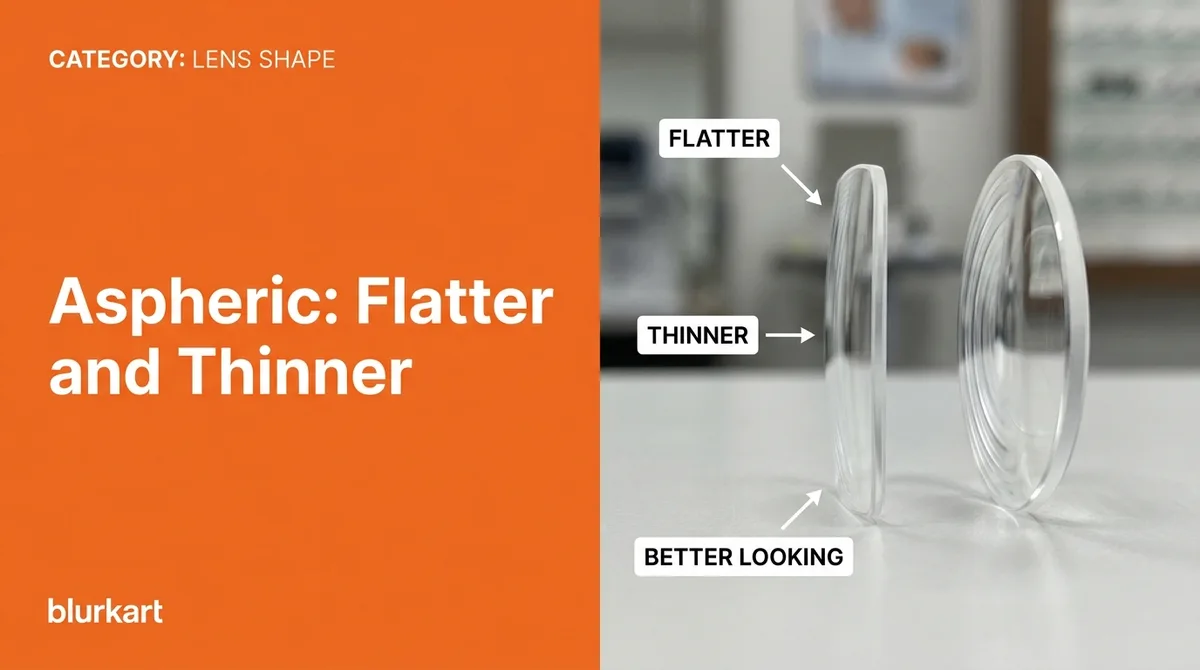
Why some lenses bulge and others lie flat
Look closely at two pairs of glasses with the same power and you may notice one sits deep and curved while the other looks flat and sleek. The flat one is almost certainly aspheric. It is a quietly clever design that improves both looks and vision, and it matters more the stronger your prescription is.
Spherical versus aspheric, simply
A traditional spherical lens has a single constant curve, like a slice of a ball. It works, but a strong power forces a deep, bulging curve. An aspheric lens uses a curve that changes gradually from centre to edge. That lets the lens sit flatter and thinner for the same power, while controlling the distortions a steep curve would introduce.
Same prescription, smarter curve: flatter on your face, slimmer at the edge, and clearer across more of the lens.
The three real benefits
- Thinner and flatter: a slimmer profile that looks better in the frame.
- Less edge distortion: clearer vision as you look away from the centre.
- More natural eyes: less of the magnified look (strong plus) or shrunken look (strong minus) that others see.
How much it helps, by power
| Prescription | Benefit of aspheric |
|---|---|
| Very mild | Small, often not worth the extra |
| Moderate | Noticeable thinner, flatter look |
| Strong | Big improvement in looks and distortion |
| Very strong (with high index) | The slimmest, most natural result possible |
Aspheric plus high index
Aspheric design and lens index solve thickness in different ways, and they stack. A high index uses a material that bends light more, while an aspheric curve flattens the shape. Combine them and a strong prescription that would once have meant thick, bulging lenses becomes slim, light and flattering. For high powers, this pairing is the usual recommendation.
Fitting matters more with aspheric
Because the curve changes across the lens, aspheric optics must be centred accurately to your eyes. A careless fitting places the sweet spot in the wrong position and wastes the design. So insist on a proper measurement of your pupil position in the frame you have chosen, not a rough estimate.
Choosing in Nepal
If your prescription is moderate or strong, ask specifically about an aspheric design, ideally paired with the right index for your power. The difference in how your glasses look, and how natural your eyes appear to others, is one of the most visible upgrades you can make. For a mild power, save your money; the gain is slim. As always, match the technology to your prescription, not to the sales pitch.
Single aspheric versus double aspheric
You may be offered a plain aspheric or a double (or bi-) aspheric lens. A single aspheric lens applies the clever curve to one surface, usually the front. A double aspheric applies it to both surfaces, squeezing out a little more thinness and flatness and controlling distortion further. The extra benefit is most worthwhile at higher powers; for moderate prescriptions a single aspheric already does most of the job.
How to know the fitting is right
Because aspheric optics are centred to your eyes, a good fitting shows itself in use: clear vision straight ahead, comfortable vision as you glance around, and no pulling or swimming sensation. If a new aspheric lens feels oddly distorted off-centre or makes you tilt your head to find focus, it may be miscentred in the frame. Go back and have the fit checked rather than assuming aspheric lenses simply do not suit you; nine times out of ten it is a fitting issue, not the design.
Shop the lenses mentioned in this guide
- ZEISS ClearView 1.56 UVProtect – Single Vision FSV, DuraVision Platinum UV (Pair): a standard-index lens for mild to moderate powers
- ZEISS ClearView 1.6 UVProtect – Single Vision FSV, DuraVision Platinum UV (Pair): a thinner choice for moderate prescriptions
- ZEISS ClearView 1.67 UVProtect – Single Vision FSV, DuraVision Platinum UV (Pair): a high-index lens for strong powers
- ZEISS ClearView 1.74 UVProtect – Single Vision FSV, DuraVision Platinum UV (Pair): the slimmest option for very strong prescriptions
Keep reading
- Lens Index Explained: 1.56 vs 1.61 vs 1.67 vs 1.74
- How Thick Will My Lenses Be? A Power-to-Thickness Guide
- Lens Options for Very High Power (-8.00 and Beyond)
- High index lenses: how to make a strong prescription look thin
Not sure which lens suits you? Book a free eye test at our Pulchowk or Boudha branch.
Frequently asked
- What is the difference between aspheric and spherical lenses?
- A spherical lens has one constant curve, like part of a ball. An aspheric lens has a curve that changes gradually from centre to edge. That lets it sit flatter and thinner, with less distortion, especially at higher powers.
- Do aspheric lenses make my eyes look more natural?
- Yes. Strong minus lenses can make eyes look smaller, and strong plus lenses can magnify them. Aspheric designs reduce this effect, so your eyes look closer to their real size to others.
- Are aspheric lenses worth the extra cost?
- For moderate to strong prescriptions, usually yes, because the thinner, flatter look and reduced distortion are clearly noticeable. For very mild powers the benefit is small.
- Can aspheric lenses be high index too?
- Yes, and they often are. Combining an aspheric design with a high index gives the slimmest, flattest lens possible for a strong prescription.
- Is there any downside to aspheric lenses?
- They require careful fitting because the optics are centred precisely to your eyes. A good fitting is essential to get the full benefit, which is why an accurate measurement matters.