
Trekking sunglasses for Annapurna and Everest Base Camp
For Annapurna or Everest Base Camp you need UV400 lenses in category 3 for most days and category 4 for snow, a frame that wraps or has side coverage, a retainer strap, and a spare pair. Ultraviolet is roughly 10 percent stronger for every 1,000 metres of altitude and fresh snow reflects up to 80 percent of it back into your eyes. Snow blindness is a corneal burn and it happens to trekkers every season.
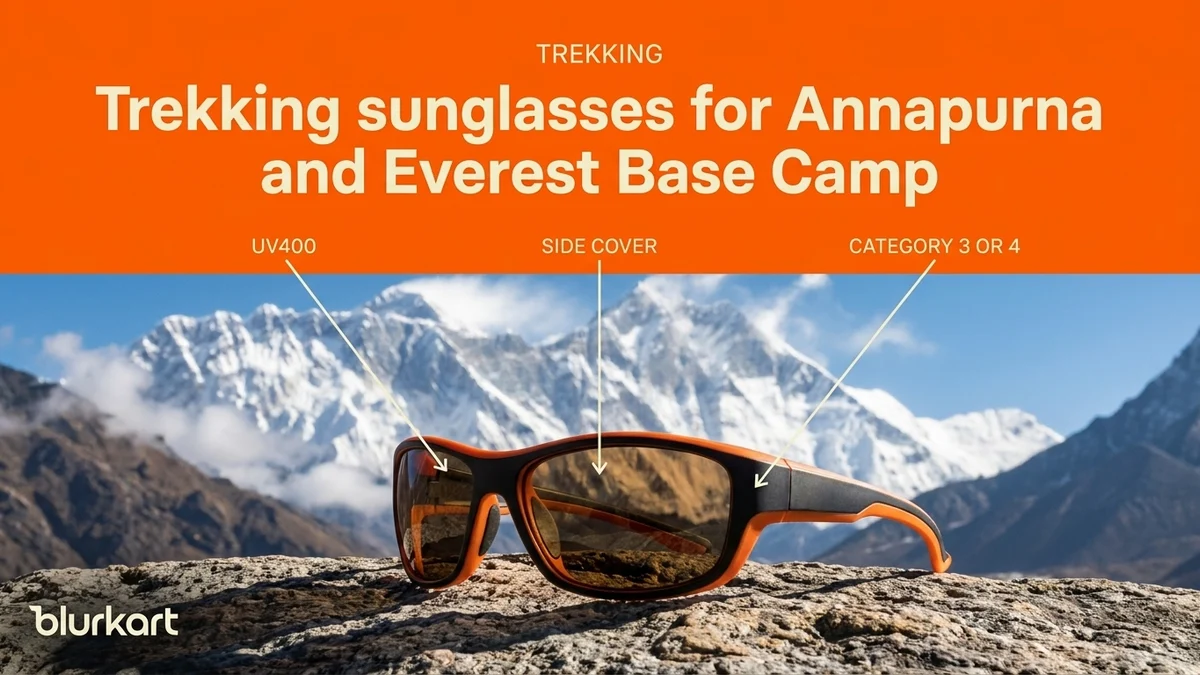
Trekking sunglasses for the Annapurna and Everest Base Camp routes need UV400 lenses in category 3 or 4, a frame that covers the sides of your eyes, a strap so they cannot fall down a slope, and a spare pair in the bag. Ultraviolet gets stronger with altitude and snow throws it back up at you, and snow blindness is a burn of the eye surface that catches trekkers every season. Here is what those requirements mean and what we stock for them.
Why the mountain sun is different
Ultraviolet increases about 10 percent for every 1,000 metres you climb, because there is less air above you to absorb it. Kathmandu sits at 1,400 metres. Annapurna Base Camp is 4,130 metres, Everest Base Camp 5,364. By the time you reach either, UV is 30 to 50 percent stronger than in the city. Fresh snow reflects up to 80 percent of it back, so your eyes are hit from above and below at once.
The result of a day of that without protection is snow blindness: a sunburned cornea. It starts hours later, with pain like sand in the eyes, streaming tears and blurred vision. It heals in a day or two in darkness, but on a schedule with a flight from Lukla, it can end the trek.
Lens category: 3 for the trail, 4 for the snow
Sunglass lenses are graded 0 to 4 by how much light they let through. Category 3 passes 8 to 18 percent and is the everyday dark lens. Category 4 passes 3 to 8 percent, is meant for snow and glacier, and is too dark to drive in. For treks that stay below the snow line, category 3 is fine. For passes like Thorong La or the walk from Gorak Shep to base camp in bright snow, category 4 is what mountaineers use.
UV400 is separate from category. A dark lens without a UV filter is worse than none. Every sunglasses pair we sell is UV400; we test any pair on our counter meter for free. Our post on what the UV400 and polarised stickers mean explains the difference.
Coverage: the part people miss
Most snow blindness comes from light entering at the sides and from below, past a flat fashion frame. A wraparound shape or side shields close those gaps. If you already own a pair you love, removable leather side shields cost little and attach to most frames. Keep the frame close to the face; a big gap at the cheeks lets reflected light straight in.
Polarised or not
Polarised lenses kill the glare off snow and water and make long bright days easier. The trade-off is that they can hide the sheen on icy patches of trail, which you want to see. Many guides prefer non-polarised category 4 for the glacier sections and polarised category 3 for the lower valley days. If you take one pair, polarised category 3 with side coverage is the practical middle.
Trekking sunglasses we sell in Lalitpur
- Maverick Aviator Metal Sunglasses, NPR 6,500: polarised, UV400, large lens with good cheek coverage. Our pick for treks up to the snow line.
- Navigator Round Aviator, NPR 1,800: polarised and UV400 at a price that makes a fine spare pair.
- Prescription tinted lenses in a wrap-friendly frame if you cannot wear contacts. Allow two weeks before departure.
The packing list
- Main pair, category 3 or 4, UV400, side coverage.
- Spare pair. A lost pair above Dingboche is not something a lodge can replace.
- Retainer strap. Stops the pair sliding off when you look down a slope.
- Hard case and a microfibre cloth. Dust from the trail scratches lenses fast.
- Your prescription on your phone, in case a lens breaks and a shop in Pokhara or Namche can help.
Trekking sunglasses questions from Nepali trekkers
Most of our trekking customers are not tourists; they are people from Kathmandu and Pokhara doing Mardi, Langtang or the Annapurna Circuit for the first time. Their questions:
"Sadharan sunglass le pugchha?" For Poon Hill or Langtang below the snow, a UV400 pair with decent coverage is enough. For Thorong La, the Larke Pass or base camp in snow, it is not.
"Goggles ki sunglass?" Ski goggles are only for storms and glacier days. Wrap sunglasses with side coverage are lighter, do not fog as badly, and are what guides wear every day.
"Power bhayeko sunglass banna kati din lagchha?" Tinted prescription lenses take about a week, wrap frames a little longer. Order two weeks before departure.
And the one nobody asks until it is too late: "Extra pair chahinchha?" Yes. Every year someone loses a pair on a windy pass and finishes the trek squinting.
Come in before you go. We fit the strap, check the UV, and adjust the frame so it sits close to the face for the whole route.
Frequently asked
- Can I use normal sunglasses for the trek?
- Up to Namche or Ghorepani, a good UV400 pair like our Maverick Aviator will do. Above the snow line you want more coverage and a darker lens.
- What is snow blindness?
- A sunburn of the cornea from UV reflected off snow. Symptoms start six to twelve hours later: gritty pain, watering, blurred vision. It heals in a couple of days in the dark, but it can end a trek.
- Do prescription trekking sunglasses exist?
- Yes. We make tinted prescription lenses in wraparound-friendly frames, or you can wear contact lenses with non-prescription trekking glasses. Bring the prescription two weeks before you leave.
- Are photochromic lenses good for trekking?
- They darken well in mountain sun but rarely reach category 4, and they do not darken behind a jeep window. A dedicated dark pair is safer above 4,000 metres.
- Trekking ko lagi kun sunglass ramro?
- A UV400 pair with category 3 lenses and side coverage for treks below the snow line, category 4 for snow and glaciers. Add a retainer strap and carry a spare pair. Our Maverick Aviator at NPR 6,500 and Navigator at NPR 1,800 are both polarised and UV400.