
Tinted prescription lenses: which colour and how dark
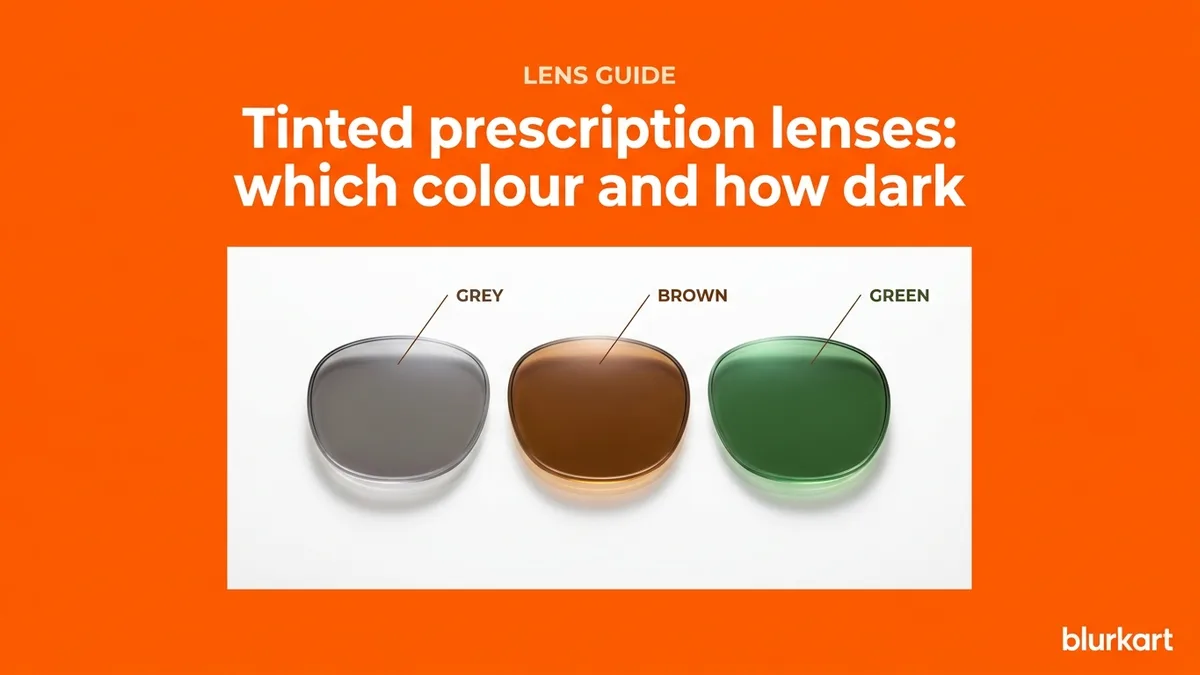
Grey tints keep colours true and suit general use and driving. Brown and amber lift contrast, which helps on variable trails and in haze. Green sits between the two. For sun, 70 to 85 percent darkness is right; anything above that is too dark to drive in, and a dark tint at night is genuinely dangerous.
Ordering tinted prescription lenses means making two decisions most people are never walked through: what colour, and how dark. They do different things, and getting either wrong produces a pair you stop wearing.
Choosing the colour of tinted prescription lenses
Grey is neutral. It dims everything evenly, so colours look the same as they do with bare eyes, only darker. That neutrality is exactly why it is the standard recommendation for driving: a traffic light stays the colour it is meant to be. If you want one pair for everything, grey.
Brown and amber cut more of the blue end of the spectrum, which increases the contrast between objects and their background. On a variable-light trail, in haze, or on a bright overcast day, brown makes the ground in front of you read more clearly. The trade is a slight warm shift in colour.
Green sits between the two. It holds colour reasonably true while lifting contrast a little, and many people find it the least tiring over a long day outdoors.
What we would avoid for daily use are strong novelty colours, blues and pinks and reds. They distort colour perception in ways that stop being fun by the second hour.
How dark, in percentages
Tint darkness is quoted as the percentage of light the lens absorbs, so a higher number is darker.
70 to 85 percent is proper sunglass territory and what you want for Kathmandu daylight, rooftops, riding and anything at altitude. 50 to 70 percent suits bright but not harsh conditions and overcast glare. 20 to 40 percent is a light fashion tint. It looks good and it is not sun protection.
Above about 85 percent you are into specialist territory for snow and very high altitude. That is too dark for driving, and most road rules treat it that way.
The rule nobody should break
Do not drive at night in any tinted lens, in any colour or percentage. A tint that is comfortable at noon removes light you genuinely need after dark, and it delays how quickly you pick out a pedestrian in an unlit stretch. If you need correction for night driving, that is a clear lens with a good anti-reflective coating, which is the combination that actually reduces headlight glare.
Tint is not UV protection
Worth repeating because it is the thing that causes harm. Darkness and ultraviolet filtering are two separate properties. A lens can be almost black and block no UV at all, which is worse than wearing nothing because the dark makes your pupil open wider. Every sunglass we sell carries a UV400 lens, and we will test any pair free on a UV meter at either showroom. Cheap roadside sunglasses goes into what that means in practice.
Or skip choosing
If you cannot decide, photochromic lenses darken outdoors and clear indoors, so one pair covers both. They are slower to clear than to darken and they do not work well behind a windscreen, which blocks the UV that triggers them. How fast they darken in Kathmandu has the honest timings.
Come to either showroom with your prescription and we will hold the tint samples up in daylight rather than under a shop light, which is the only way to judge them. Browse sunglasses from NPR 999 while you decide.
Gradient tints, and when they beat a flat one
A gradient tint is dark at the top and fades towards clear at the bottom. It suits driving particularly well: the top of the lens cuts the sky and the sun, while the bottom stays light enough to read the dashboard and the instruments without lifting the glasses.
It is also the more forgiving choice for a first tinted pair, because the lighter lower half keeps the pair usable when you step indoors for a few minutes.
What a gradient does not do is protect less. The UV filter runs across the whole lens regardless of where the tint sits, so a pale lower half is no weaker against ultraviolet. Our guide to gradient lenses goes into the look in more detail. One practical note: a gradient is hardest to judge in a shop, because the fade only reads properly against a bright sky. Step outside with it before you decide.
Frequently asked
- Does a darker tint mean more UV protection?
- No, and this is the most dangerous misunderstanding in eyewear. Tint is shading, UV filtering is separate. A very dark lens with no UV filter opens your pupil and lets more ultraviolet in than bare eyes would.
- Can I get my prescription in a tinted lens?
- Yes. Tint is applied to a lens already made to your power, so any prescription we can make in clear we can make tinted. Allow one to three extra working days.
- Kun rang ko tinted lens ramro hunchha?
- Gaadi chalauna ra sadharan prayog ko lagi grey ramro, rang pariwartan hundaina. Trekking ra dhamilo mausam ma brown ya amber le safa dekhauchha. Rati chai kunai pani tinted lens lagaera nachalaunus.