
UV400 or polarised: what the sunglasses sticker really means
UV400 means the lens blocks ultraviolet light up to 400 nanometres, which is the part that harms your eyes. Polarised means the lens cuts reflected glare from roads, water and snow. They are separate features. A dark lens without UV400 is worse than no sunglasses, because the pupil opens wider behind it.
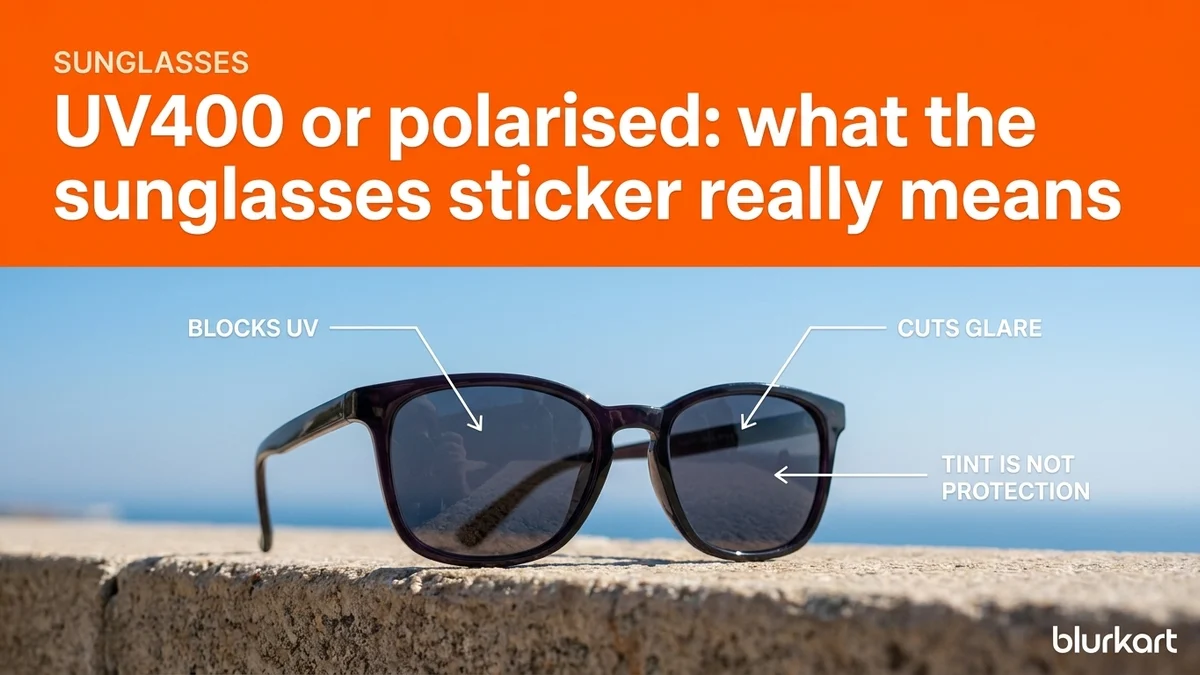
Walk down New Road and every stall has sunglasses with a small silver sticker on the lens. UV400. Polarized. Sometimes both, sometimes neither, sometimes a sticker that just says Protection. The sticker costs a rupee to print. What it claims may or may not be in the lens.
These are two different features. Here is what each one does and how to check for yourself.
UV400: the one that protects your eyes
Ultraviolet light is the part of sunlight you cannot see and your eyes cannot feel. Over years it contributes to cataracts and to pterygium, the fleshy growth on the white of the eye that we see often in people who work outdoors in Nepal.
UV400 means the lens blocks ultraviolet light up to a wavelength of 400 nanometres, which covers the whole UVA and UVB range. It is a property of the lens material or a clear coating on it. It has nothing to do with how dark the lens is.
That last sentence is the important one. A dark lens with no UV filter is worse than no sunglasses at all. The tint makes your pupil open wider, and the open pupil lets more ultraviolet in. Cheap roadside pairs are often exactly this: dark plastic, no filter.
Polarised: the one that cuts glare
Light bouncing off a flat surface, like a wet road, the Phewa lake, or snow on a trek, gets lined up in one direction. A polarised lens has a filter that blocks light lined up that way. The glare disappears, the road surface looks matte, and you stop squinting.
Polarised lenses are a comfort feature, not a safety one. They do not block UV by themselves, though almost every polarised lens sold today also has a UV400 layer. Check for both.
The one thing polarised lenses do badly: some screens. Phone displays and some car dashboards go dark or show rainbow patches at certain angles. If you use your phone for navigation on the bike, you will notice.
Testing polarised at home
Hold the glasses in front of a phone screen or a laptop. Now rotate the glasses slowly until they are at 90 degrees to normal. If the screen goes dark or nearly black through the lens, the lens is polarised. If nothing changes, it is not, whatever the sticker says.
Testing UV400 at home
You cannot, not reliably. UV is invisible and there is no phone trick. What you can do is bring the pair to either of our Lalitpur showrooms. We have a UV meter on the counter, it takes ten seconds, and we do not charge for it. We have measured plenty of "UV400" stickers at zero.
Why it matters more here
Kathmandu sits at about 1,400 metres. Ultraviolet increases with altitude, roughly 10 percent for every 1,000 metres, and our winter skies are clear for weeks. On the trek to Annapurna Base Camp you are above 4,000 metres with snow underfoot reflecting sunlight back up. Snow blindness is a UV burn of the cornea. It hurts, it is common, and a proper lens prevents it.
If you trek, look for a category 3 or 4 lens with UV400 and side coverage. If you ride a bike in the Valley, polarised plus UV400 is the combination that cuts the glare off the Ring Road and protects your eyes from the sun you never notice.
UV400 sunglasses we stock in Nepal
Every pair of sunglasses at Blurkart is UV400. That is our floor, not a feature. Polarised is marked on each product page.
- Maverick Aviator Metal Sunglasses, NPR 6,500: polarised, UV400, metal frame, the one we would take on a trek.
- Navigator Round Aviator Sunglasses, NPR 1,800: polarised and UV400 at a price that makes sense for a bike commuter.
- Unisex Wayfarer Black Sunglasses, NPR 1,800: UV400, non-polarised, so phone screens stay readable.
For where this matters most, read our guides on sunglasses for the Annapurna and Everest treks and on why Kathmandu's winter sun is stronger than it feels.
Sunglass price in Nepal and what the price tells you
A NPR 300 pair from a New Road stall and a NPR 999 pair from us can look identical. The difference is inside the lens. Our cheapest sunglass, the Stella at NPR 999, has a UV400 lens because that is the minimum we will put our name on. The stall pair usually has a dark acrylic lens with no filter at all, and no way for you to tell without a meter.
Above NPR 1,500 you start paying for polarisation, better lens optics with no distortion at the edges, and frames that survive a season. Above NPR 5,000 it is mostly the frame material and the brand. UV protection does not get better with price once it is real; it is either there or it is not.
So the rule for buying a "sunglass" in Nepal at any price: check for UV400 on a meter, check for polarisation with a phone screen, and only then decide how much the frame is worth to you.
If you already own a pair and are not sure what it does, bring it in. We would rather tell you the truth about a lens than sell you a new one.
Frequently asked
- Are dark sunglasses safer than light ones?
- Not by themselves. Darkness is tint, not UV filtering. A light grey UV400 lens protects your eyes more than a near-black lens with no UV layer.
- Do I need polarised lenses for driving?
- They help a lot on wet roads and low winter sun. The one downside is that some LCD dashboards and phone screens look dark at certain angles.
- Can I test UV400 at home?
- Not reliably. Bring the pair to our showroom and we check it on a UV meter in a few seconds, free.
- Which Blurkart sunglasses are both UV400 and polarised?
- The Maverick Aviator Metal Sunglasses and the Navigator Round Aviator are both. The product page lists lens features for every pair.
- Sasto sunglass le aankha lai bigarchha?
- A cheap dark lens without a UV filter is worse than no sunglasses: the tint opens your pupil and lets more ultraviolet in. A cheap pair with a real UV400 lens is fine. Bring any pair to our showroom and we test it on a UV meter for free.