
ZEISS Prescription Sunglasses: Polarised, Mirror and Flash
ZEISS Sun Rx lenses put your prescription into sunglass lenses, in solid, gradient or polarised tints. Mirror and Flash coatings add colour and style, and DuraVision Sun makes lenses easier to clean. Polarised lenses in classic shades absorb about 85% of light and cut reflected glare. ZEISS lenses are available for all focal types, including progressives.
Quick answer
ZEISS Sun Rx lenses are prescription sunglass lenses available in solid, gradient and polarised tints, with optional Mirror or Flash coatings and a DuraVision Sun coating for durability and easy cleaning.
If you wear glasses every day, ordinary sunglasses may mean blurry vision or wearing contact lenses just to enjoy the sun. Prescription sunglasses solve that by putting your exact prescription into a tinted lens.
Choosing the tint
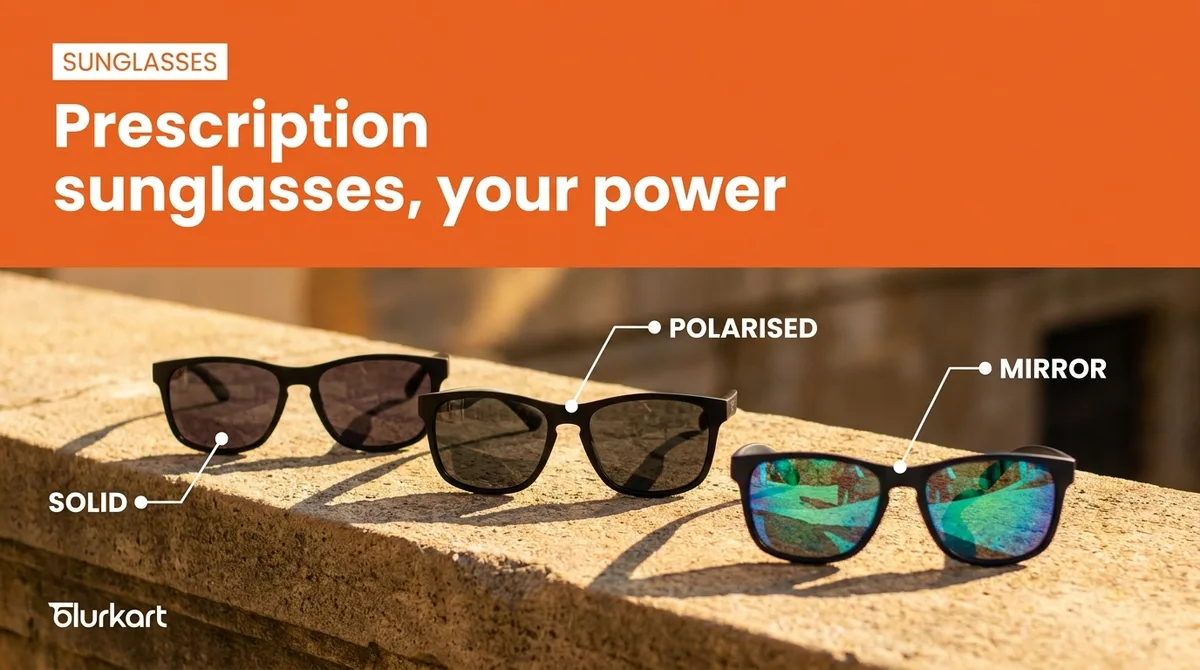
- Solid tints: a uniform colour throughout the lens.
- Gradient tints: darker at the top and lighter at the bottom, useful when you look down at a phone or dashboard.
- Polarised: a filter that reduces glare reflected from flat surfaces. ZEISS says its polarised lenses in grey, brown and Pioneer absorb about 85% of light, and are also available in fashion colours.
Mirror and Flash coatings
These coatings go on the front of the lens and can be added to solid, gradient and polarised lenses.
| Coating | Look | Best for |
|---|---|---|
| DuraVision Mirror UV | Bold reflective colours such as silver, blue, bronze or green | A statement look and extra glare reduction |
| DuraVision Flash UV | Subtle pearly reflections in a few colours | A lighter, more discreet style |
ZEISS notes that tinted lenses with Mirror or Flash coatings also come with an anti-reflective coating on the back surface.
Protect the lens itself
Sunglasses suffer from sand, sweat and sunscreen. ZEISS DuraVision Sun adds water repellence, anti-static and anti-smudge properties and scratch resistance, so the lens stays clearer for longer. ZEISS also offers DuraVision Gold UV on sunglasses, which it says cleans up to three times faster than earlier coatings.
Polarised lenses: good to know
- They shine on the water, roads and snow, which is why they are popular for driving and outdoor activities.
- Many phone and car displays can look dim or dark through polarised lenses at some angles.
- They are not a substitute for UV protection, but ZEISS lenses include UV protection up to 400 nm.
Progressive wearers are covered
You do not need to give up multifocal vision outdoors. ZEISS Sun Rx lenses are available in your focal type, including progressives, so you can read a map or phone in the sun without taking your sunglasses off.
Tips before you order
- Choose a frame with enough wrap or coverage if you need strong sun protection.
- Think about where you use them most: driving, trekking, the beach or the city.
- Ask whether your frame suits your prescription strength, as strong powers can look thick in some shapes.
Ready to see your world in sunglass quality? Book a free eye test at Blurkart and discuss prescription sunglass options.
Information is based on ZEISS product pages. Colours, coatings and availability vary by market.
Frequently asked
- Can I get my prescription in sunglasses?
- Yes. ZEISS Sun Rx lenses are made to your prescription and are available for your focal type, including single vision and progressive lenses.
- What do polarised lenses do?
- They filter horizontally reflected light, reducing glare from surfaces such as water, wet roads and snow, so vision looks clearer and more comfortable in bright conditions.
- What is the difference between Mirror and Flash coatings?
- Mirror coatings give a bold, reflective, colourful front. Flash coatings give a subtler, pearly reflective shade. Both can be added to solid, gradient and polarised lenses.
- How dark are the classic polarised tints?
- ZEISS says its polarised lenses in grey, brown and the grey-green Pioneer colour absorb about 85% of light.
- Why are polarised lenses hard to see through on phone screens?
- Many digital screens emit polarised light, so a polarised lens can make them look dim or dark at certain angles. Tilting your head or phone usually brings the screen back.