
First time wearing contact lenses: what the first week feels like
Expect fifteen to twenty minutes fighting the first lens, and under a minute by the end of the week. Start at four hours a day and add two hours daily. Mild awareness of the lens, slight watering and a little redness in the first hour are normal.
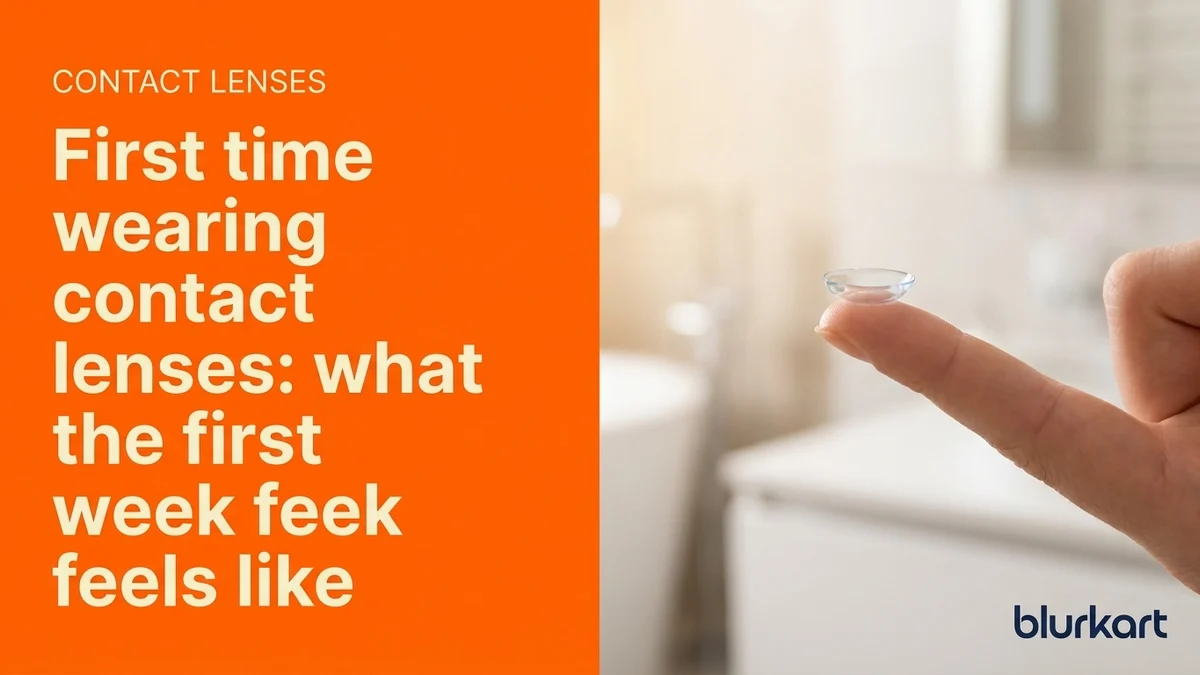
Your first time wearing contact lenses takes about twenty minutes of fumbling on day one and under a minute by day five. That is the honest arc, and knowing it in advance is most of what stops people giving up on the second evening.
Here is what actually happens, day by day, from a fitting room in Lalitpur.
First time wearing contact lenses: day one
Your eyelid does not want a finger near it. That reflex is the whole difficulty; the lens itself is soft and thin and does not hurt.
The technique that beats the flinch: hold the upper lid open with your other hand rather than trusting yourself not to blink, look away from the approaching finger, and place the lens on the white of the eye slightly to the side rather than dead centre. It slides into place on its own when you blink.
Wear them four hours on day one, then take them out. That is enough.
Days two and three: it speeds up
Insertion drops to a few minutes. You will still misjudge once or twice and drop a lens in the sink, which is why a beginner should stand over a closed drain with a towel down.
Add two hours of wearing time a day. Six hours on day two, eight on day three. Building up like this lets the cornea adjust to slightly less oxygen than it is used to.
Expect a little redness in the first hour and some watering. Both settle.
Days four to seven: normal
By now most people insert in under a minute and forget the lenses are in. The tell that you have adapted is realising at 4 pm that you have not thought about your eyes all day.
This is also when the first mistake happens: wearing them too long because they feel fine. Ten to twelve hours is a sensible ceiling for a new wearer, and dry Kathmandu afternoons from November to March shorten that.
What is normal and what is not
Normal: awareness of the lens for the first half hour, mild watering, slight redness that fades, and a moment of blur right after a blink that clears immediately.
Not normal: pain of any kind, sensitivity to light, redness that gets worse through the day, discharge, or vision that stays blurry with the lens in. Any of those and the lens comes out and stays out until we or a doctor look. We wrote about this in more detail in everything you need to know about contact lenses.
Three mistakes that send beginners back to glasses
- Starting with monthly lenses. Learning insertion and a cleaning routine in the same week is twice the work. Start with dailies like the SEED 1dayPure 32-lens pack at NPR 3,900, then switch later.
- Wearing them on a dusty commute in week one. Kathmandu road dust on a new wearer's eyes is a bad combination. Give it ten days.
- Topping up old solution instead of replacing it. This is how infections start, and it is entirely avoidable.
Pahilo choti lens: what we hear in the shop
"Aankha ma haleko thaha hunchha?" For the first thirty minutes, yes. After a week, no. If you still feel it constantly after two weeks, the fit is wrong and we change it.
"Lens aankha pachhadi janchha ki?" It cannot. There is a membrane joining the eye to the inside of the eyelid. A lens can slide up under the lid, which feels alarming and is harmless; look down, massage the lid gently, and it comes back.
"Chasma chhodna sakinchha?" Not entirely, and you should not want to. Every lens wearer needs glasses for sick days, dusty days and the last hours of the evening.
"Kati ghanta lagauna milchha?" Start at four hours, build by two a day, and stop at ten to twelve once adapted.
Before you start
Get a fitting rather than just handing over a glasses prescription. A contact lens sits on the eye, so it needs a curvature and diameter measurement that a glasses slip does not carry. The fitting is free at both our Lalitpur showrooms, and it comes with a trial pair and ten minutes of practice with an optician watching, which is worth more than any article.
Two follow-ups worth bookmarking: dry eyes in the dry season and coloured lenses that look natural on brown eyes. If you decide lenses are not for you after a week, that is a normal outcome too. A light pair of glasses like the Premium Rectangle Frame at NPR 1,200 is not a consolation prize.
Frequently asked
- Can a contact lens get lost behind my eye?
- No. A membrane connects the white of your eye to the inside of your eyelid, so there is nowhere for a lens to go. A lens that has slid up under the lid can be worked back down by looking the opposite way and massaging gently through the closed lid.
- How long until contact lenses feel normal?
- Most people stop noticing them within five to seven days. If you are still aware of the lens every minute after two weeks, the fit or the material needs changing, not your patience.
- Should I start with daily or monthly lenses?
- Daily. Learning insertion and removal is enough for week one without a cleaning routine on top. Switch to monthly later if you end up wearing them most days.
- Pahilo choti lens lagauda dukhchha?
- It should not hurt. A strange awareness and some watering is normal for the first half hour. Sharp pain, stinging or light sensitivity means take it out and come in, because the lens may be inside out, torn or the wrong fit.
Shop on Blurkart
Find the right eyewear for you